Once more, as we move toward our nation’s semiquincentennial, I am focusing on the Revolutionary War effort of attaining independence and the related contributions and connections of folks of the Fork, the Knox County lands between the French Broad and Holston rivers.
This kind of research sometimes gets a little messy. Revolutionary War soldiers by the same name make sorting it all out more than a little confusing at times. Even though I can’t say his Fork connections are certain, I believe the story of Andrew Evans is compelling enough to share. He was definitely somewhere here in Knox County for 13 years sometime after the war, and the old newspapers show letters were waiting for him at the post office in 1820.
The pension applications of Revolutionary War soldier Andrew Evans and his wife state that Andrew was born in Mecklenburg County, North Carolina, on September 28, 1759. (That’s the same county that the Alexander family in the Fork came from.)
At the age of 20 in 1779, Andrew Evans enlisted in Virginia as a private under the command of Col. William Campbell to search for and pursue loyalist Tories near the New River. Although Andrew was discharged after that term of service, he was soon called out again by Campbell to help quell the rising Tories. An assignment that led his company near what is now Winston-Salem, on to the Dan and Yadkin rivers, before being sent home again. However, the men were told to “be on the readiness at a moment’s warning to again take the field.”
Ten days later, he was called again to volunteer under Capt. William Edmundson, who marched them to Abingdon, Virginia, where they were led by colonels Campbell, Shelby and Sevier to Kings Mountain. Evans saw British Major Patrick Ferguson fall in that battle. He stated it was a shot to the face that killed Ferguson.
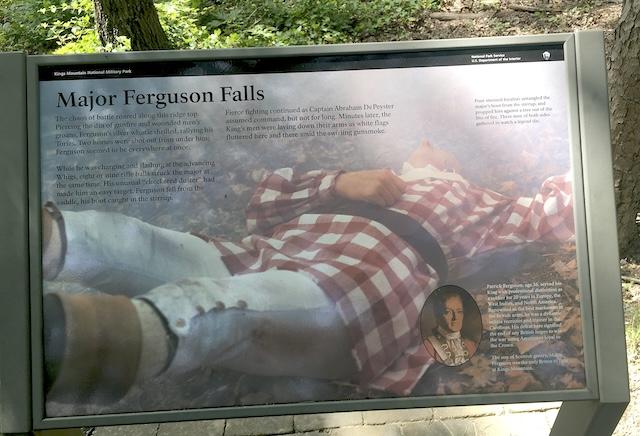
Kings Mountain National Military Park, South Carolina, storyboard telling of Ferguson’s death
An 1833 essay, read by a man named Foster at the Knoxville Lyceum and published by order of the historical society, states that near the end of the battle at Kings Mountain, British Major Patrick Ferguson’s successor, Captain Abraham DePeyster, raised a white flag. However, not all of the Overmountain Patriots ceased firing. Some of the new recruits didn’t know that a white flag signified a surrender, while others, who had seen it raised before and then withdrawn, didn’t believe it meant anything for sure. The essay states that Andrew Evans was among the latter.
The essay continues, “He was standing near to Col. Campbell and in the very act of shooting, when Campbell jerked his [Evans’] gun upwards to prevent its effect, exclaiming, ‘Evans, for God’s sake, don’t shoot; it is murder to kill them when they raise the flag.’”
Evans’ pension application tells that though he and others were honorably discharged and were home by November 1780, they were immediately called again to serve for three months under Col. John Sevier in pursuit of the Cherokee, who had been making raids while the frontiersmen were away from home. Evans said he and his comrades “took Christmas dinner in Cherokee country at Old Chota.”
My next article will tell more of Andrew Evans’ reputation for not ceasing to fire, a story of perseverance and heroics that shouldn’t be forgotten in the Fork.
Jan Loveday Dickens is an educator, historian, and author of Forgotten in the Fork, a book about the Knox County lands between the French Broad and Holston Rivers, obtainable by emailing ForgottenInTheFork@gmail.com.
Follow KnoxTNToday on Facebook and Instagram. Get all KnoxTNToday articles in one place with our Free Newsletter.

