
My mother wasn’t one to over-police the time my siblings and I spent in front of a television. Back in the 1970s and before we had cable, the options were pretty limited for running into anything too mature for our eyes. She certainly had a sense of “that’s enough” for one day, time to go outside and play or otherwise do something else.
But there were a handful of occasions where she gathered us to watch things she felt were important for us to know and understand. One of those was the 1978 mini-series Holocaust. But before that was the January 1977 miniseries Roots, the adaptation of Alex Haley’s Roots: The Saga of an American Family.
Roots wasn’t just a mini-series; it was a cultural phenomenon. I honestly can’t think of anyone I knew at the time who didn’t watch it. It was a topic of discussion at school, not just amongst the students, but as part of class. When it aired, I was 11 years old and in the fifth grade at Sterchi Elementary. Granted, this was watching a made for television film adaption, not reading the book, which clocks in at 587 pages. However, just like Holocaust, Roots came with a warning that viewer discretion was advised. Because there’s nothing gentle or pretty about the history of slavery in the United States.
The mini-series lasted eight nights, and there was some discussion of it every day at school. I was in Frank Scimonelli’s split class of fifth and sixth graders, so students ranging in age from 10 to 12. Though the scene was not graphic in its depiction (nor is it in the book), and though we were indeed young, we understood what happened to Kizzy. We knew who Chicken George’s father was and understood the meaning of “child of the plantation.” We learned that certain things are just plain wrong, and we were not damaged by it.
Less than a decade after Roots aired, Haley had moved to Knoxville (he got hooked on East Tennessee during the World’s Fair) and was made an adjunct professor in communications and American studies at UT. I was initially in journalism school when I started college, and it was not uncommon to pass him in the halls of the Communications Building. He had made fast friends with Lamar Alexander as well as John Rice Irwin, founder of the Museum of Appalachia, so much so that he bought a small farm on the other side of I-75 from the museum.
I went out to that farm when I was a reporter for The Knoxville Journal for his announcement that he would be leaving the lion’s share of his papers to the University of Tennessee. I met Haley and interviewed him on several other occasions. For a man who set the template for how to compose an interview (he was the first and foremost interviewer for Playboy magazine. Regardless of what you feel about the rest of it, the interviews were top shelf), he was difficult to keep on task as the subject of one. No matter my list of questions, to which Haley might give a cursory response, he was gonna start telling tales. Because that is who he was, a storyteller.
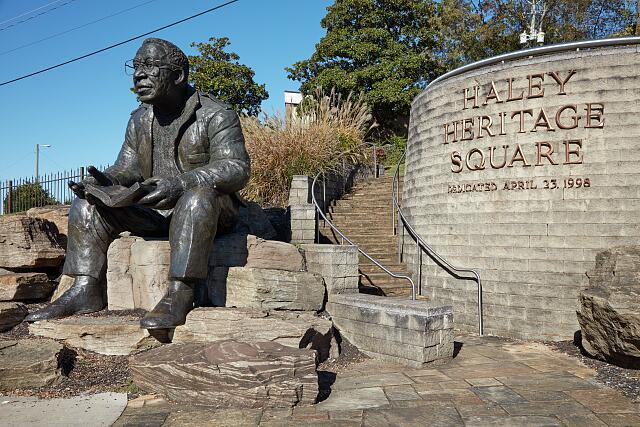
Just a couple of years later he was gone. There is no need for me to list all of his accolades, but he won the Pulitzer Prize for Roots, which is an official state book for Tennessee. We have a whole statue and Heritage Square dedicated to him here in Knoxville. But now Knox County Schools has decided his signature work can’t sit in school libraries. I can understand not having it in elementary or middle schools. But HIGH SCHOOLS? It’s shameful and utterly ridiculous.
I have a first edition copy of Roots, which was published in 1976, the year of our bicentennial. The dedication reads as follows:
It wasn’t planned that Roots’ researching and writing would take twelve years. So I dedicated Roots as a birthday gift to my country within which most of Roots happened.
Fifty years on, we should honor that gift and not forsake it.
Beth Kinnane writes a history feature for KnoxTNToday.com. It’s published each Tuesday and is one of our best-read features.
Sources: The Knoxville Journal digital archives, The Tennessee State Museum, East Tennessee History Center – McClung Digital Archives
Follow KnoxTNToday on Facebook and Instagram. Get all KnoxTNToday articles in one place with our Free Newsletter



Great column, Beth. Alex Haley was indeed a treasure. Knoxville and Norris were lucky to have had him among us. Let the record show that a local woman, Evon Easley Milton, was a driving force in getting the Haley statue sculpted, funded and installed. Like most hellraisers, Evon annoyed some in “leadership,” and never made the dais during the dedication.
Thank you, Sandra. I wasn’t in Knoxville when the statue and square happened. Evon deserves her flowers.
Beth,
I knew you would jump on this atrocity as soon as possible! It’s harder each day to believe the ridiculous decisions made against our democracy. Thank you for continuing to speak out and defend truth, whether highlighting those before us with high ideals who lived out their lives defending them, or speaking out against present day assaults against our Constitution.
I loved the picture of my life long bestie! I miss her every day, but at the same time I know how blessed we were to have such a lasting friendship. We didn’t always agree, and had deep, often lively discussions, but always ended up laughing and loving each other no matter what. That’s almost unheard of today.
I loved seeing your dad and Patrick at the recent CHS Wall of Fame ceremony.
Love you forever, keep up the good work, Cindy is so proud!
BTW as different as you might have been about some things…you get that fire in the belly from her as well as the love for history from both parents.
Thank you, Janice. Love you!
You are so right Beth. I am very glad you got to know Alex as a kind, gentle man and certainly the quintessential storyteller. I shared many a stage with Alex during Homecoming ’86 and we became good pals. Later, we rubbed elbows at a few public events and parties in Knoxville, and I always had the sense that he would much rather be on a front porch somewhere enjoying the sounds of a country night. ROOTS is a book and film of importance to all Americans, and highschoolers (and others) should, as you said, “…honor that gift and not forsake it.”
Thank you, Judith.
All my research has led me to the conclusion that none from Appalachia had slaves to help run the farm. To the contrary, people of Appalachia were/are a poor but proud “I can do it myself” group that scratched out a living in the rugged hills of North Alabama, East Tennessee,(Dolly Parton) North Carolina, Virginia and on up to Southern New York. Appalachians would be highly insulted, and ready for a fight at the idea of someone doing their work. On the subject of Haley, I would think that a Country could better heal if some of their offensive dark past didn’t keep popping up.
Philippians 3:13-14
“Brothers and sisters, I do not consider that I have made it my own yet; but one thing I do: forgetting what lies behind and reaching forward to what lies ahead, I press on toward the goal for the prize of the upward call of God in Christ Jesus”.
It is absolutely incorrect that no one in Appalachia had slaves, I can name them among just my ancestors. While it is true it was rarer among the people who lived in the mountains, it was not zero. The two primary drivers behind that were poverty and land/topography that was not conducive to large scale farming operations that drove the demand for enslaved labor. While East Tennessee voted against secession from the Union and even voted to secede from the state of Tennessee, those votes were not 100%. Additionally, all anti-secessionists weren’t opposed to slavery. And all abolitionists weren’t concerned with equality among the races. Many of them were of the emancipate and return to Africa stripe, because plenty of abolitionists were also virulent racists.
Those who do not learn from their history are doomed to repeat it. The darkness in our imperfect history has never been reconciled.
This is wonderful.
Thank you for your readership!
Roots can’t be seen in high school libraries? Seventeen year olds can join the military and receive a license to kill. I suppose our sactimonious censors are still upset that we would remove a monument glorifying those who were also plantation owners and role models for Roots storyline atrocities. Oh, another thought: high-schoolers have unsupervised access to every naughty in the world in their pocket: the cell phone. Let’s confiscate that, too.
Thanks for confirming that everyone claiming to buy a Playboy for the articles were not just dirty old men making excuses. They offered some of the best writing of the day. The literature was varied; if you saw one picture, you had seen them all.
Playboy interviews were outstanding. Thank you for commenting! Remember the one with Jimmy Carter?
She is on target and I agree.
Thank you !
It does seem surprising that the man and book honored elsewhere in Knoxville is considered unsuitable for students in Knox Schools. But then this is 2026, not 1970. Have we made progress or have we regressed?
That question is best answered by watching the 6 O’clock news on any given day. In many Cities we definitely see a reversion; with racially themed crime at near epidemic levels. By deciding not to punish crime, beginning around 2008, we have allowed criminal entitlements. No fear of retribution. EXAMPLE: ‘Teen takeover’ descends into wild brawl inside DC Chipotle — as feds promise to charge ignorant parents.
I wrote a song containing this line–“Black and White are poles apart like it’s 65 again, What the H*!! is going on today”.
Absolute regression.