

First Lady Abigail Adams was in high dungeon. She bemoaned the lack of guillotines on this side of the pond. President emeritus George Washington was beyond peeved and the wanted the subject of their mutual ire to be “held in detestation by all good men.”
So, who were they so mad at? William Blount, former governor of the Southwest Territory and then one of brand spanking new Tennessee’s senators in our temporary capital of Philadelphia, Pennsylvania. A founding father of the nation and this state, signer of the United States Constitution, his name and reputation were in ruins.
Blount and his brothers were shrewd land speculators. By the time Tennessee was becoming a state in 1796, they had accrued millions of acres across the territory. But by the time he was a senator, land values were falling. Westward settlement was stalling, and there were fears concerning navigation rights on the Mississippi River and the port of New Orleans, then controlled by Spain.
Now Spain had guaranteed to the U.S. duty free use of the river and the port in The Pinckneys Treaty of 1795. Problem was, and this is an extreme condensation, France and Spain had been at war, and France won. Spain’s revenues were in a shambles, and thus control over its colonies was tenuous at best. The fear was that Spain would cede the Louisiana territory back to France, making the Pinckney Treaty null and void. Free navigation of the Mississippi River was essential for Tennessee’s nascent economy. And keeping land values afloat
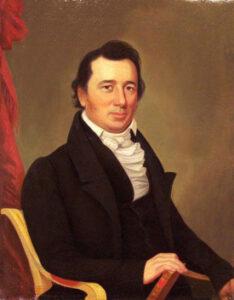
William Blount
Now, Blount and his brothers had a lot of debt tied up in their real estate holdings. He first made an effort to sell to British investors in a partnership with Philadelphia physician, Nicholas Romayne. That didn’t pan out. Blount and local tavern owner John Chisholm concocted a plan to convince Great Britain to gain control of the Louisiana and Florida territories. The Royal Navy would attack Pensacola, New Orleans and New Madrid. Blount and company would provide militias from the land approach. Britain would gain control, navigation rights saved, and land would start selling again.
Problem was, this was highly illegal. And Blount knew it. He recruited local merchant and interpreter, James Carey, to gain the cooperation of the Cherokee. Blount wrote Carey a letter outlining the whole plan, finishing by telling him to “read this letter over three times, then burn it” because discovery guarantee failure and “much injure all the parties concerned.”
Well, Carey failed across the board. Drunk at the Tellico Blockhouse, the letter fell into the hands of the trading post operator, James Byers. Now follow the bouncing ball: Byers gives it to Col. David Henley (street and bridge), agent for the War Department in Knoxville. Henley and Blount were well acquainted, but Henley was not Blount’s biggest fan. Henley then sent it on to Secretary of War Timothy Pickering, who actively despised Blount. He was delighted to turn it over to President John Adams.
In short, Blount walked into the senate chambers, such as they were, on July 3, 1797, hearing his conspiratorial letter being read aloud. By July 7, the house had voted for impeachment hearings and the senate had expelled him, demanding he post an additional bond to assure he returned for his trial. Instead, Blount skipped town and rode back to Tennessee with his hair on fire, never to see the city of brotherly love again.
The folks back home, for the most part, didn’t care. As far as they were concerned, he was doing his best to protect Tennessee’s interests. The Senate Sergeant at Arms came to fetch him, but he was entertained then shown the north road back to Philly. Chisholm ended up in debtor’s prison in England before eventually making his way back. He and Romayne both spilled the beans to the impeachment committee. The vote to impeach Blount ultimately failed over jurisdictional issues since he was no longer a senator.
Beth Kinnane writes a history feature for KnoxTNToday.com. It’s published each Tuesday and is one of our best-read features.
Sources: William Blount by William Masterson, McClung Historical Collection-Knox County Library, Tennessee Encyclopedia
Follow KnoxTNToday on Facebook and Instagram. Get all KnoxTNToday articles in one place with our Free Newsletter




Thank you. I look forward to more of the same.