

Last week, we discussed the city’s decision to mothball the Gay Street bridge’s availability for handling auto traffic in favor of becoming another footbridge: here. This drastic decision was made without first obtaining a national bridge specialist engineering evaluation of the feasibility and cost to fix the degraded steel members of the load-transferring arches. That issue should have been publicly aired with hard facts in hand. The city’s stated rationale simply emphasized that our stately bridge was over 125 years old and currently weakened.
We can take that decision for what it is, reacting with a “So what?” or we can ask the question, “Why can’t it be fixed?”
There are many older bridges still in service in the U.S., with the Eads Bridge being a prime example.
The Eads Bridge in St. Louis is a much longer span over the Mississippi River, connecting east and west St. Louis. That steel arch bridge — some 6,400 feet long (Gay Street bridge, by contrast, is 1,500 feet long) — took about 7 years to build and was opened in 1874, which is over 150 years ago. Eads was the first U.S. bridge to utilize a steel arch design (similar to our later Gay Street bridge), and it is listed on the National Register of Historic Places.
Eads still handles 8,000 vehicles a day on its main level (4 lanes) plus railroad passage on two tracks on the lower deck under the auto deck, as well as pedestrian traffic.
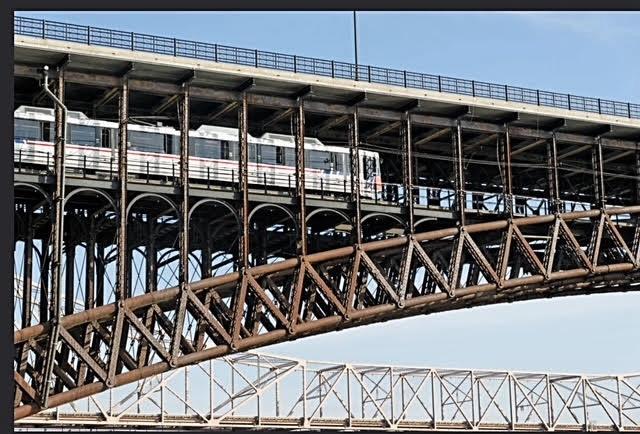
Eads Bridge with metro link
And, yes, Eads needed to be repaired after the turn of this century. Rehab crews had to work with unknown steel alloys and handcrafted steel members (since this was a first-of-a-kind design in its day) in effecting repairs and replacement of support steel. The work included replacing 1.2 million pounds of the earlier steel struts, bracing, and other support steel. Once repaired, the entire superstructure had to be sandblasted and repainted. In addition, the Metrolink track system included new rail ties and the installation of a modern overhead rail power system or conductor to power passenger trains more efficiently and reliably.
This extensive, several-year rework is said to have extended the bridge’s multipurpose life by 75 years and cost $48 million (90% fed funds). The rehabilitation was completed in phases and was finally finished in October 2016.
You may ask, “What’s the point?” The point being that steel bridges can be fixed. Rehab of the younger Gay Street bridge is likely feasible. What would it take? We need to weigh the costs and benefits of restoration. More detailed examination is warranted.
The key questions are what rework would be required and what the projected cost would be. Those questions deserve the benefit of a professional engineering assessment by an experienced national bridge rehabilitation firm (one formally recognized for the analysis and repair of historically significant bridges), followed by vigorous public participation and discussion. Thus far, that rigor has been lacking.
Weighing the issue yields one conclusion: The city council and the tax-paying public deserve a deeper examination of the full bridge restoration potential. Our article states that Eads was thereby given 75 years of renewed life and we should insist on a more rigorous examination of this issue for the Gay Street bridge before making a final decision.
Editor’s note: Nick would like to acknowledge the generous assistance of two Knoxville engineers, David Bogaty and Marvin House, who unselfishly volunteered their time and provided valuable information for these Gay Street bridge articles.
Nick Della Volpe is a lawyer, a gardener, and a former member of the Knoxville City Council.
Follow KnoxTNToday on Facebook and Instagram. Get all KnoxTNToday articles in one place with our Free Newsletter.




Corrected and expanded information: The first article should have more clearly mentioned that TDOT did its annual bridge check in June 2024 and discovered enough rusted areas, defective bolts and bent steel segments in Bridge Span no.2 and some in Span no. 4 (there are 5 spans) to question the safety of structure, which was then closed to vehicles as a precautionary measure. That was followed by the City hiring local engineers Gresham Smith to design an emergency fix to allow a reopening of the bridge for pedestrian use (cost $448k). The physical repair work is being performed by local constructor, Blalock, with a December 2025 target completion date ($1.9M). There has not, as yet, been an overall bridge restoration evaluation by nationally recognized bridge rehabilitation engineering and construction company.
Thanks for keeping the focus up on this issue. The Gay st bridge is a valuable piece of infrastructure for our community. It’s worth the effort to ask “How much to repair it for vehicle use?” before we demolish it and seek funding for an entirely new structure.
Hmm. Interesting that there is no reference to that fact that this is an old truss bridge, which has no redundancy built it. Meaning that if one truss fails, the entire bridge may collapse like a string of dominoes. I watched and listened to the engineers that spoke on this subject. While they acknowledged repairs might be able to be made, they could provide no assurance they would work. So, you see it’s more than just deteriorating steel beams, it’s the integrity of the structure. I would think anyone who was cognizant of past truss bridge failures over the years would see the wisdom in replacing a bridge that could collapse when one component fails.