
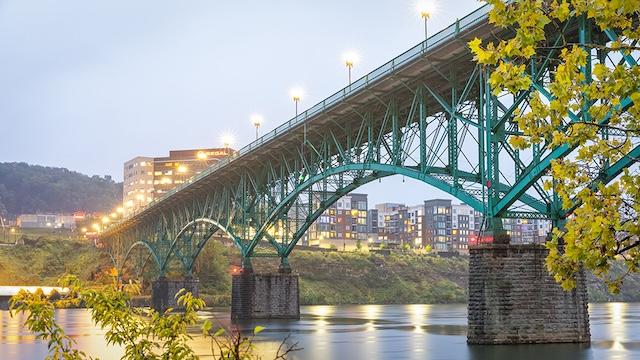
Nick Della Volpe, a former member of the Knoxville City Council, asks some critical questions about the Gay Street Bridge.
- Should the stately but aging Gay Street Bridge be restored to handle auto traffic, or should it be relegated to footbridge status?
- Will it become another “walkable bikeable” tribute to pro-pedestrian, anti-auto new thinking espoused by the city government?
- Can it be returned to handle its basic vehicle crossing function?
However, that mixed engineering and public policy question is ultimately answered; a vigorous public airing, debate, and evaluation are needed.
Background. The underlying question arose when city engineers learned that some of the bridge’s aging steel, arched support structure had rusted and twisted steel members that compromised its design strength. Load strength and public safety are, of course, clearly important concerns.
The city has stated that the bridge will be sufficiently repaired to handle pedestrian traffic. But not routine auto traffic.
- How did we get to this point?
- Is the cart ahead of the horse?
In layman’s terms, the arched steel-webbed design transfers the bridge loading to the stone and concrete pillars embedded in the river below. When local engineering firm Gresham Smith discovered the structural issue during a periodic inspection (required by TDOT), the city hired Blalock Construction to repair bent or twisted members and add some reinforcing cross supports. That work is expected to be completed in December, and the bridge will be reopened to pedestrian traffic only.
Where are we going? But the bridge’s design future remains in doubt. The city made its current use downgrade decision before — that is, without — obtaining a professional evaluation by a national-level bridge engineering team. Huh?
- Can this bridge be fixed to handle vehicular traffic once again?
Granted, the bridge is old. So what? Rationally, steel can be welded, bolted, braced and reinforced. TDOT actually did that to the Gay Street bridge some 12 or 15 years ago to address maintenance issues related to earlier flaws.
The pertinent question is:
- Can a more substantial support fix solve the current load-carrying concern?
- Must we “simply shift” auto traffic to the already-busy Henley Bridge, or possibly to the Victor Ashe/ Rogero bridge that deadends into an Urban Forest bike trail (instead of its original purpose to relieve overloaded Chapman Hwy traffic)?
Unanswered questions.
Sadly, the city’s pronouncements suggest that it has already made up its mind to replace the Gay Street bridge with another one, if it can secure enough matching federal funds to pay for it. Think about that. A new bridge would require approach roads, acquiring land rights, and at least $ 100 million in new construction costs, not to mention several years to build it. By contrast, a heavy-duty structural repair of the Gay Street bridge steel would likely need a fraction of that time and cost — possibly something closer to $10 million. Thus far, that information has not been explored or revealed to the bridge-using taxpaying public.
So, what’s up?
- Where are the top-notch engineering pros when it comes to bridge rework? Those facts and opinions are essential to a rational decision.
- What about public involvement? Thus far, “the debate” has been limited to a short-term fix and a council-approved bridge approach dress-up for the pre-determined pedestrian-only use.
These questions need public airing and informed decision-making, with expert facts and advice, plus public input. A hip shot is not enough.
For further reading, read about the National Historic Landmark recognized Eads Bridge in Missouri: here.
Nick Della Volpe is a lawyer, a gardener and a former member of Knoxville City Council.
Follow KnoxTNToday on Facebook and Instagram. Get all KnoxTNToday articles in one place with our Free Newsletter.




I agree with the other commentors, what data informed the decision to permanently downgrade the Gay St bridge? How much was the estimate to return it to driving capability? Surely that figure was contemplated before deciding its cuurent fate.
Agree with Nick. Broader/deeper additional professional input is a must along with taxpaying citizens’ involvement before any decision about the Gay Street Bridge use being downsized for pedestrian/bike only. Henley Bridge is already bike/pedestrian along with auto, plus there is the proposed pedestrian-only bridge just down the street at the stadium. I don’t drive for miles to downtown Knoxville and pay exorbitant parking fees to then walk across a bridge, and I am among the greater populace of taxpayers upon whom will bear the price.
Thank you for this timely article Nick. Your service to the community continues. You articulated the thought in my mind, where is the heavy engineering analysis?
“heavy engineering analysis” is generally very unpopular among those whose minds are made up pursuant to other objectives.