President Calvin Coolidge stood at the marble rostrum in the amphitheater at Arlington Cemetery to give his Decoration Day address in 1926. It was Monday, May 31. Just a week earlier he had signed the landmark bill authorizing the creation of the Great Smoky Mountains Park. But on this day, he was acknowledging all veterans who had given their lives in service to their country.
He heartily denounced militarism, racism and intolerance while advocating for peace through arbitration and disarmament. “A determination to do right will be more effective than all our treaties and courts, all our armies and fleets,” he said. “A peaceful people will have peace, but a warlike people cannot escape war.”
We were less than a decade out from World War I. The embers that would spark World War II were still smoldering beneath the surface. But on this day, Coolidge was participating in ceremonies that over time changed Decoration Day to Memorial Day.
Decoration Day began in Charleston, South Carolina on May 1, 1865 in the immediate aftermath of the Civil War. Union POWs that hadn’t survived their incarceration at the former Washington Race Course and Jockey Club had been hastily buried in a mass grave behind the grandstand. Former slaves, newly emancipated, exhumed the 257 bodies from behind the grandstand for proper burial. On that May Day, a large crowd gathered to honor them, with a parade, patriotic songs, and laying flowers on every grave.

Old Glory flew at half-mast Memorial Day at Knoxville National Cemetery (photo by Beth Kinnane, 2023)
In time, the tradition spread across the country, to honor the Civil War dead, and became official as May 30 in 1868. By the end of World War 1, the tradition had expanded to honor all those who fell in armed service to the country and migrated to the last Monday in May. By 1971, the name had changed to Memorial Day and it became a federal holiday.
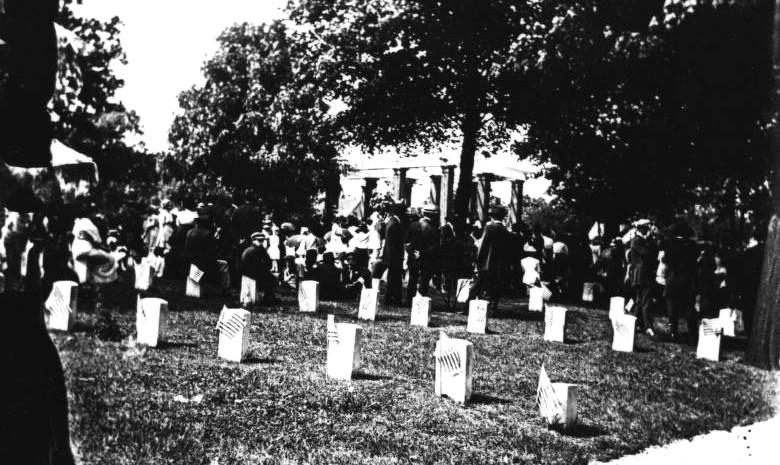
Here in Knoxville, 100 years ago, Decoration Day was a production in two parts. That May 31st morning, a crowd first gathered at the county bridge (presumably Gay Street) to honor those whose lives had been lost on the water during the Civil War. Flowers were tossed to the still undammed Tennessee River below. A smattering of gray-haired Civil War veterans were present in the crowd. An address was given by Judge Robert M. Jones, who acknowledged that the time was coming sooner than later that no participants nor witnesses to that terrible conflict would remain. “I wish,” he said, “that we might learn war no more, and that we could get away from its curse.”
At 2 p.m., the day’s events moved to the Knoxville National Cemetery (see story here) on Tyson Street just off Broadway next to Old Gray Cemetery. Speeches were made by Gen. Cary F. Spence, WWI veteran, and John M. Thornburg. In an interesting twist for grave decoration, flowers were dropped over the cemetery from an airplane piloted by Frank Andre.
Beth Kinnane writes a history feature for KnoxTNToday.com. It’s published each Tuesday and is one of our best-read features.
Sources: The Knoxville Journal digital archives, East Tennessee History Center – McClung Digital Archives, Library of Congress
Follow KnoxTNToday on Facebook and Instagram. Get all KnoxTNToday articles in one place with our Free Newsletter