As we celebrate our nation’s semiquincentennial, I continue to focus on the related contributions and connections of folks of the Fork, the Knox County lands between the French Broad and Holston Rivers.
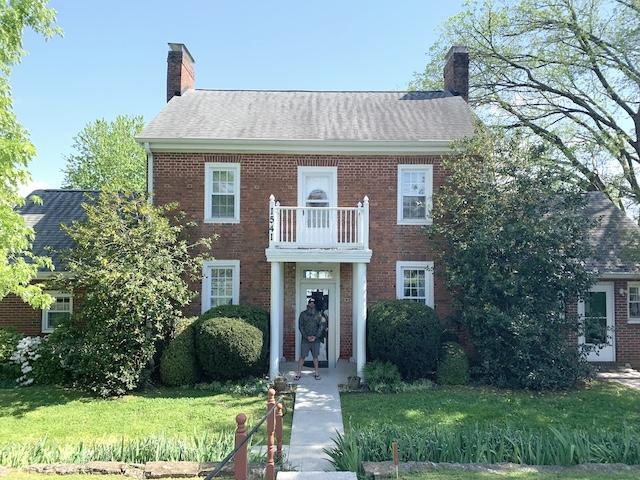
You wouldn’t be reading many of my articles if he hadn’t settled a little upriver on the French Broad from where I live. His 1804 two-story brick home still stands on what is now Douglas Lake. His name was Samuel McSpadden, and later during the War of 1812, he made gunpowder from the saltpeter (potassium nitrate) formed from bat poop in the cave on his property and floated it to Andrew Jackson down in New Orleans.”
However, decades before that, in 1775, Samuel McSpadden was drafted from his home at Rockbridge, Virginia, and into the Revolutionary War under Captain Charles Campbell, commanded by Colonel Dickerson. He enrolled at Lexington, then served three months at Point Pleasant, was discharged, and was drafted again in 1776. For three months under Captain McDowell, he guarded Fort Donnelly, commanded by the Colonel with the same name. Samuel’s first wife was Sarah Keyes.
Samuel then married Nancy Harris in 1799 in Jefferson County, Tennessee, where he applied for a pension in 1834 at the age of 78, more than 30 years after he had moved from his post-war home in Abingdon, Virginia, and settled on the French Broad. Robert McFarland was the presiding judge during Samuel’s pension examination when he was later interviewed in his home. Silas Henry vouched for his character and his service, as did Rev. John McCampbell of the Dandridge Presbyterian Church, where generations of McSpaddens are buried. Samuel McSpadden died on August 3, 1844.
How is old Sam connected to the Fork? Well, his descendant Bartholomew McSpadden invested in river pilot and Fork resident Captain James Newman’s 1890 steamboat, the Lucile Borden. It was named for Bartholomew‘s daughter and served up and down the French Broad River. Samuel’s descendants also married into several of the Fork families I’ve written about. But more significantly related to these articles I write, old Sam’s 5x great-grandson, Chase McSpadden, is my “history adventure buddy” who helps me find graves and homesites, etc. Chase descends from Samuel and his second wife, Nancy.
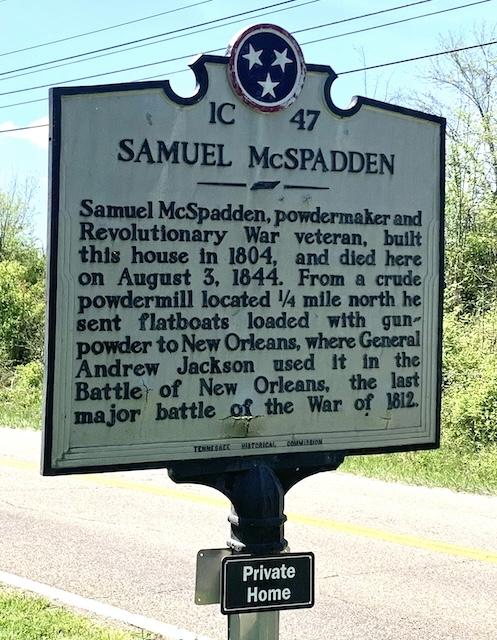
Historical marker at the McSpadden home
From the moment I met Chase, I was impressed with his knowledge and have become even more so over the years. He introduced the term “taphophile” to me. Among other things, he is a talented blacksmith who does educational demonstrations at festivals, workshops, and special events. In addition to the smithing he does for historic restoration projects, he often dresses in period clothing and is entertaining and patient as he helps others learn about the craft. He also served as Vice President of the Board of Directors at Historic Ramsey House. And my husband and I have basically “adopted” him into our family.
My husband, who has a common background with Chase’s work as a lineman but really doesn’t care about history or sharing in my adventures, says that as long as I’m with Chase on my crazy outings, he doesn’t worry about me. Chase is still young enough to crawl around on the ground, jump ditches, and kneel at gravestones. I’m not. He helps me bushwhack my way through overgrown cemeteries, keeps me from breaking my neck among the cemetery vines and holes, and laughs as he swears that he has kept me from getting shot at least twice. He might not be wrong.
Chase is a lot like his fearless ancestor. I’ve seen him climb trees, fight bees, stand on the edge of precipices, charm snakes, ford creeks, delve into the darkness of caves, and go down into the depths of crumbling structures, just to better “read” what we’re investigating (with owners’ permission). He can spot a log cabin at a distance, even if it’s covered in shingles and/or decades of kudzu. He knows a lot about architecture and the craftsmanship of the periods we study. Sometimes he scouts out a location for me when I can’t go. His insights and knowledge often help inform what I write. And, dang it, the camera on his phone is better than mine.
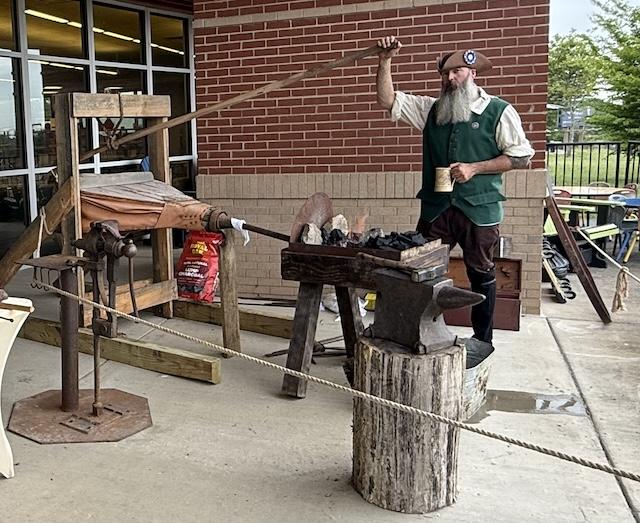
Chase McSpadden demonstrating blacksmithing processes
Chase bears the characteristics of his honorable and industrious ancestor. If old Samuel McSpadden hadn’t lived where he lived and had the family he had, I wouldn’t have the assistance of his descendant Chase, and lots more history would remain forgotten in the Fork.
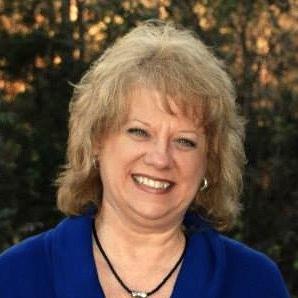
Jan Loveday Dickens is an educator, historian, and author of Forgotten in the Fork, a book about the Knox County lands between the French Broad and Holston Rivers, obtainable by emailing ForgottenInTheFork@gmail.com.
Follow KnoxTNToday on Facebook and Instagram. Get all KnoxTNToday articles in one place with our Free Newsletter.