
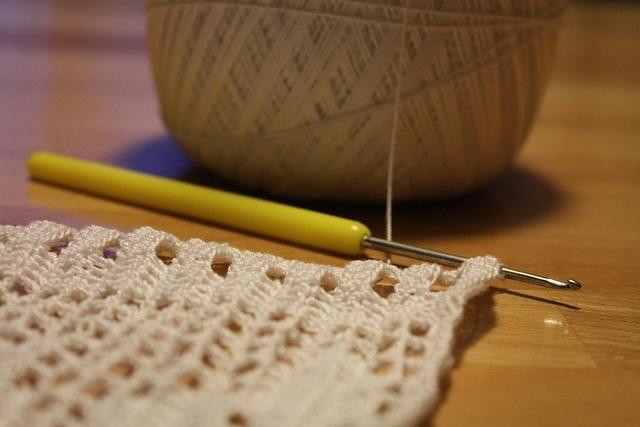
Imagine my husband’s surprise when I told him that all crochet is still done entirely by hand. Over the centuries, many once-common jobs have been lost or relegated to novelty status by advancing technology. The blacksmith is no longer one of the most important people in the village. Computers used to be people working out calculations with mechanical calculators and on paper. And our clothes are far more likely to come from a factory than a local seamstress. Crocheting has not been automated!
Crochet, as we know it, started in the early 1800’s in England. It involves using a hook to create interlocking loops of yarn to make a fabric. The name comes from the French word for hook. It differs from knitting in that only one crochet hook is used, and only one open stitch is worked at a time. Knitting uses two needles, and all the stitches in a row are kept on one needle and kept “open.”
Both the power loom for weaving fabrics and a knitting machine were invented before crochet rose to popularity as a handcraft. While there are warp knitting machines that can create fabrics that imitate crochet, even today, there is no machine that can truly replicate this craft.
One reason is the tremendous dexterity, 3D manipulation, and sensory feedback required to crochet. Each stitch requires multiple hand movements that would be difficult to replicate without advanced robotics. The tension of the yarn and the tightness of the stitches, or gauge, are also things the crafter constantly assesses and adjusts by sight and feel. A machine would need to be equipped with many sensors to do the same. Another complication to creating a crochet machine is the variety of stitches used and the many ways to use them.
It isn’t necessarily impossible to make a crochet machine. Knitting can make many of the same fabric items that are made by crochet, and knitting uses less yarn for the same-sized piece. This means there is little market demand to prompt manufacturers to develop a crochet machine. For now, the research seems limited to university labs and tinkerers in garages. While, from a practical perspective, it may seem like a novelty, the invention of such a machine would be an engineering marvel. For now, if you are looking to make a unique gift that can’t be copied by machine, try learning to crochet.
Crystal Kelly is a feature writer for Bizarre Bytes with those unusual facts that you only need to know for Trivial Pursuit, Jeopardy, or to stump your in-laws.
Follow KnoxTNToday on Facebook and Instagram. Get all KnoxTNToday articles in one place with our Free Newsletter.