
I have walked into a lot of facilities over the years — jails, prisons, probation offices, treatment centers. They all carry a certain weight. But stepping into Men of Valor’s Knoxville campus felt different. The men were not simply completing a program; they were engaged in a way I rarely saw during my years as a detective. There was purpose in the room, and a kind of brotherhood that did not feel manufactured or forced.
And in a city where recidivism touches every neighborhood, that difference matters.
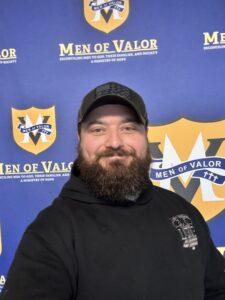
Brandon Burley
Why I went: I have seen the justice system from angles most people never have to. I have watched men cycle through arrests, probation violations, short jail stays, and long sentences — often without ever receiving the kind of support that could change their trajectory. Later, when I transitioned into teaching criminal justice, I began studying redemption stories more closely. The men and women who managed to rebuild their lives almost never did it alone. Their turning points had patterns: structure, accountability, mentorship, faith, and someone willing to walk with them longer than a court order ever would.
That is why I wanted to visit Men of Valor. Not to endorse a program — but to understand why this one works. When you have spent a career watching what does not work, you pay close attention when something starts producing consistent, measurable, life-changing results.
The culture at Men of Valor: Most people assume reentry programs are a combination of classes, support groups, and job training. Men of Valor is all of that, but the real difference is not in the curriculum — it is in the culture.
Men of Valor expects the men to show up for themselves and for each other. There is accountability, but not the kind that humiliates. It is more like a brother placing a hand on your shoulder and reminding you that you’re capable of more. Discipline does not feel punitive; it feels formative. Boundaries are not there to restrict; they’re there to support.
There’s also a noticeable absence of chaos. Many of the men come from environments shaped by instability, addiction, and broken relationships. MOV meets that instability with structure — predictable days, consistent expectations, and mentors who refuse to disappear when things get hard.
And faith plays a central role, but not in a performative or coercive way. It’s woven into the community, a guiding foundation rather than a requirement to perform.
It is not a place where men “do their time.” It is a place where they do the work.
What I saw while I was there: During my visit, I spent time with five men — each at a different point in their journey.
Two were graduates who now work on staff, living proof that transformation is possible and sustainable. Two others were in their first 30 days, the most fragile and often decisive period of the program. And one student, John, will graduate later this month.
Their stories revealed something important about the heart of Men of Valor.
Bobby Stout, Employment Coordinator and Assistant Re-Entry Manager, completed the program himself years ago. He told me, “I think maybe the greatest impact is being able to give back for me. Because we are disciples, making disciples.” He said it quietly, almost humbly — but with conviction.
A few minutes later, he added, “We are in the business of changing lives. What we do here is we, one man at a time, one family at a time, reconcile men first to Christ, to their families, and to the community.”
Then there was John — graduating December 26th, the day after Christmas, and on his daughter’s birthday. He told me openly:
“I was in full-blown addiction from the time I was 13 until I was 43. I’ll be 46 in February. Men of Valor has played a huge factor in me not going back into that lifestyle. I’m an ex-gang member… all I know is the streets. This place has helped shape me into someone who is tired of killing the community, and actually wants to serve the community.”
That kind of honesty stays with you.
The newest student, Kevin, had been there less than a week. He said, “The love for God and love for each other these guys have… I heard about it while I was in the jail program, but actually seeing it and feeling it — it’s a whole different experience.”
And in the middle of all that encouragement, I learned something sobering:
Men of Valor usually keeps around 24 of its 30 beds full, but the holidays are the hardest time of year for attrition. Men miss their families. Old feelings resurface. Temptation calls. Some leave.
That reality — that reentry is fragile — is exactly why programs like this matter.
And it’s worth noting: Men of Valor will expand its reach in 2026 with a new campus opening in Chattanooga. That’s what growth looks like when a model works.
Why this matters for Knoxville: Recidivism is not just a criminal justice problem. It is a neighborhood problem, a workforce problem, a family problem, and ultimately a safety problem. Every time someone returns to custody, the cost is not just financial. It falls on victims, children, employers, and the community as a whole.
That is why programs like Men of Valor deserve more than passing recognition — they deserve attention and support. They succeed because they give men what the system often cannot: time, mentorship, accountability, patience, and a pathway to belonging.
This matters especially in Knoxville, where community partners are working hard to strengthen recovery, reentry, and second-chance employment. Men of Valor is part of a larger network of ministries, nonprofits, mentors, and churches that understand that redemption is not an abstract idea. It is a process — one that requires structure, sacrifice, and people willing to walk the long road with someone trying to rebuild their life.
Knoxville is safer, stronger, and more stable when programs like this thrive.
Final thoughts: I left Men of Valor both encouraged and challenged — encouraged by the men doing the hard work of change, and challenged by how much more our community could do if we supported programs already producing real results.
Accountability changes people. Grace does too. Men of Valor brings both to the table, and Knoxville is better for it.
Det. Brandon Burley (Ret.), M.P.A., is a criminal justice educator whose academic work focuses on reducing recidivism through public policy. He has authored several criminal justice books and has been published in national law enforcement publications.
Follow Detective Burley (Ret.) on his website here.
Follow KnoxTNToday on Facebook and Instagram. Get all KnoxTNToday articles in one place with our Free Newsletter.

