
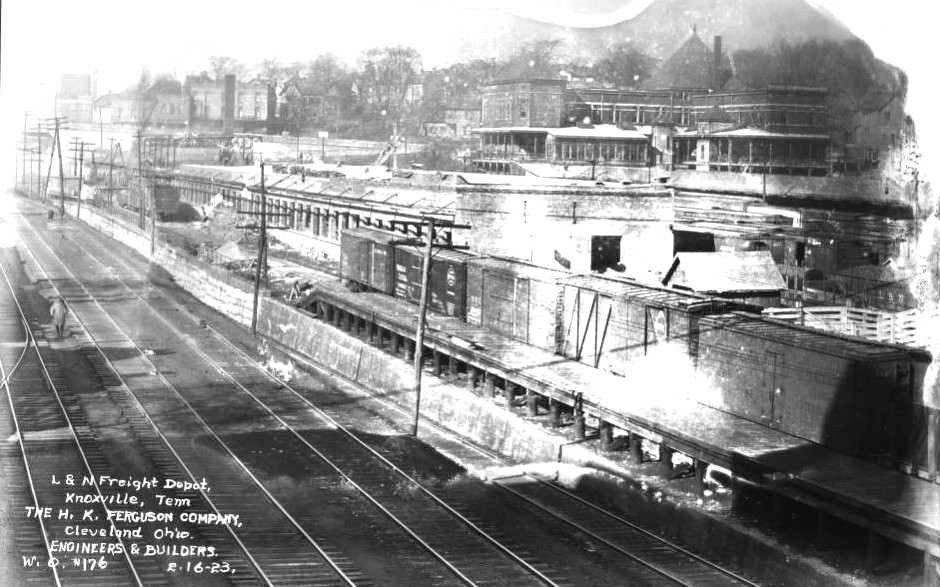
In today’s dollars, the damage was nearly $6 million. In 1922, the number was $300,000. The destruction in question was to the freight depot of the Louisville & Nashville railyard, better known these days as World’s Fair Park. This did not involve the station now occupied by L&N STEM Academy.
The conflagration occurred on Sunday, August 6, 1922, around four in the afternoon. The state’s deputy fire commissioner, William Grooms, felt certain the cause was “incendiary” but had little hope the perpetrators would be caught.
Complicating matters once the blaze began was a lack of water pressure for the fire fighters. Water pressure was not then what it is today, and requests had to be put in for an increase, usually in the case of a fire. Apparently, there was some confusion among the lower ranks of the city’s water department about who could demand the high pressure. Police commissioner Nathan Kuhlman wasn’t happy when he arrived on scene and saw a trickle that could barely reach the structures. Proper pressure arrived about 45 minutes too late.
Kuhlman was in a froth and said that when the fire department calls for an increase, it should be done, immediately without waiting for some other higher up to weigh in. Infrastructure be damned, if a pipe gets blown somewhere, a pipe gets blown, there’s a fire to put out!
Firemen battled the blaze for hours in the late summer heat. Members of the Salvation Army organized in a nearby store on Asylum Street (Western Avenue) and started making lemonade, which was hauled down to the railyard in tubs to bring some sweet relief to the firemen.
Water pressure wasn’t the only contentious issue in the wake of the inferno. Inspector Grooms took issue with an insolent police officer while he was trying to inspect the burnt-out warehouse (where he suspected the fire was set intentionally). It turned into a “you shall not pass” stand-off, with a Deputy Fielden not wanting Grooms to proceed further despite being shown the inspector’s badge. It got to the point where both Fielden and Grooms were on the brink of drawing their weapons. Grooms eventually shoved Fielden aside and went about his business. But he called for the deputy’s head, asking Kuhlman to fire him. Grooms was also unamused with the water pressure fiasco, saying some structures could have been saved had the pressure been turned up sooner.
L&N, for its part, wasted no time trying to put things back in order. Crews were on the grounds the next day clearing debris and setting up temporary structures to serve a freight warehouse until new plans could be drawn up and more permanent buildings constructed. The office moved into the dining hall and lobby of the passenger depot. By Aug. 9, a 253- by 36-foot shed was erected for temporary freight storage. Loading platforms were reconstructed as well. It was all hands on deck to return to full operations as quickly as possible.
Beth Kinnane writes a history feature for KnoxTNToday.com. It’s published each Tuesday and is one of our best-read features.
Sources: McClung Historical Collection-Knox County Library, Knoxville Journal Digital Archives
Follow KnoxTNToday on Facebook and Instagram. Get all KnoxTNToday articles in one place with our Free Newsletter