As we continue to move toward our nation’s semiquincentennial, I’m still researching the Revolutionary War effort to attain independence and the related contributions and connections of families of the Fork, the Knox County lands between the French Broad and Holston rivers.
According to his 50-page pension records, Abraham Hankins was born to Richard and Deborah (Churchman) Hankins in 1763 in Frederick County, Virginia, and lived there until he was 8- or 9-years-old, when his family moved to a spot near the New River in Montgomery County. At age 17 in 1780, he served as a substitute for Thomas Sperry and enlisted as a private under Ensign Francis Charlton. They rendezvoused at Col. Cloyd’s, then marched to the head of Bluestone, a contributory of the Sandy River, where they guarded a station. The day his two-month tour ended, Lt. William Davis showed up on his way to Guyandotte along the New River and invited anyone who wanted to join them to come along to search for some deserters. Abraham and a few others volunteered. However, their guide made a mistake and they got lost, not finding their way back home for about six weeks.
A few months later, Abraham’s 47-year-old father, Richard Hankins, was drafted for a three-month tour, but Abraham took his father’s place in Capt. James Burns’ company of horsemen that was attached to Col. Frank Preston’s regiment at Fort Chisel. They marched to the Moravian Towns, then made their headquarters at Guilford Courthouse, where Abraham said they foraged, scouted, and encountered Lt. Col. Henry Lee’s Light Horse cavalry, who wore green coats. While there, they came in contact with British Col. John Pyle’s company of Tories, who thought Abraham’s company was with British Lt. Col. Banastre Tarleton’s Loyalists, who also wore green coats, enabling Abraham’s company of Patriots to ambush them. The skirmish, known as Pyle’s Massacre, caused Tories in the area to think twice about supporting the Loyalist cause.
Later, Abraham took care of the horses when his company was ordered to send them off and join the main army on foot. Thus, Abraham was a few miles away tending horses when the Patriots were defeated at the Battle of Guilford Courthouse. Afterward, they were sent home.
Abraham later volunteered more than once as part of a scouting party under Capt. Israel Parton for two or three weeks at a time in pursuit of the many Tories of Montgomery County. As support for the British continued to dwindle, Cornwallis eventually was captured and surrendered at Yorktown.
In 1787, Abraham moved to Jefferson County, where he lived for approximately eight years. He married Sally Skaggs in 1791 before settling in Knox County. His parents also lived in Jefferson County at New Market, where they are buried. In 1794, Abraham served as a private in Beaird’s Company of the Knox County Regiment of the Hamilton District Militia under James White in the Territory South of the River Ohio (“Southwest Territory”) for the “protection of the frontiers.”
Abraham was awarded a pension at age 62. He died 15 years later in Knox County in December 1840. In 1848, after considerable effort and official paperwork, Sally was granted a widow’s pension at the age of 76. Children of Abraham and Sally included James, Richard, Tillindy, Eli, and maybe others.
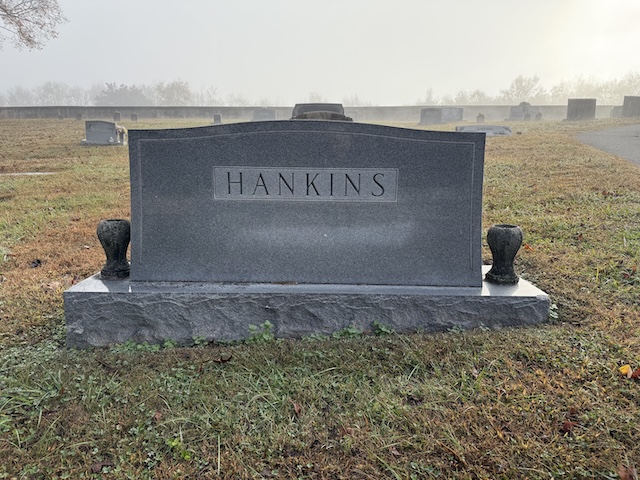
Various lines of the Hankins family moved into the region, and more than one road in Knox County bears the Hankins name. Abraham and Sally might have been forgotten in the Fork, where several Hankins are buried, but the Fork includes Hankins Lane leading to the French Broad River.
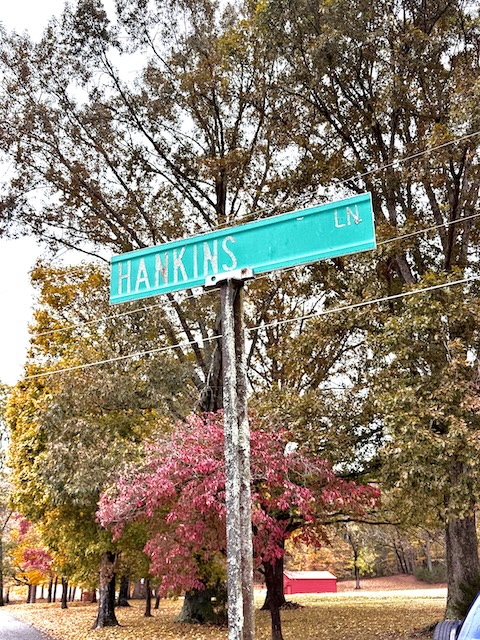
Hankins Lane leads to the French Broad River.
Jan Loveday Dickens is an educator, historian, and author of Forgotten in the Fork, a book about the Knox County lands between the French Broad and Holston Rivers, obtainable by emailing ForgottenInTheFork@gmail.com.
Follow KnoxTNToday on Facebook and Instagram. Get all KnoxTNToday articles in one place with our Free Newsletter.


Jan, thanks so much for the suggestion to subscribe. I honestly didn’t realize all I had been missing!!
Thoroughly enjoy your articles!
Patricia
Love your history lessons, Jan!
Thanks!
Eric
Thanks so much, Eric! Good to know someone is reading the articles!