

This is just a little ramble in the Fork, the Knox County lands between the French Broad and Holston Rivers.
Today isn’t Tuesday, and this article isn’t about a Revolutionary War tie to the Fork, but that’s OK. Sometimes it just is what it is.
You see, I was having a bad morning because my laptop decided it didn’t have enough space to save the article I had researched for days and worked on all week. When I restarted my computer, all those words no longer existed. Trust me, I tried everything I could to retrieve it. I didn’t know whether to scream, cry, or throw up.
However, at lunch with my hubby, Gary, and another couple, our friend prayed for “a touch” for my wounded spirit as part of the blessing over our meal. And before I got out of the building, an unknowing 93-year-old angel with white hair randomly took my hand and literally radiated light into my soul as I reached for a paper towel. She told me her age and bubbled about God’s goodness. In the ladies’ room. At a pizza joint. Never met her before. But she was full of joy, she couldn’t help but share, and it was contagious.
Later, in the evening light, as my history adventure buddy Chase McSpadden and I stood in the middle of the deep woods at Matilda Johnson’s overgrown grave, I thought about Dolly the horse.
Because 10 years ago, I read a story published 28 years ago from a memoir written 67 years ago that included details about a life that had been lived more than 100 years ago. And one of those details was that Rufus Perry Johnson, born in 1832, would ride his cherished horse Dolly from his home on Huckleberry Springs Road in the Fork, up dusty Strawberry Plains Pike, to his wife’s grave beyond Lyon’s Creek Baptist Church in “Trentville.” Though now the iron fencing around the plot was mangled and the boxwoods were tangled and towering at the perimeter of nearby unmarked fieldstones, I reflected on Rufus’ lasting devotion as I contemplated Matilda’s stone.
Rufus had been a Union cavalryman during the Civil War, and Luther Ray Johnson recorded in his memoir how his grandfather Rufus would get up at daybreak to feed Dolly. He would also ride her to church on Sundays, as well as some Saturdays to attend the monthly business meetings. After his wife Matilda (Rhea/Ray) died in 1881, he would ride to visit her grave, right where I was standing. He never remarried, though he lived another 34 years after her death. He was buried right beside her in 1915, after a life of service committed to his family, community, and country. A government stone marks his military years.
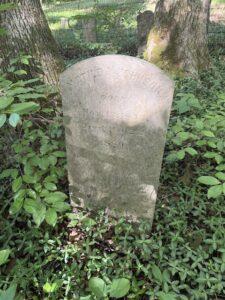
Matilda Johnson’s headstone
In Hebrews 12:1, the Bible talks about how “we are surrounded by a cloud of witnesses.” I don’t know for certain it means that those who have gone before us can see or know what we do, but as I stand at the graves of those who are long gone, I like to imagine they appreciate it when I think of them or call their name or tell their stories. The verse goes on to say how we should throw off everything that hinders us and entangles us, so that we can “run with perseverance the race marked out for us.” I was walking in that lost burial ground simply trying to “stay the course” of preserving history and repeating others’ testimonies, despite my temporary setback, when I stumbled across those familiar names. My heart smiled.
Psalm 145:4-6 says that one generation shall proclaim God’s mighty acts to other generations. That’s what the little white-haired lady was doing when she grabbed my hand in the bathroom, and even though she had no idea about my morning struggle with feelings of defeat, she helped me to persevere. That same passage in Psalm 145 encourages us to meditate on the splendor of God’s work, and that’s exactly what I did as I first saw the evening light on the periwinkle vine that covered the ground ahead of me in those woods. I literally gasped in wonder at the beauty of it. God is good. Even when technology isn’t.
And y’all think I’m just out here stumbling around in briars, recording names and dates from gravestones forgotten in the Fork.
Jan Loveday Dickens is an educator, historian, and author of Forgotten in the Fork, a book about the Knox County lands between the French Broad and Holston Rivers, obtainable by emailing ForgottenInTheFork@gmail.com.
Follow KnoxTNToday on Facebook and Instagram. Get all KnoxTNToday articles in one place with our Free Newsletter.


Jan: Appreciate your work and your resilience. – Sandra
Thank you, Sandra!
Awwww, thank you, Tim! If I get this laptop storage issue figured out, I might attempt to recreate the other article. But honestly, I’m paralyzed by the thought of trying. My plan was to continue with the Revolutionary War stories until July 4th. We’ll see. I’m really looking forward to returning to random stories like this. The Rev War research takes a LOT of time!
I knew something was up when I didn’t see your name on Tuesday’s edition! Thank you for your graceful way of handling situations!
Well, Mike,, you’ve brought tears to my eyes! Thanks for taking time to reach out. I’m a wreck right now. I think this little challenge has broken my brain! Ha! That little jaunt into the woods was “cemetery therapy.” My hubby says I “ain’t right.” It’s probably true!
Beautiful message this morning. I don’t know if your intended column could have been any more encouraging than today’s article. I look forward to each and every story “of families of the Fork, the Knox County lands between the French Broad and Holston Rivers.”