As we continue to move toward our nation’s semiquincentennial, I’m still focusing on elements of the Revolutionary War effort of attaining independence and the related contributions and connections of families of the Fork, the Knox County lands between the French Broad and Holston Rivers.
I often say that history wants to be known. I’ve had so many unbelievable “coincidences” that I can’t help but believe that spiritual forces are at work at times. This little adventure was like that.
I had been working for months on another of my family lines for First Families of Tennessee. Out of the blue, an old friend who also grew up in the Fork contacted me about helping him with research for his own effort. He mentioned a couple of cemeteries I was well familiar with in the foothills of the Smokies, so my husband and I met him and his wife at Bush’s Family Café for lunch and further discussion before looking for graves. He shared with me about a book I had never heard of, but it appeared to mention my own Webb family line, which I was working on. I paid $100 to buy that old, out-of-print, 354-page volume and held my breath. Arriving a couple of weeks later, it more than paid off. It answered many questions and provided additional information I didn’t even know existed. I’m thrilled!
My friend Alan descends from Revolutionary War soldier Mordecai Lewis, who was born on October 26, 1751, in Frederick County, Virginia, and married Mary Zeigler/Segler in 1777. Records show that Mordecai was a private in Captain Jacob Holleman’s militia that served in Governor Lord Dunmore’s forces against the Native Americans in 1774. They defeated the Shawnee and Delaware warriors at Point Pleasant, attempting to secure safety for settlers south of the Ohio River.
Mordecai moved his family to what is now Sevier County after the war and settled on the east side of the West Fork of the Little Pigeon River. His 151 acres included the lands of the Old Mill in Pigeon Forge. After helping to establish Sevierville as the county seat in 1794, Mordecai served as a Judge and the coroner. He died about 1818.
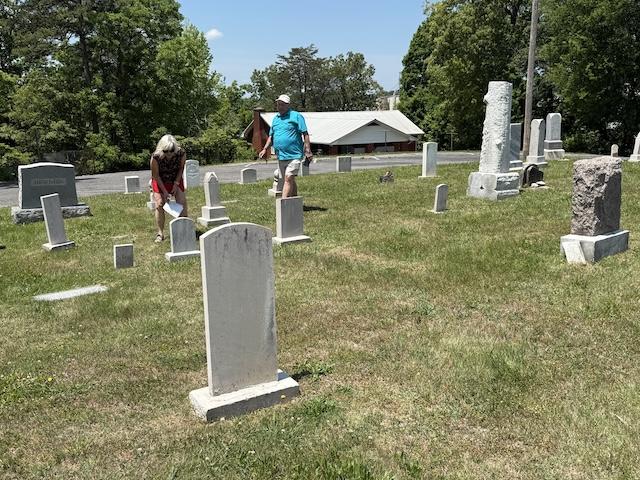
My husband, Gary, and I helped Alan and Pam Lewis find the graves of Alan’s ancestors at the Fox Cemetery and at Chestnut Hill, where some of my own family members are buried. A few days ago, Chase McSpadden and I visited the vine-covered Pine Chapel graveyard, where a monument memorializes a 1792 massacre and lists Alan’s ancestor, Mordecai’s son George Lewis’s 1807 death.
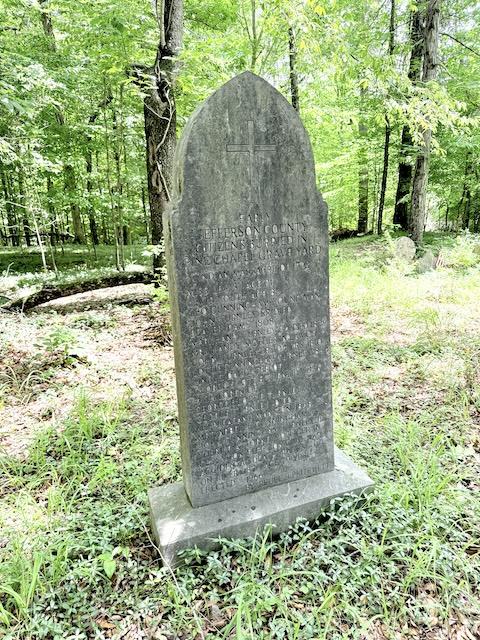
The 1966 Pine Chapel massacre memorial stone, which was knocked down by a falling tree but was uprighted by Ronnie Brimer of Brimer Monuments in 2000.
Historian Dr. J.G.M. Ramsey wrote about a massacre of William Lewis’s family on Indian Creek, which is where Pine Chapel is located. Was it the same tragedy? Ramsey also stated that the Webb and the Martin families first settled at Greasy Cove, but the harassment by the Native Americans was so bad that Webb went back to Virginia and brought more settlers with him. John Webb is considered the first settler of Chestnut Hill in what is now Jefferson County. George Lewis and his wife, Rachel, were founding members of Pine Chapel on Indian Creek, which, with Muddy Creek, is part of the Chestnut Hill area. She lived until 1833. Their son Gabriel fought in the War of 1812, and Gabriel’s son Andrew Jackson Lewis married into my ancestor’s line through the Martin family.
Records show that George Lewis was the Muddy Creek neighbor of my Webb ancestor that I had been researching! I had had no idea. However, the Lewis family records, old newspaper articles, and that thick, expensive book showed the many connections between the Lewis family and my own. My effort to help a friend ended up providing me with answers to the questions I had recently been asking about my own family tree.
A 1727 Welsh Bible that records Lewis family lines is on display at the East Tennessee History Center on Gay Street in Knoxville, Tennessee. Descendants from Alan’s ancestors and my own Webb lines eventually moved down into the Knox County lands between the French Broad and Holston rivers, where I hope our forebears smile upon us, knowing their contributions to the establishment of our nation will not be forgotten in the Fork.
Jan Loveday Dickens is an educator, historian, and author of Forgotten in the Fork, a book about the Knox County lands between the French Broad and Holston Rivers, obtainable by emailing ForgottenInTheFork@gmail.com.
Follow KnoxTNToday on Facebook and Instagram. Get all KnoxTNToday articles in one place with our Free Newsletter.