

As I’ve explained before, I like to immerse myself in my research. Literally, at times. So, as I thought about Swan Pond Creek, which runs through the heart of the Fork, the Knox County lands between the French Broad and Holston rivers, I got really curious about the origins of the creek’s name.
Historian J.G.M. Ramsey described in his 1853 book, Annals of Tennessee, the waterfowl wonderland created long ago by a beaver dam on Swan Pond Creek. He stated that when the swans, geese and ducks on it were disturbed, the ruckus they made could be heard all the way to the point of the Fork, the confluence where the French Broad joins the Holston to make the Tennessee. That’s about two miles as the crow flies, or should I say, as the waterfowl fly, from where Swan Pond Creek empties into the Holston.
Ramsey said that the Swan Pond had two arms of water that extended about two miles and was about half a mile wide at its widest point. In some places it was at least six feet deep. The dam itself was where Swan Pond and Sand Branch creeks merge, in the vicinity of the soccer field and park near the intersection of Strawberry Plains Pike and John Sevier Highway. He called the dam “ancient,” and it had certainly been there long enough to have established the area as significant hunting grounds in the 1700s for trappers and the Cherokee, who had not wanted to give it up.
Dr. Charles Faulkner, former head of the Anthropology Department at the University of Tennessee, once said that archaeological evidence suggested the Cherokee’s Archaic Period ancestors also came there for the other wild game drawn to it for the same reason.
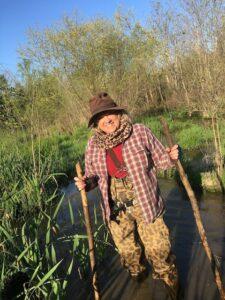
The author, dressed for the cool morning air, not for fashion, in the wetlands of Swan Pond Creek
According to Ramsey, one arm of the pond had been on what became the Armstrong family lands and the other extended down toward Marbledale where a Pickel family lived in the mid-1800s. Of course, I had to figure out just where that was, so I used a few old maps listing landowner names and a topographical one.
I believe what he referred to as the “island field” was where the old Maynard Dairy was once located (on Strawberry Plains Pike), having that rise right behind it. He said the “island” could be reached only by canoe. I tend to see the landscape in terms of its history once I learn something like this, so now I can’t drive down that section of John Sevier without envisioning it all submerged in shallow water enjoyed by trumpeter swans, thanks to ancient beavers.
However, just as the descendants of early settlers are still in the community near their ancestral homes, so are the ancient beavers’ resulting generations. A few years ago, I had the privilege of donning chest waders and sloshing through the wetlands created by the current beaver residents on Swan Pond Creek. I was out trudging knee-deep at 6:15 in the morning to watch the geese fly in for their daybreak swim. It was heavenly! The variety of birds singing their sunrise praises made for a humbling, meditative devotional time. What I had witnessed as beautiful meadows 35 years ago was now teaming with frogs and minnows. I tried not to think about the snapping turtles as I sloshed along. I still shiver when I think of the HUGE fishing spiders I saw in the rushes. However, the most stunning aspect was the work of the ambitious beavers. I’d seen residual stobs and tree stumps before along Tuckahoe Creek, but I’d never seen anything like what they’d done on Swan Pond Creek in recent years.
Did you know that beavers use stones as wells as sticks to create their dams and lodges, which have several rooms and passageways? They also stash limbs point-down in the mud outside their winter chambers so they’ll have food when everything else is frozen. Leave it to the industrious beavers to plan for the future like that, a legacy not to be forgotten in the Fork.
-

- Work by the present beavers of Swan Pond Creek
-
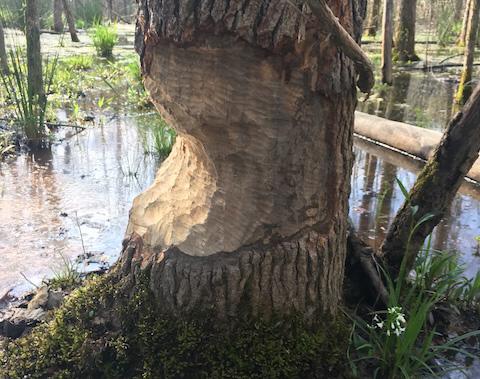
- Work by the present beavers of Swan Pond Creek
Jan Loveday Dickens is an educator, historian, and author of Forgotten in the Fork, a book about the Knox County lands between the French Broad and Holston Rivers, obtainable by emailing ForgottenInTheFork@gmail.com.
Follow KnoxTNToday on Facebook and Instagram. Get all KnoxTNToday articles in one place with our Free Newsletter.




Good story Jan!