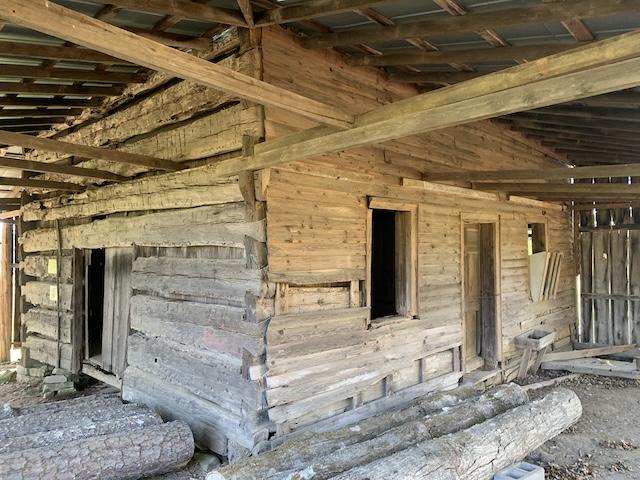
One of the most fascinating resources I have related to Fork history is the 1853-56 diary of John Porterfield Jack, who described the establishment of the New Salem Seceder Presbyterian Church mentioned in my January 28 article “J.P.’s” grandfather Jeremiah Jack (1750-1833) was one of the first settlers to identify lands to be his home in the Fork, the Knox County lands between the French Broad and Holston Rivers.
Jeremiah Jack and William Rankin, veterans of the Revolutionary War’s Battle of King’s Mountain, were Quakers living in what is now upper East Tennessee near the Nolichucky River when their settlement ran out of meal for bread. They loaded a canoe with clothing to trade for corn from the Cherokee who lived farther downstream, south of the Tennessee River. Although the Cherokee were reluctant to make the trade, their Beloved Woman Nancy Ward was there to negotiate and seal the deal.
On their way back, Jeremiah and William camped on what would become Jack Island on the French Broad, about a mile above the confluence with the Holston. (See the map in my January 21 article.) Jeremiah moved his family to the Fork in 1787 and eventually owned at least 338 acres. His wife, Martha, was the daughter of Quakers George and Elizabeth (Young) Gillespie, whose stone home still stands at Limestone near the Nolichucky. Their son Thomas Gillespie had moved to the Fork in 1786.
Jeremiah served as a judge for the area. He and Martha had several children, among whom was James (1789-1851), whose son was John Porterfield Jack (1821-1882).
J.P. Jack served as constable for the Fork, and his daily diary is a treasure trove of interesting tidbits that mention by name the mills, churches, blacksmiths, stores, shops, etc., as well as neighbors of the area, which included those across the French Broad. Although his entries were short, they are rich with details of his daily activities. He helped survey land; plowed fields; chopped and hauled wood; spayed and killed hogs; hunted and fished; hued timber; made an ash house and rail fences; sowed clover; “dropt,” hoed, shucked and shelled corn; cut briers; set apple trees; wrote letters; pulled cockle out of the wheat and then cut, cradled, bound, shocked, thrashed, sifted and hauled it; sowed and tramped out oats; planted cotton; went swimming; fixed the wagon, the canoe and the barn; used a thresher and a cotton gin; brought home a windmill; cut peaches; stacked fodder; mended bridles and hames; made an ox yoke; bought oxen; worked horses and mules; ground axes and made handles; had boots and an overcoat cut; set traps; built and repaired churches and houses; made sawhorses; ground a scythe; bought cloth, a coat, hat, shoes and jacket; made a garden; dug graves; chopped willows; repaired tools; cleaned a turnip patch; made cider; hued sills and hauled rock and “prises” to raise his cabin for a new foundation, and added a kitchen, among other things.
He worked hard, but he always observed the Sabbath, and he apparently attended every type of service within his reach, no matter the denomination, and noted who preached and where. He attended funerals, barn warmings and Sabbath School, and enjoyed events at the nearby academies, as well as the camp meetings at Huckleberry Springs. He also went to all kinds of political meetings, often listing the participating candidates or the issue at hand, such as proposed railroads in the Fork, and what he thought of them. As constable, he tells when and where he went “lectioneering” and many of the duties he carried out in his position, including serving warrants, collecting notes and being appointed “Waiter” on the Federal Court.
The names, places, activities and issues of the mid-1800s mentioned in J.P. Jack’s diary are just a few more examples of the history that has been forgotten in the Fork.
-
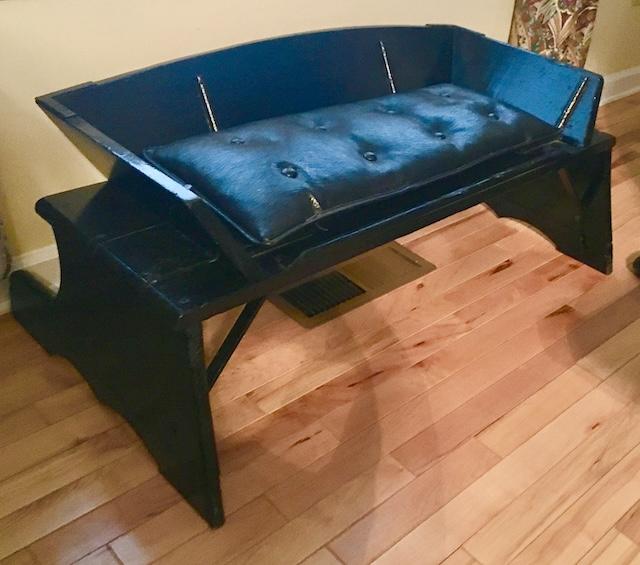
- Seat from spring wagon of Andy J. Jack (1881-1962), J.P. Jack’s grandson.
-

- Tax notice
Jan Loveday Dickens is an educator, historian, and author of Forgotten in the Fork, a book about the Knox County lands between the French Broad and Holston Rivers, obtainable by emailing ForgottenInTheFork@gmail.com.


Is it possible to read these diaries? Have they been transcribed and typed so they are legible? Fascinating?
Hey Jan: I wondered if you had ever been to this cabin, started to mention it to you, but just forgot!
Robert
Of course! I see it all the time. But I always appreciate a heads up on anything you think I might be interested in! Thanks, Robert!