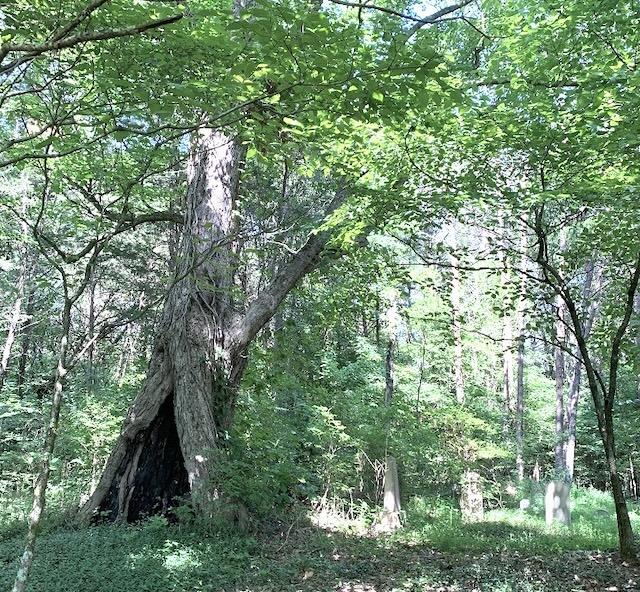
I was fascinated as a child when my father would point out houses in the Fork, the Knox County lands between the French Broad and Holston rivers, where enslaved individuals had once worked and cemeteries where enslaved persons were buried. As an adult, I’ve visited many of these places where the unmarked graves are sunken and overgrown with brush and trees, silent testimonies of a tragic and shameful aspect of our nation’s history. I’ve learned that such nameless plots are far greater in number in our area than I had ever thought, having been taught in school that slavery wasn’t very prevalent in East Tennessee.
Rachel was enslaved in the Fork but later married and moved to Ohio after the Civil War. She was interviewed at the age of 81 as part of the Writers Project during the Great Depression, leaving behind interesting details of her life and the lives of other enslaved individuals.
She was born in 1856, the daughter of her master’s youngest son and the family’s enslaved cook. As her owners’ granddaughter, she slept in a little bed at the foot of their bed. She was well-clothed, and she said her hardest chore was to fetch a pipe or go to the spring to get a glass of water for her master.
In contrast to her comparatively favorable conditions and the “generosity” her master showed to her mother’s mother, who cooked for the field workers and was allowed to get whatever meats and vegetables she wanted to cook from the master’s smokehouse and garden, others were not so fortunate. Though at her farm the enslaved workers wore clothes made on the premises from carding, spinning, dying and weaving bought cotton or wool from their hundreds of sheep, others on nearby farms were made to wear coarse, scratchy hemp. She considered her mistress kind-hearted because she made sure the enslaved men stopped work at noon on Saturdays so they could visit their wives and families until Sunday night, and she always made sure they had a gift such as butter, meat, sweet potatoes or grapes to take with them. According to Rachel, they “looked upon all their people as their children.” Evidently, some of them actually were.
Any enslaved person leaving the farm had to have a pass or face the possibility of running into the “paddyrollers,” white men who patrolled the country looking for runaways to whip, “just like dogs hunting rabbits.” Her mother told her the story of a time her master attempted to whip an enslaved young man and how the young man had whipped him instead. Rachel said her master didn’t seem to have a heart for it.
Another enslaved young man, possibly the master’s son, took the master’s horse and literally rode it to death while joy-riding at night. After he was “whipped” and complained afterwards with a hurting side, they called in the doctor, who confided to the young man’s enslaved mother that nothing was wrong with him. Still, he was allowed to lie in a bed in the dining room for two weeks. He had grown up with his owners’ youngest son and often got into trouble by also borrowing the master’s gold-headed cane or overcoat on his nightly escapades. Eventually though, he borrowed the shoes of a preacher who stayed overnight, but couldn’t get them off before everyone awoke. They found him asleep on his enslaved mother’s bed in the kitchen. When no one could get the shoes off his feet, they bought the preacher a new pair and let the young man keep the old ones.
Among the many accounts of life as an enslaved person that Rachel told, was that the same young man was recruited by the Union during the Civil War. When he came back to the farm leading a dozen Black men, her master was terrified until the young man told his soldiers to honor his master, and the soldiers took off their caps and cheered. The farm’s mistress, actually the owner who had inherited the enslaved persons and brought them into the marriage, was pro-Union, and she had a fine chicken dinner cooked for the unit. They were likely part of the U.S. Colored Heavy Artillery, described in my February 11 article.
Jan Loveday Dickens is an educator, historian, and author of Forgotten in the Fork, a book about the Knox County lands between the French Broad and Holston Rivers, obtainable by emailing ForgottenInTheFork@gmail.com.