As we continue to move toward our nation’s semiquincentennial, I am focusing on the Revolutionary War effort of attaining independence and the related contributions and connections of families of the Fork, the Knox County lands between the French Broad and Holston rivers.
Andrew Creswell might not have actually lived in the Fork, but his descendants have been present here for generations, and the public now enjoys some of their lands.
Andrew Creswell was born in 1757 in Camden, South Carolina, but he moved with his family to Virginia in 1772. He started at the age of 19 in 1776 as a private in Capt. Coville’s company was part of Col. Shelby, Lt. Newell, and Col. Campbell’s regiment in the Virginia line. He performed garrison duty and protected Black’s Station in Washington County, Virginia. After being discharged from that term, Andrew spent the next few summers under Col. Evan Shelby and Lieutenant Newell, protecting the settlements at the headwaters of Clinch River.
He married Dorothy Evans in 1780. He then had a tour at the head of the New River “suppressing the Tories” (loyal to the British king) that same fall before the Battle of King’s Mountain, where he fought under the command of Col. William Campbell. He then returned home.
However, early in 1781, Col. Campbell called the regiment together again and gave them the choice of going west to quell the Native Americans or going to meet General Greene at Guilford Courthouse, which is what he chose. Because of delays in travel, they didn’t arrive there until the battle was over. British General Cornwallis’s army of 2,100 defeated American General Greene’s 4,500 men.
According to Andrew’s pension statement, he afterwards spent so many short and frequent fights against the Native Americans and Tories that he couldn’t remember who led what. Still, they totaled about a year’s service. He eventually earned a pension of $40 a year.
In about 1787, Andrew and Dorothy and their children came with other family members to live at Boyd’s Creek in Sevier County, and he continued to fight in what is known as the Indian Wars. Andrew died at the age of 81 in 1838 and is buried in Blount County at Eusebia Presbyterian Church, where he and Dorothy were founding members. Their daughters married into the Huffaker and Randles families, many of whose descendants still live in the Fork.
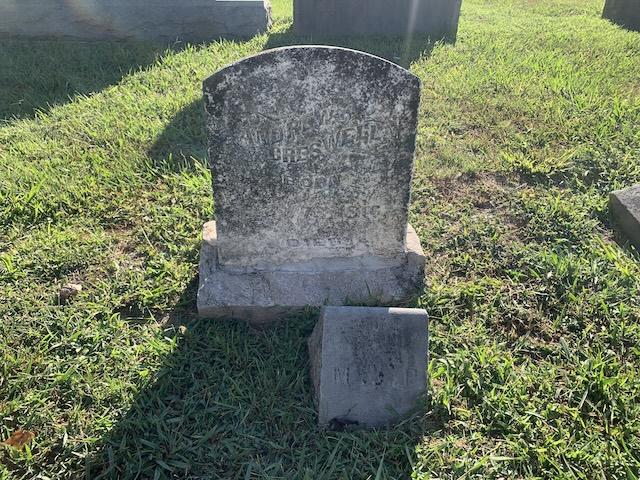
Andrew Creswell’s marker at Eusebia Presbyterian Church graveyard in Blount County
Dorothy and Andrew’s great-grandson, Samuel Anderson Creswell, a Union Civil War veteran, and his wife, Sallie, bought from W.P. Keener 58 acres on the French Broad at Kelly Bend in the Fork in 1891. Their son later sold the farm to Samuel’s brother George in 1915, and then George and Jennie’s son Clarence worked the farm. The land was transferred to Clarence in 1945 before George died in 1954. One of Clarence’s 17 children, Oliver “Greasy” Creswell, pumped sand at the point of Kelly Bend in the mid-1960s as a part of Creswell’s Sand Company that ran until the late 1970s.
The Creswell farmland on Kelly Bend continued to change hands until it became part of what we know today as Seven Islands State Birding Park, where the Creswell heritage cannot be forgotten in the Fork.
Next week, we will look closely at the life of Andrew and Dorothy Creswell and what it meant to settle on the frontier in what would become Tennessee.
Jan Loveday Dickens is an educator, historian, and author of Forgotten in the Fork, a book about the Knox County lands between the French Broad and Holston Rivers, obtainable by emailing ForgottenInTheFork@gmail.com.
Follow KnoxTNToday on Facebook and Instagram. Get all KnoxTNToday articles in one place with our Free Newsletter.




Love this, thank you Jan for posting!
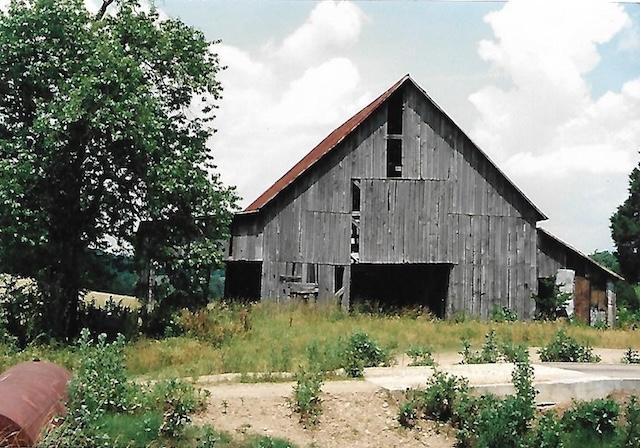
I spent lots of time running through the fields there, playing in the barn building tunnels with the hay bales, climbing the sand piles & sliding down. It was a perfect place to learn to drive except for passing dump trucks with sand. Sure do miss my Papaw with his garden (also known for running his tractor in the river since he couldn’t see well). Dad (known as Greasy) spent many hours helping Papaw & running our sand company.
Wonderful childhood memories!
Those are precious memories, for sure! My dad took me fishing at the end of the lane. Thank you, Libby, for taking time to comment! You have such deep and significant roots in the Fork!
Never knew “Greasy’s” in all my life!!!
Jan, thank youfor all of the “Forks” articles. So would be lost if not for your work and passion!!
Thank you so much for your interest and for taking time to reach out with kind words! I never know whether anyone reads the articles!
Thank you, Glyn, for reaching out with such kind words! I never know whether anyone is reading my articles unless they comment, so your message is encouraging!