

The card simply said “male, estimated age, 50 – gray hair and moustache.” It noted that he was wearing a vest and trousers as well as a black frock coat and overcoat. His effects were listed as a gold watch and chain, masonic charm pin, his glasses, a knife, a photograph. He also had his pipe lighter, gold mounted eye glasses, gold links, four gold studs, a cigar holder. One men’s purse contained seven shillings, two pence and three farthings. A sovereign purse contained four pounds, 10 shillings.
This is how a man dresses on a cold, dark night in the midst of a disaster, trying to brace for the elements, gathering what he thinks will be essential, not realizing just yet that he is running out of time. The man was The Rev. Robert J. Bateman, native of Bristol, England, late of Jacksonville, Florida, and, previously, of Knoxville, Tennessee. The clothes and items are what was found when his body was recovered from the North Atlantic on April 20, 1912 by the Mackay-Bennett, a cable ship contracted by the White Star Line to recover the dead that went down with the HMS Titanic.
Bateman first came to North American in the mid-1880s, spending several years in Toronto, Ontario, Canada. Though a minister, he was also a stone mason by trade and he and his wife, Emily Hall, eventually made their way to the states, first spending time in Missouri before coming to Knoxville in 1896. Bateman was invited here to help raise money for the fledgling Florence Crittenton home for “wayward women” and their children. He preached in every church and lectured at the old Staub’s Theatre.
He wasted no time becoming a much loved and admired citizen, from the shadows of the Bowery to the parlors of high society. He founded the People’s Tabernacle (originally called the Rescue Mission for its first three years), which began in the unused former powerhouse of a predecessor of the Knoxville Railway and Light Company on East Cumberland Avenue. Now if you look on a map today you will not find a 115
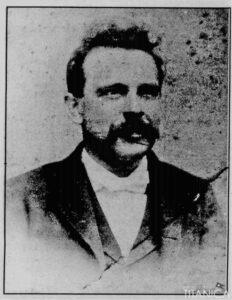
Robert Bateman (Photo: Encyclopedia Titanica)
East Cumberland Avenue or even an East Cumberland. Like Main Street, Cumberland Avenue used to run east of Central over towards where the Knoxville Civic Coliseum now sits. Urban renewal, interstates, Neyland Drive and James White Parkway took out road and the tabernacle when the Frist Creek went underground in the late 1950s.
The tabernacle was located pretty much just east of what is now Theatre Knoxville Downtown in the middle of Neyland Drive. In fact, the Theatre Knoxville building is where the tabernacle moved to (the building was used by other congregations as well) after the loss of the original structure.
Bateman was mourned with great fanfare here, in Jacksonville (where he’s buried), in Baltimore and back home in England. He was on a trip visiting family and doing some mission work before that fateful voyage on the Titanic. He had also convinced his wife’s widowed sister, Ada Elizabeth Balls, to return to the states with him on the unsinkable ship of dreams.
There’s a bit of conflicting information about how events unfolded that night after the reverend and his sister-in-law conducted a prayer service in second class. But the end result was he made sure she made it into a lifeboat. He handed his Bible off to her, and his las words to her were If I don’t meet you again in this world, I will in the next.” As the band played on, he is allegedly the one who requested they perform Nearer, My God, to Thee. His Bible has been on display at the Titanic Museum in Pigeon Forge.
Beth Kinnane writes a history feature for KnoxTNToday.com. It’s published each Tuesday and is one of our best-read features.
Sources: McClung Historical Collection-Knox County Library, Knoxville Journal Digital Archives, Encyclopedia Titanica
Follow KnoxTNToday on Facebook and Instagram. Get all KnoxTNToday articles in one place with our Free Newsletter