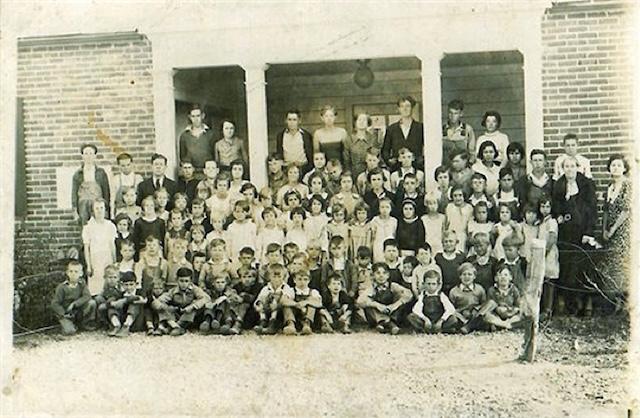
It’s about time for schools to close for summer, but what about those that closed for good? Once, a couple dozen schools stood in the Fork, the Knox County lands between the French Broad and Holston Rivers, but today only four Fork public schools are in operation: Sunnyview Primary and the Carter Elementary, Middle and High schools.
Historian Dr. J.G.M. Ramsey started Mecklenburg Academy on his property at the confluence of the rivers in 1829, the same year Tennessee started a system of common schools. The state provision often was not successful though, because much of the general populace still felt that education was only for the upper class.
Although efforts toward public education in Tennessee began long before the Civil War, the state’s third constitution in 1870 finally mandated a public school system. Before that, most educational facilities were associated with local churches. For instance, James Kennedy’s New Salem Seceder congregation started a school at their church on the end of Wayland Road near Thorn Grove Pike in 1855. Similarly, a seminary school later established at Whortleberry Springs (now Huckleberry Springs), was led by Prof. F.C. Beaman and his wife.
The Public School Act of 1867 was probably the initiative for establishing Moshina School, which existed as early as 1869. Moshina served students of 10 grades and was initially a one-room log structure that was replaced with other structures as needed.
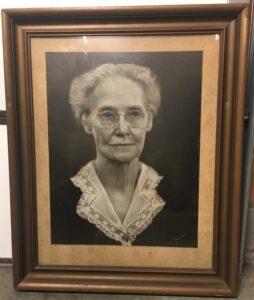
Dora Kennedy portrait that hung in the school renamed for her
A story related by old timers of the community told that at some point, a community member contracted another man to remove logs from the old Moshina school to use them as beams in the barn he was building, but the preacher who was holding services there told others that he had received a word from God, saying that whoever touched the building to tear it down would die within the year. The contractor was scared by the warning but was told by the farmer that the preacher was only afraid of not having a place to preach. The contractor eventually went ahead with the job, but he did die within the year.
Ebenezer M. Kennedy (1847-1919) was one of Moshina’s first teachers. However, it was his daughter Dora Kennedy (1871-1956), the 52-year Knox County veteran school teacher, for whom the community and the newer brick school was renamed in 1943. The log structure Ms. Dora Kennedy had taught in was moved on log “rollers” by a mule team to the field between the school and Ms. Dora’s home beside Mt. Harmony Baptist. The cabin was rented to various families throughout the years but burned on Halloween in the 1960s. A three-room brick school was built on the original school location and continued to be enlarged over the decades to include more classrooms, a kitchen and a gymnasium, serving different purposes over time for the Knox County school system. It was eventually retired as an educational facility and was used by the community for voting, etc. until it became the family life center for Mt. Harmony Baptist.
Next week, we’ll look at more schools that have been forgotten in the Fork.
Jan Loveday Dickens is an educator, historian, and author of Forgotten in the Fork, a book about the Knox County lands between the French Broad and Holston Rivers, obtainable by emailing ForgottenInTheFork@gmail.com.