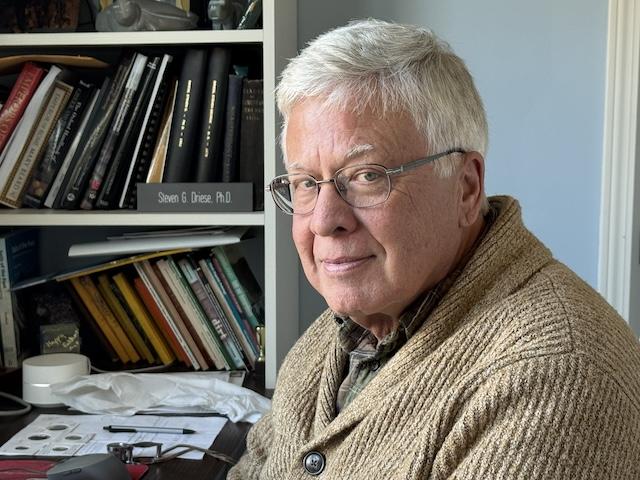
I’m chatting today with Dr. Steven G. Driese, Chairperson for Knox Climate Watch, a non-profit organization.
Q: Briefly, in your own words, how did Knox Climate Watch get started?
A: “The group started about 4 years ago as a social gathering of primarily retired professionals from various private and public sectors that discovered that they shared a common concern, which was climate change and its effects on Earth’s environment. In 2024 we decided to organize formally as a 501(c)(3) non-profit and begin our work in the Knoxville and Knox County community.”
Q: How would you sum up the group’s mission?
A: “Our core statement is ‘To confront the climate crisis with urgency in order to accelerate the transition to a post-fossil fuel society.’ We hope to accomplish this through focusing our efforts on the areas of Education, Outreach, and Policy. We have a core group of 10-15 active members who meet monthly and map out their activities. We have a website: www.knoxclimatewatch.org that provides more detailed information about our group.”
Q: Please share how your professional background lends itself well to your volunteer role?
A: “I’m a Geoscientist by training and taught at the University of Tennessee-Knoxville for 22 years, and then at Baylor University for 18 years before retiring in 2022 and moving back to Knoxville. My research involved paleoclimatology, which is the study of the Earth’s past climate, and I accomplished this through the study of ancient soils turned into rock, called paleosols. From these studies I was able to detect changes in carbon dioxide and oxygen in the atmosphere, as well as changes in surface temperatures and rainfall, over the 4 billion years of Earth history. So, I think that I am well-suited because I have “the long view” of Earth’s climate history with which to interpret the recent, rapid changes in carbon dioxide that have occurred over the past 200 years. These rapid increases in greenhouse gases, mainly attributable to human activities, and chiefly due to fossil-fuel burning, are unprecedented, and there is no analog for this rapid change in Earth’s “deep-time” past history. So I am very concerned about where we are headed unless we do something to reverse our consumption of fossil fuels.”
Q: If this topic seems overwhelming to some or they aren’t in tune with all of the climate science, what practical, down-to-earth things can individuals or businesses do right now that might be beneficial?
A: “Well, obviously they can become more energy efficient through insulation of homes and businesses and use of more energy-efficient appliances, which is a win-win because it saves individuals and businesses money, which everyone I’m sure can agree on is a good thing. Electrification of vehicles and electricity for heating and cooling, where possible or practical, is another strategy. Anything to reduce our reliance on fossil fuels (natural gas, oil, coal) and increase our use of renewable energy (solar, wind, hydroelectric, etc.) and building small nuclear reactors contributes in a positive away. Reuse, refill and recycling programs also benefit the environment by better managing consumer resources. And careful preparation and planning for climate change and its attendant natural disasters (e.g., flooding, wind damage, fires) will help us better cope with these events, which are becoming increasingly frequent in not only our own country but across the world.”
Q: What makes you most hopeful about Knox Climate Watch making a positive difference in the coming years?
A: “I see encouraging signs in polls showing that 70% of Americans are becoming increasingly concerned about climate change, with polled individuals spanning the political spectrum. Many more organizations such as ours are popping up and serving to bring focus on not only what is currently happening, but also what we can do to slow and eventually reverse what we have set in motion. Communication of reliable, science-based information is the key. Because there are so many national and international programs, Knox Climate watch has decided to “act locally” in the Knoxville and Knox County area communities.”
Q: If someone wants to invite a speaker or learn more about Knox Climate Watch, what is the best way for people to connect with you?
A: “The best way to contact me on behalf of Knox Climate Watch is through my personal e-mail, Steven_Driese@baylor.edu, or through Knox Climate Watch’s general e-mail, knoxclimatewatch@gmail.com.”
Anne Brock-Rankin is Marketing Coordinator for Solar Alliance, a renewable energy company that installed solar and energy storage for Crawford House. She can be reached at abrock@solaralliance.com.
Follow KnoxTNToday on Facebook and Instagram. Get all KnoxTNToday articles in one place with our Free Newsletter.