
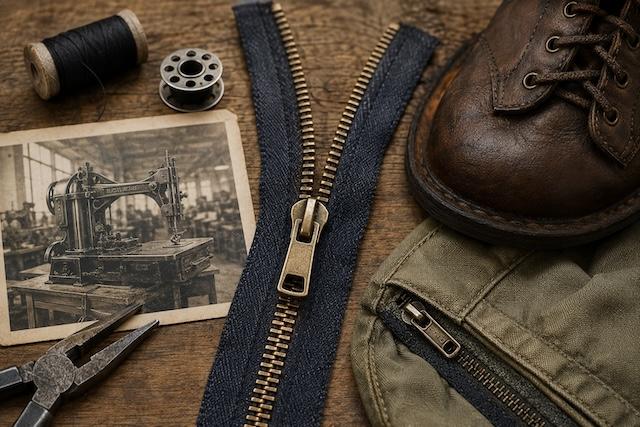
Imagine getting dressed every morning without a zipper. No quick pull on a jacket. No easy fastening on a pair of jeans. You’d be relying on rows of buttons, hooks or laces for almost everything.
As ordinary as the zipper seems today, its journey to becoming an everyday necessity was anything but smooth.
The story begins in 1851 when inventor Elias Howe — better known for developing the sewing machine — patented what he called an “automatic, continuous clothing closure.” It was an interesting idea, but Howe never pursued it. His attention stayed focused on sewing machines, and his invention quietly disappeared into history.
More than 40 years later, inventor Whitcomb Judson tried again. In 1893, he introduced the “Clasp Locker,” hoping it would make fastening shoes easier. Unfortunately, it had one major problem: it didn’t work very well. The device often popped open or jammed, leaving customers frustrated rather than impressed.
The breakthrough came in 1913 when Swedish-born engineer Gideon Sundback redesigned the entire concept. He increased the number of interlocking teeth, strengthened the mechanism and created the design that closely resembles the modern zipper we use today. His version was far more dependable and could be manufactured efficiently.
Even then, people were slow to embrace it.
Early zippers were used mostly on boots, tobacco pouches and military equipment. Clothing manufacturers worried shoppers wouldn’t trust this strange new fastener. It wasn’t until the 1930s that children’s clothing companies began promoting zippers because youngsters could dress themselves more easily.
The name “zipper” didn’t come from the inventors at all. In the 1920s, the B.F. Goodrich Company used Sundback’s fastener on a new line of rubber boots. The company liked the sound the fastener made — “zip!” — and began calling the boots “zipper boots.” The catchy nickname stuck and soon became the name of the fastener itself.
Today, billions of zippers are manufactured every year and are found on everything from tents and luggage to backpacks, coats and space suits.
It’s funny to think that one of the simplest inventions we use every day spent more than 60 years struggling to earn the public’s trust. Sometimes the biggest breakthroughs don’t happen with a bang — they happen one tiny tooth at a time.
Crystal Kelly is a feature writer for Bizarre Bytes with those unusual facts that you only need to know for Trivial Pursuit, Jeopardy, or to stump your in-laws.
Enjoyed this article. Read more Bizarre Bytes by Crystal Kelly.
Follow KnoxTNToday on Facebook, Instagram, X, and LinkedIn. Get all KnoxTNToday articles in one place with our free newsletter. Comments may be sent to news@knoxtntoday.com.

