
Two relatives and three friends in Georgia are still celebrating the Southeastern Conference championship. Alabama suffered a knockout.
The bully Bulldogs, Texas A&M, Ole Miss, Oklahoma and the struggling Crimson Tide are in the national playoffs. Strength of schedule must have mattered. Alabama somehow survived minus three yards rushing in the SEC title game.
College football is today the talk of a dozen towns and Pilot stores all over the country. Good (or frenzied) arguments are going on about who is in and who was left out. Notre Dame thinks its playoff rights were stolen.
Selection committee behaved as if nobody really deserved the 12th spot but James Madison was least unworthy.
Other news: Tennessee will play Illinois in the Music City Bowl. You can have that. I hear that hundreds of fans have already said they don’t want any part of it. There are better ways today to claim a little piece of the football conversation. Let us remember the best of times for the Volunteers.
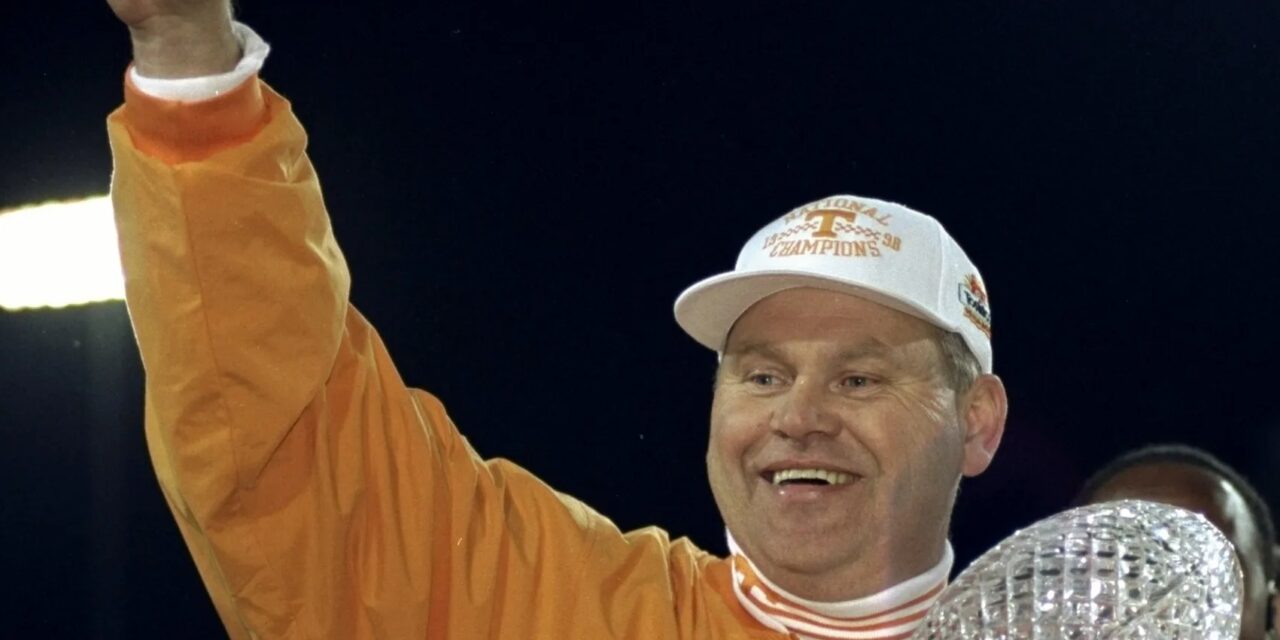
Gather round, young people. It has been a while but Tennessee has been there and done that. The university claims six national championships – 1938, 1940, 1950, 1951, 1967 and 1998. Who am I to argue?
Let’s start with 1998. It was very official with little debate. I have the happiness picture on my office wall.
That summer, Tennessee fans accepted the fact that there might be a drop-off coming. Peyton Manning, Terry Fair and Marcus Nash had gone in the first round of the NFL draft. Five others went along later for the ride.
In August, coach Phillip Fulmer was fussing about bad practices back-to-back. He called a team meeting. He said the way they looked, the Vols might win six games. Tee Martin says that was the spark that lit the first fire.
The opener at Syracuse was a close call. Donovan McNabb riddled the Tennessee defense (22 of 28 for 300 yards and two touchdowns plus another on the ground).
Al Wilson fought off the Syracuse running game. Jamal Lewis gained 140 yards for the Vols. Peerless Price caught two TD passes from Tee. Alas, Syracuse was ahead and time was running short.
A clutch call by an official, a fourth-down pass interference flag against the home team, gave Tennessee the chance it needed. Jeff Hall kicked the winning field goal, 34-33, as the clock ran out.
The defining moment of that undefeated season was the stumble and fumble, how the Vols stunned Arkansas on a drippy November 14 at Neyland Stadium.
The Razorbacks had the ball and a 24-22 lead, 43-yard line, 1:47 remaining. The game was essentially over, as were Tennessee’s national championship hopes. Oh well, it had been a great run.
All Clint Stoerner needed to do was make a first down and run out the clock. Vol guard Billy Ratliff disrupted the finish. He knocked all-American Brandon Burlsworth backwards. The offensive guard stepped on the quarterback’s foot.
Stoerner lost his balance and put his right hand down to perhaps prevent a fall. There was a problem. That hand was holding the football. Stoerner lost his grip. Ratliffe couldn’t believe his eyes.
“That ball seemed like it was out there for five or six seconds.”
Ratliffe got it. Offensive coordinator David Cutcliffe called five consecutive Travis Henry runs. Linemen accepted the challenge. Cheese scored the winning touchdown with several seconds to spare.
Remaining games were less stressful. The Vols took down Florida State, 23-16, in the Fiesta Bowl.
“We did something not many will ever be a part of and that was to win a national championship,” Fulmer said. “I do cherish those moments and memories.”
I don’t know why Tennessee didn’t win other titles during the Fulmer era. His teams won a hundred more games than they lost.
Tennessee lists 1938 as a championship campaign based on 11-0 and four Hall of Fame Vols, tailback George Cafego, end Bowden Wyatt and guards Ed Molinski and Bob Suffridge.
That team slowly climbed in the AP poll, from eighth to sixth to fourth. By the Orange Bowl, it was No. 2 against No. 4 Oklahoma. Vols won, 17-0. Cafego scored two touchdowns, gained 145 yards on 19 runs and knocked out the star Sooner with a vicious block.
Neyland liked the season numbers – 293 points scored, 16 allowed. Texas Christian somehow won the AP national title.
Zeros said 1939 was a remarkable year. Ten opponents failed to score but the Vols lost to Southern Cal in the Rose Bowl. Cafego was sidelined with an injury. Texas A&M was awarded first prize.
The university claims 1940 as a title season. The Vols won 10 but received minimum support for the national championship. Bob Foxx was a great wingback. Suffridge and Molinski, famous guards, were still playing. Ed Cifers was a good end. Vols lost to Boston College in the Sugar Bowl. Minnesota won the AP title.
Tennessee and several groups that gave out trophies said 1950 was a championship season – 11-1 record. There was a September loss at Mississippi State. The Associated Press and UPI coaches’ polls said Oklahoma was the champ. The Sooners were in a 31-game winning streak.
The 1950 grand finale, victory over Texas in the Cotton Bowl, boosted the Vols to No. 1 for the start of ’51. That was an undefeated season, consensus national championship, awarded before the loss to Maryland in the Sugar Bowl.
The 1951 team was outstanding. There were big names in the backfield – Hank Lauricella, Andy Kozar, Herky Payne, Bert Rechichar and Jimmy Hahn, winner of the Jacobs Blocking Trophy.
Among the other blockers and tacklers were such stars as John Michels, Pug Pearman, Ted Daffer, Jim Haslam and Doug Atkins. There are plaques in the College Football Hall of Fame. Lauricella was runner-up for the Heisman Trophy.
Herky summarized the famous coach, Robert R. Neyland.
“General Neyland was a great leader. He was a disciplinarian as you would expect. He did not run a popularity contest, but he was very fair.”
Good team. My cousin, Ray Byrd, was No. 3 fullback. I saw the home games. I was a UT freshman.
The Tennessee establishment plus coach Doug Dickey, Bob Johnson, Steve Kiner, Richmond Flowers, Charley Rosenfelder, Dick Williams, Jim Weatherford, many others and I wanted 1967 to be a national championship campaign.
The Litkenhous Difference by Score Ratings, a mathematical formula created by a Vanderbilt professor, was the Vols’ only semi-official evidence. All I had was an emotional attachment to the team. It may have been my all-time favorite. I liked the Sugar Vols, too.
The 1967 team lost twice, to Gary Beban at UCLA and to Oklahoma in the Orange Bowl when old friend Karl Kremser was accused of missing a field goal by an inch and three-quarters. Dewey Warren, the colorful Swamp Rat, holder for the kick, still insists it was good.
Dickey, Johnson and Kiner represent this gutty group in the College Hall of Fame.
Marvin West welcomes comments or questions from readers. His address is marvinwest75@gmial.com


I remember crying myself to sleep the night they called Kremser’s kick wide against Oklahoma. I was up alone watching the last game of the bowl season, as I remember it, on our new color TV. Thanks again for more memories, Marvin. Music City bowl may seem a bit beneath how good we could have been, but still loking forward to it like every game we ever play, GO VOLS!!!
It’s a sheer pleasure to read a Marvin West column. West is the best.
I remember ’98 of course. What a year. I was there in Scottsdale for the big showdown with Florida State. I’ll never forget it.
I”ll never understand how we did not win the 1939 NC.
Undefeated and NC the previous year. I don’t know if
they had pre-season polls back then, but we had to be
ranked very high. And then all we did that year is go
undefeated,untied,and unscored on for the regular season.
It is my understanding that back then only the regular season
counted toward the N.C. It just doesn’t make sense.
The most glaring of the many Media robberies in the history of Tennessee Football.
I’m one of those fans saying, meh about the MCB, even though its 25 minutes from home. I’ve been to all of our previous appearances in the Nashville bowl. If my old UT roommates call and say let’s go again, for old times’ sake, I’ll consider it — if ticket prices drop.
Meanwhile, I’m laughing at the whining from West End Avenue about the ‘Dores not making the CFP. It is almost erasing our loss to them.
Today’s column could very well be named “Who’s Who in Tennessee Football”. Great names and great memories. Thanks, Marvin.
exactly
Today’s column could very well be named “Who’s Who in Tennessee Football”. Great names, great memories, great column.
Money may or may not be the root of all evil, but it sure doesn’t buy happiness. Once there were no bowls. Then there were six. (Rose, Sugar, Orange, Cotton Gator and Sun) Now there are forty-one. We once voted for a national champion, but everyone did not agree. (Warming up to disputing who won a presidential election) Now, teams reject bowl invitations and fans won’t go. Never mind. To ESPN, a bowl game is cheaper than producing a three-hour movie. We decided voting was not the way to decide a champion, so we have a playoff system. But that doesn’t work because Notre Dame and Carson Newman did not get invited. Whatever system we think up, just follow the money, as they say. But it won’t buy happiness because everyone doesn’t get all the want.
Marvin West, a 1951 UT Freshman. Wrap your head around that; the Man is still at it and still writing at the highest level. Thank you Mr. West, the words haven’t been invented to adequately describe true Vol fans’ appreciation for what you do. Great Column! And NO! Nobody cares about the Music City Bowl, which I correctly predicted for Heuple’s crew after the Alabama game.
I totally agree!!
Mr. West is undisputedly the best there has ever been, and likely will ever be. In my days on The Hill, we couldn’t wait for the big thick Sunday News-Sentinel to hit Cumberland Avenue late on Saturday nights after games, with its pages of game coverage — thanks to him and his talented crew. Have read him ever since.
Great memories Marvin. I listened to the 50-51 Cotton Bowl game with my Dad…Tennessee 20-16 over Texas as I recall. Bill Stern and Lindsey Nelson each announced the game …two different stations. Let’s just bask in the glory of the years you reminded us of. Maybe the hoopla over the playoff debacle will carry us through until basketball gets going strongly. Are we really going to play a bowl game in Nashville?