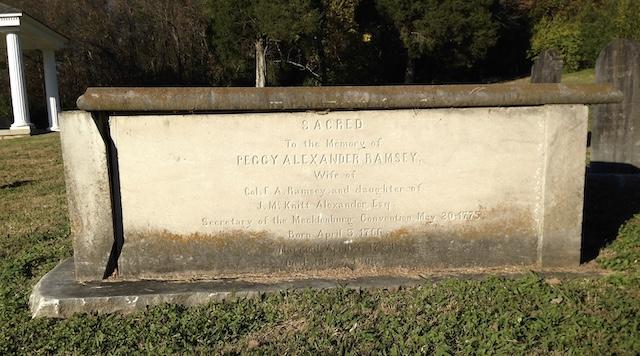
We continue to move toward our nation’s semiquincentennial, and I’m still sharing about the Revolutionary War effort of attaining independence and the related contributions and connections of families of the Fork, the Knox County lands between the French Broad and Holston rivers.
This one hits a little differently. She was named for the Greek goddess of love. Her name was Venus.
It was common during the colonial period to name an enslaved child after a god, goddess or a historical person of significance or power, thereby contrasting the enslaved person’s status. Another practice was to call an enslaved individual by a child-like nickname, suggesting a lack of maturity or agency. Venus was called “Vinnie.”
Venus was born in about 1766, probably no later than 1770, and she lived in Mecklenburg, North Carolina. Her owner, John Alexander, who was a Patriot leader in his area during the Revolution, had given Venus to his daughter “Peggy” as Peggy’s personal maid.
During the Revolution, a neighboring “Tory” (someone who chose to remain loyal to the British king) came to the Alexander home, hoping John would provide empathy and protection from the surrounding Patriots who would do the man harm. However, John wasn’t home.
As recorded in J.B. Alexander’s book, The History of Mecklenburg County, North Carolina, from 1740 to 1900, the Alexander family sent Peggy and Venus to ride out and fetch John, who was at the local Patriot soldiers’ training camp. Peggy was just a teen. At the camp, Venus would have seen the preparations for battle, just as Peggy did. As an enslaved person, what might Venus’s thoughts have been as she watched the men getting ready to fight for freedom?
We know that when Peggy married in 1789, Venus’s ownership changed hands, and she went with Peggy and her new husband to Limestone, a settlement near the Nolichucky River. Peggy and her young family soon moved to their Swan Pond farm in the Fork, which was part of the frontier that would become Tennessee in 1796. Sometimes Peggy’s husband went off with other men of the Fork to quell Native American uprisings, while the women were left at fortified homes or “stations.” How would Venus have felt, knowing the Native Americans were fighting to keep from being removed from their homelands, just as her people had been?
Venus’s daily life probably included activities related to tending to Peggy’s needs, keeping house, caring for children, and other domestic duties that allowed Peggy’s family the time they spent contributing to the Revolution and the establishment of the local, state, and national government. While their enslaved persons toiled at manual labor, the owners were availed of the opportunity to hold official government positions. In that way, Venus involuntarily supported our nation’s founding through her work as an enslaved woman.
But Peggy died in 1805. What fears would Venus have experienced then concerning her own future?
Peggy’s widowed husband soon married again, but Venus was kept for the new mistress of the house, who then died in 1816. Venus’s owner’s will, made that same year, provided that Venus would be inherited by one of his sons upon the father’s death. However, the following year, in 1817, her owner, Francis Ramsey, and his sons signed for her to marry Isaac Smith. The law required that an owner had to sign for an enslaved person to marry legally. Did Venus, who was named for the goddess of love, choose this union? Was Isaac free? We currently don’t know anything about him.

1817 marriage record for enslaved Venus Ramsey and Isaac Smith
Although Francis’ son J.G.M. did buy Venus from his father’s estate in 1822, we don’t know what became of Venus and Isaac or their descendants, if there were any. However, what little we do know about Venus’s life is owed mainly to Francis and Peggy’s son, J.G.M. Ramsey, the historian who kept Venus’s story from being totally forgotten in the Fork.
Jan Loveday Dickens is an educator, historian, and author of Forgotten in the Fork, a book about the Knox County lands between the French Broad and Holston Rivers, obtainable by emailing ForgottenInTheFork@gmail.com.
Follow KnoxTNToday on Facebook and Instagram. Get all KnoxTNToday articles in one place with our Free Newsletter.