
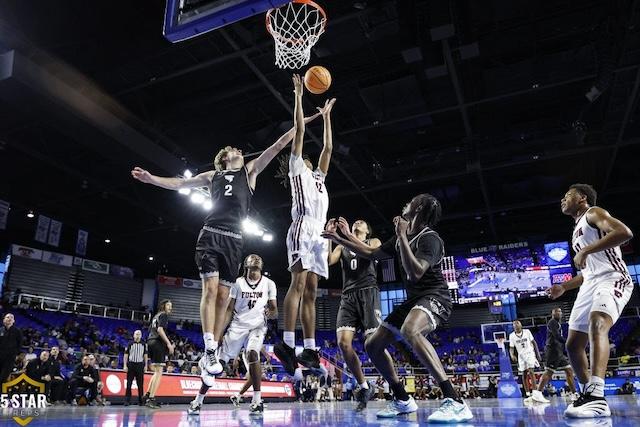
The Tennessee Secondary School Athletic Association (TSSAA) wasn’t the first state association to bring a shot clock into high school basketball, but it sure wasn’t the last.
The TSSAA Board of Control approved on Tuesday, June 9, 2026, a four-year plan to fully implement a 35-second shot clock into the sport.
By the start of the 2029-30 season, roughly all 400 basketball-playing member schools will need to be up to speed.
The vote passed by an 8-4 margin at Tuesday’s meeting in Mt. Juliet, though the proposal put forth to the board by Bartlett High School was amended.
Originally, Bartlett proposed a three-year rollout of the 35-second shot clock in Tennessee high school basketball.
Year One would have allowed for shot clocks to be used in preseason/Hall of Champions games. Year Two would have seen shot-clock usage in Hall of Champions games, invitational tournaments and in non-district games where coaches agreed to use it. And then, in Year Three, all schools would be expected to have shot clocks in the gyms with properly trained operators.
Fulton’s longtime basketball coach and athletics director, Jody Wright, who serves on the Board of Control, wanted to see a longer introductory period. That, in turn, would allow all schools to save money to buy the equipment and properly learn how to use it.
Wright suggested the four-year plan in the meeting on Tuesday. He said it’s an easier sell than the three-year plan.
“I’ve heard a lot of comments: ‘This is going to make the game of high school basketball better.’ I’m not in that camp,” said Wright, who’s led Fulton to five state titles and six state runner-up finishes. “Good basketball is still going to be good basketball. And bad basketball is still going to be bad basketball. Shot clock’s not going to change that.
“I do know the noise of the shot clock is not going to go away. You got people who are for it. You got people who are against it. And you got coaches who are for it and administrators who are against it. … It’s all over the place. But the noise for the shot clock isn’t going to go away. So how do we navigate this where everyone can feel, like, OK. The only way I felt like that could happen is to give schools plenty of time to get this process done.”
Webb School of Knoxville girls basketball coach Greg Hernandez, who has led the Lady Spartans to back-to-back Division II-AA state titles, is excited for the change. His team has played some out-of-state games where the shot clock was in play. Webb didn’t encounter any shot-clock malfunctions or mismanagement that he could remember that negatively affected the games.
“I think it challenges us coaches to continue to get better at our craft,” he said. “How to manage the time, in regards to: do you want to shorten the game, speed up the game.
“We’ll have three shot-clock games this year on our schedule. And last year, I think we played four games with the shot clock. I watch a lot of college basketball. I played college basketball. I watch a lot of NBA basketball. The strategy behind it and the last couple of years when we’ve had those (shot-clock) games where we’ve had leads, it’s, ‘Hey, can I go into a zone here so I can kill some clock defensively — make the offensive team think a little bit? Can we speed it up? Do we need to start fouling now? You can really turn the game into a possessions game with a 35-second clock in eight-minute quarters. If you can really take care of the basketball and score, you can really put a lot of pressure on teams in a different manner than you would by just setting up a press or doing other things. So I’m pretty excited about it.”
A pair of shot clocks for high school usage generally costs in the $1,500-$3,000 range with higher-end models running close to $5,000.
Adding to the costs would be schools most likely having to pay an official, retired official or trained operator anywhere from $40-$60 per home game. Given most schools play a junior varsity game before the girls’ basketball game and boys’ basketball game, that $120-$180 on top of what they already pay the on-court officials can add up over the course of a season.
Some schools might find volunteers who’d go through the training to alleviate the rising costs of this implementation.
“I can’t imagine every school would want to pay an official,” Wright said. “Even if you’re getting a retired official, that’s going to be a substantial cost.
“I imagine it’ll be somebody at your school that you train, like your clock operator. It’s not rocket science. It’s pushing a button.”
The shot clocks will be 35 seconds in length and will reset to 35 seconds every time the ball hits the rim.
The National Federation of State High School Associations (NFHS), which is the national authority that governs education-based high school athletics, has always allowed its individual state associations to make their own call on whether or not to use the shot clock since it gave the green light for it back in May 2021.
The TSSAA Board of Control shot down the shot clock three years ago.
Now that the board has approved the shot clock, Tennessee became the 34th state to bring it into play.
“The shot clock doesn’t solve bad basketball,” Wright said. “The proponents of it say, ‘Everybody uses it. The international people use it. College. Pro. We’re the only ones who don’t. We can’t get left behind.’ I don’t really think that.
“I’ve heard people say you’re preparing kids for the next level. I’ve never heard, in all my life, a college coach say ‘I’d love to play this boy, but he can’t figure this shot clock thing out.’ I’ve never heard that. Never. That’s pretty easy to adjust to at the next level. But, again, the noise was not going to go away (about adding the shot clock).”
Central boys’ basketball coach J.P. Payne told 5Star Preps news parter WVLT-TV that he thinks you’ll find coaches studying more of the college game and how they use the shot clock to their advantage.
“Probably more presses. Pushing the tempo. People like to watch offense,” Payne told WVLT, “and that’s what’s going to happen.”
Shot clocks do not have to be mounted on top of the backboard in high school play, as they are in college and pro arenas. The NFHS rules don’t mandate shot clocks be mounted on top of the backboards, as every gym has different goal configurations and architectural designs.
Most schools will likely choose to mount them. Others may opt to wall mount the shot clocks or even roll in portable ones.
As for the on-court play, the shot clock could improve the flow of high-level basketball matchups or slow down the flow of lower-level teams by adding to their turnover counts.
But, as some members pointed out in Tuesday’s meeting, most bad basketball teams can’t facilitate their offense for a full 35 seconds anyway.
End-of-game strategies will still likely change for some coaches who, if they have strong guard play and elite ball-handlers, like to milk the clock in the fourth quarter to reduce any chances of an opponent comeback.
“It will put a premium on execution (late),” Wright said. “Because now you can sit out there and you have the lead, and they are in a situation where teams will just start fouling. That changes your defensive strategy, too. And, offensively, you’re going to do something they do at the college level.
“You’re going to run clock until you get about 25 and then you’re probably going to have some type of action that at least gets you a look the last 10 seconds.”
Article written by Jesse Smithey/5Star Preps. To read more on area high school sports or to see photo galleries, videos, stat leaders, etc., visit 5StarPreps.com — and use promo code HAMMERS for 30% off your first year or month subscription.
Follow KnoxTNToday on Facebook and Instagram. Get all KnoxTNToday articles in one place with our Free Newsletter.