
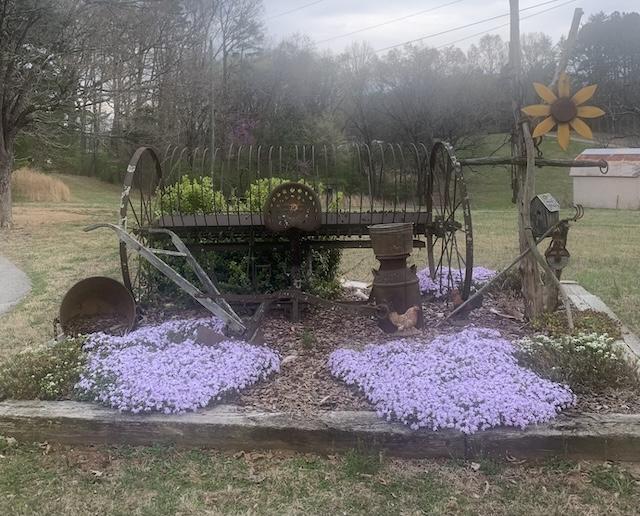
This old hay rake has some stories to tell, and my family has teased me about them most of my life. As I thought about today being April Fool’s Day, I figured this was a good time to share some humor.
The hay rake came with the little Nathan and Alice Perry farm my parents bought in 1950 in the heart of the Fork, the Knox County lands between the French Broad and Holston Rivers. The property had an old log house with a frame addition, as well as a milk house and what was left of a dairy barn that had a concrete floor. By the time I was born, Daddy had built a new house, and we used the old one for storage. I can still smell the aroma of onions and potatoes that were spread upon a table in the center of the old kitchen. For my birthday, I once got ducks for the pond that was along the old wagon road at the center of the acreage, and barrels of grain for the ducks were kept in the old kitchen too. Daddy loved the land, which included apple and pear orchards, muscadine grapes, bee hives, a couple of wooded areas, and plenty of pasture for our horse and ponies.
It wasn’t a subsistence farm, but Daddy always had a garden big enough to feed the community. He would work all day, then come home and spend the evenings out there tilling, planting, hoeing, watering, gathering, etc. We canned, froze vegetables and shared the bounty with the neighbors. One of my favorite childhood memories of summer sensations is of walking barefoot in sunlight through the rows of soft, warm soil, the scent of green peppers in the air and the sound of corn stalks rustling in the breeze. It was a good life in the Fork.
Anyway, once my brother became an adult and moved out, I was Daddy’s helper. Together, we cleared fence rows, cut trees and worked in the fields. The hay rake was originally double-tongued and built to be pulled by livestock, but Daddy had converted it to a single-tongue to be pulled by our tractor. My job was to perch upon the seat and use the lever to raise and lower the tines as needed to rake hay.
One day as we bumped across a slanted field, the tongue broke, catapulting me toward the rear end of the tractor. I must have looked like a cartoon character with my legs churning in the air, because I somehow managed to land beside the tractor wheel instead of eating the hitch. In my shock and alarm, I hit the ground running. Daddy stopped the tractor, jumped off and chased me to see that I was OK, then he and I stood and laughed.
After I started college, Daddy traded the hay rake to a man who saw it when he delivered a load of manure as fertilizer. By the time I got home from classes, the deal was done, though the man hadn’t yet returned to get the hay rake. I was heartbroken. I wanted that old hay rake. Daddy could only remember the man’s last name, which was something common like Jones or Smith or Johnson, so I started through the phonebook calling people by that last name and asking whether they had just traded a load of manure for a hay rake. Of course, it sounded like a joke, so the conversations were amusing. But I was dead serious. When I finally got the right man, he only would agree to let me keep the hay rake if I gave him another 10 dollars. I mailed him a check. Yep, I’m that kind of sentimental fool. He made money off of me and the rake had never left the farm.
The hay rake sat in one spot on the farm for decades, saplings and honeysuckle vines consuming it. After my parents passed and I moved back to the Fork, my husband and I wrestled it from nature’s grasp and hauled it home, and it is now the centerpiece of a flowerbed in our yard, my childhood memories not to be forgotten in the Fork.
-
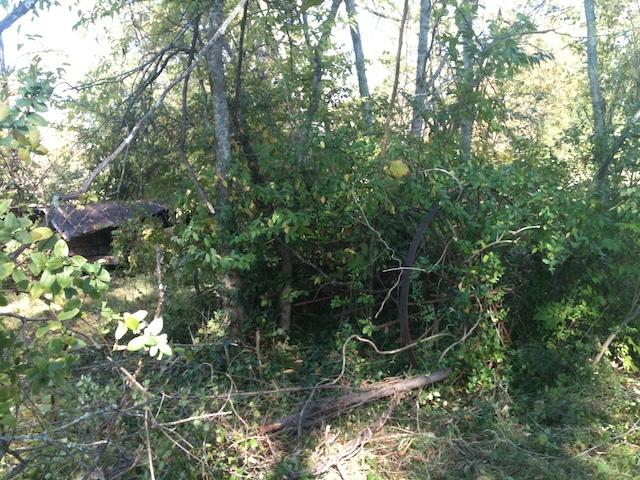
- It’s in there!
-
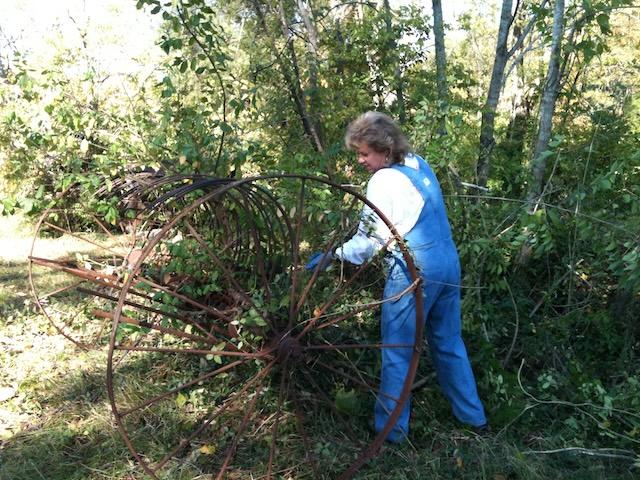
- Rescuing the hay rake
Jan Loveday Dickens is an educator, historian, and author of Forgotten in the Fork, a book about the Knox County lands between the French Broad and Holston Rivers, obtainable by emailing ForgottenInTheFork@gmail.com.

