
As we continue to move toward our nation’s semiquincentennial, I am focusing on the Revolutionary War effort of attaining independence and the related contributions and connections from folks of the Fork, the Knox County lands between the French Broad and Holston rivers.
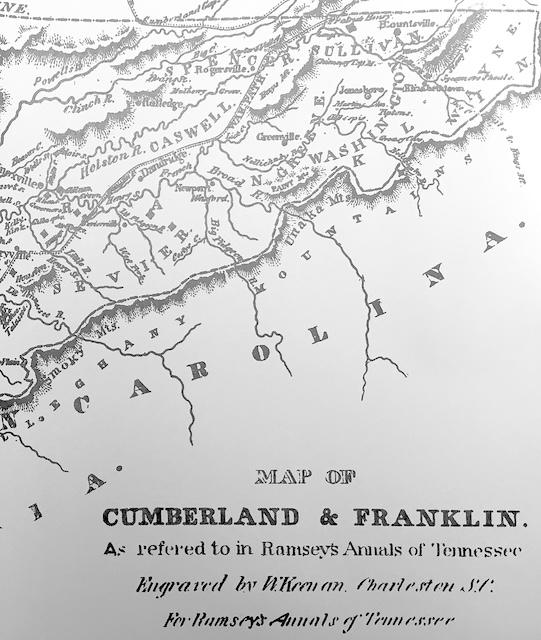
Portion of map of early stations included in J.G.M. Ramsey’s Annals of Tennessee to the End of the Eighteenth Century
My article last week told how Andrew Evans didn’t cease firing after white flags were raised at the Battle of King’s Mountain, and mentioned that he had a continued history of diligence with a gun. Evans’ pension application tells that though he and others were honorably discharged and were home by November 1780, they were immediately called again to serve for three months under Col. John Sevier in pursuit of the Cherokee, who had been making raids while the frontiersmen were away from home.
Additional military records show that Andrew later served, along with other Evans men, as part of the mounted infantry of Knox County Hamilton District Militia in the early 1790s under James White, who led pursuits of warriors during Cherokee conflicts with the early settlers. At that time, the historic Hamilton Superior Court District included Knox and Jefferson counties.
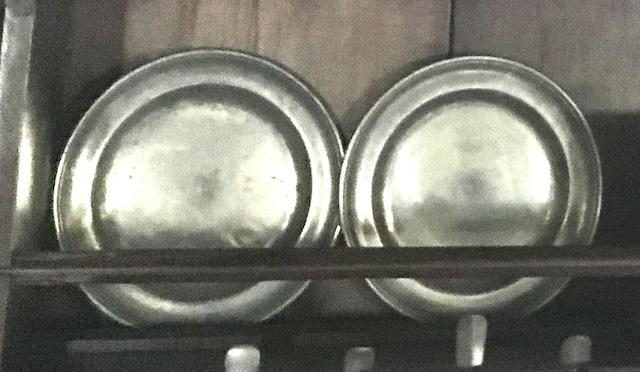
As mentioned in my earlier articles, settlers often took shelter in area block-houses when their safety was threatened. During one of those attacks, Andrew ran out of lead for bullets, but that didn’t cause him to cease firing. He quickly had his wife to melt their pewter plates to mold more bullets. He continued to shoot through the station’s portholes until the enemy retreated, and thus saved his family’s lives with their dinner plates.
In his Annals of Tennessee, J.G.M. Ramsey stated that in 1794, Andrew Evans was a magistrate for the Hamilton District, to which Sevier County was added at that time. Evans’ pension papers further show that he moved from Knox County to Kentucky, where he resided for 27 years before spending the remainder of his life in Indiana. He died at age 80 on December 2, 1840.
Did Andrew Evans ever actually live in the Fork? I can’t prove it, but Ramsey noted in his autobiography that he recalled from his childhood (which would have been the very early 1800s) that “the remains of an old house built by a Mr. Evans” stood in the Fork on property eventually owned by Ramsey’s daughter. Andrew had married Elizabeth “Betsy” Fain (Fayne) in 1780, and the sons born while they lived in this area were certainly old enough to have started families here, where much of the Evans’ heritage has been forgotten in the Fork.
Jan Loveday Dickens is an educator, historian, and author of Forgotten in the Fork, a book about the Knox County lands between the French Broad and Holston Rivers, obtainable by emailing ForgottenInTheFork@gmail.com.
Follow KnoxTNToday on Facebook and Instagram. Get all KnoxTNToday articles in one place with our Free Newsletter.

