

Most “groupies” follow a band. Not me. I followed reenactors. I had no idea when I camped among the Overmountain Victory Trail (OVT) men and their wives that I would someday be writing about it, but here I am, with photos and all. As we begin the year toward celebrating our nation’s semiquincentennial, I’m honoring the Revolutionary War veterans of the Fork, the Knox County lands between the French Broad and Holston rivers.
When I lived in Johnson City and worked and taught at Milligan University, I was a member of the Watauga Historical Society and spent a lot of time at places like the Tipton-Haynes State Historic Site and Sycamore Shoals State Historic Park. That’s where the reconstructed Fort Watauga now stands.
My John Carter chapter of the Daughters of the American Revolution hosted dinner for the Overmountain Victory Trail men, who would ford the Watauga River each year, just as their forefathers had. They would spend several days retracing the steps of their ancestors who had gathered there and then gone off to fight the Battle of Kings Mountain on October 7, 1780. I learned a lot.
In 2008, I met the OVT group at the Abingdon Muster Grounds, where I slept in the back of my SUV but enjoyed sitting around the campfire, listening to their stories. They told how Appalachian Patriots had met there in response to British Major Patrick Ferguson’s threat that if they didn’t “lay down their arms,” he would “hang their leaders and lay waste to their land with fire and sword.” Those words didn’t sit well with the frontiersmen, many of whom had ridden with John Sevier in the Cherokee Wars that began in 1776. The conflict of the Revolution was headed their way. They decided to be proactive.
The OVT men and women, dressed in period clothing and toting historically accurate supplies, told me about their individual ancestors who had participated in the journey to Kings Mountain. The next morning, we headed to the Pemberton Oak, where Col. John Pemberton had assembled his volunteer soldiers in September 1780, before other Virginia companies joined them to cross the Watauga River. The trunk was all that was left of the massive white oak that fell during a storm in 2004, but it still bore its historical marker.
The Overmountain Victory National Historic Trail was established in 1980 to commemorate what is considered to be a turning point in the Revolutionary War. Only 87 of the 330 miles the Patriots traveled are still walkable, but most of the rest can be traveled by car through Virginia, Tennessee and North and South Carolina to Kings Mountain, where Ferguson and his men, mostly pioneers who were loyal to the king, were defeated by the 1,100 Overmountain Patriots fighting for freedom. Along the way, the OVT reenactors provided educational programs for the nearby schools. We also stopped at the Sheltering Rock, an outcrop of stone, where the Overmountain militiamen had camped to keep their powder dry during a storm after leaving Sycamore Shoals. It’s located along the Doe River, near Roan Mountain Community Park.
How does all this connect to the Fork? Several of the Fork frontiersmen, who eventually brought their families to settle here after the 1783 “Land Grab Act” opened up these lands between the rivers, were there at the Battle of Kings Mountain. Alexander Campbell, whose original lands I now live on, was one of them. He was among the militiamen under the command of his kin, Virginia leaders Cols. William and Arthur Campbell, who met at the Pemberton Oak. See my January 28 article about Alexander, whose contributions to our nation’s independence should never be forgotten in the Fork.
-
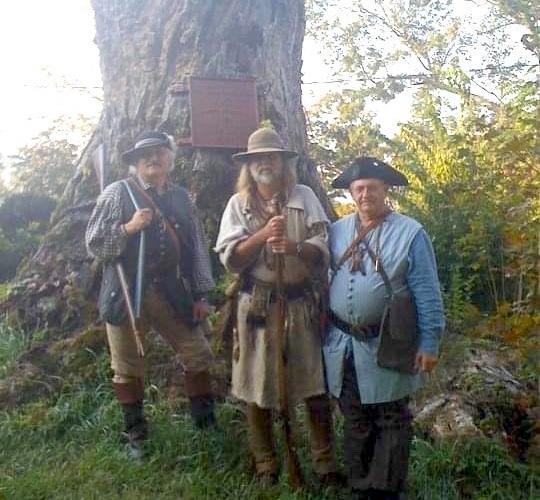
- Overmountain Victory Trail men at Pemberton Oak, 2008
-

- Overmountain Victory Trail men giving school presentation, 2008
Jan Loveday Dickens is an educator, historian and author of Forgotten in the Fork, a book about the Knox County lands between the French Broad and Holston Rivers, obtainable by emailing ForgottenInTheFork@gmail.com.
Follow KnoxTNToday on Facebook and Instagram. Get all KnoxTNToday articles in one place with our Free Newsletter.

