
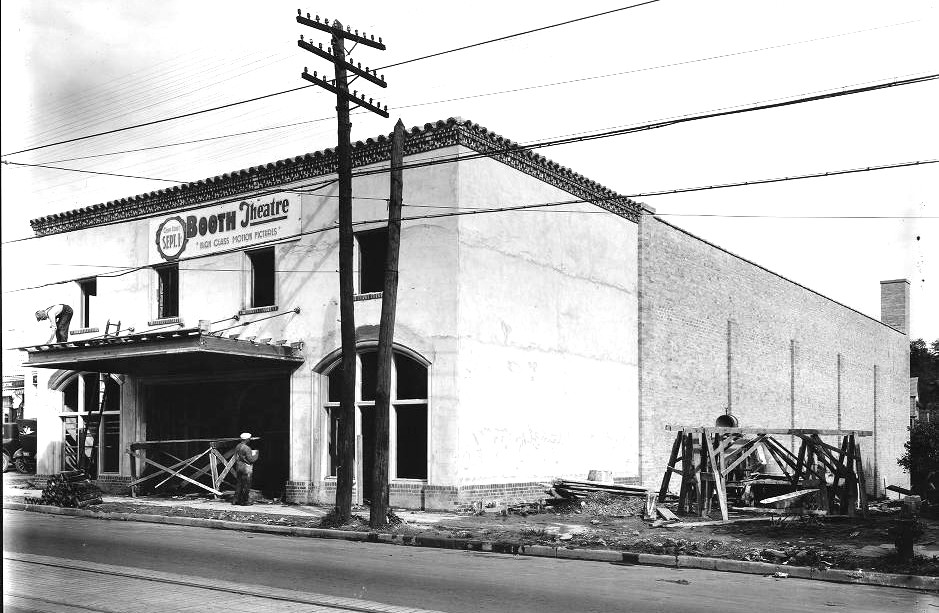
I was recently perusing the internet for a copy of Cumberland Avenue Revisited: Four Decades of Music from Knoxville Tennessee, edited by my friend and former Knoxville Journal colleague, Jack Rentfro. The retrospective on The Strip that once was contains a world of history on not just businesses closed but structures lost to the wrecking ball. Now out of print, snagging a copy will put you out about $150.
Cumberland has changed so much since it was one of my regular haunts from the mid-1980s well into the 90s that it’s hard to remember where some things used to be (see story here). There is very little left in the commercial corridor between 17th Street and the west end of Volunteer Boulevard that still has any age on it. One spot that sticks out is at 1836, currently the home of Hanna’s Café (a sister spot is also open in The Old City).
Back in my day, as we geezers say, it was the home of Flamingo’s, a popular music venue for local bands. It was the first place anywhere in Tennessee that the ever popular, ever touring PHISH performed. The building itself is closing in on a century. Construction began in 1927 on what was announced at the time as the first movie theatre in West Knoxville.
The Booth Theatre opened in late September 1928, just a few weeks before the Tennessee opened on Gay Street. There were theatres aplenty downtown at the time, but the Tennessee and Booth were two of the earliest constructed for the primary purpose of showing movies. The others (such as the Bijou) predated the talking picture era and were constructed initially for live performances.
The Booth was one of a string of theatres built or purchased/ repurposed by Edwin A. Booth, usually listed as E. A. Booth, under his Booth Enterprises. Originally from Junction City, Kentucky, he first came to Knoxville by way of Chattanooga in September 1920 to manage the Bijou. By the late 1920s, he had theatres scattered across East Tennessee, including the Grand in Lenoir City, the Moneta in Sweetwater, the Lyric in Jonesboro, the Gay in Newport, the Jefferson in Jefferson City, and the Princess and Liberty in Greeneville.
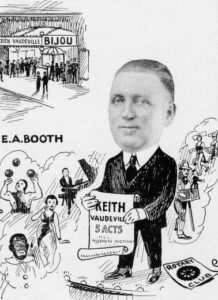
Illustration of E. A. Booth from Men of Affairs of Knoxville – 1921 (McClung Digital Collection)
Booth made a fast entry into Men of Affairs in Knoxville. The 1921 edition states that he moved to Chattanooga to accept a position as chief clerk of the North Carolina & St. Louis Railroad before later taking employment with the Signal Amusement Company. He was lauded for bringing “high class vaudeville acts” to Knoxville, and that his “sole aim” was to bring in top shelf entertainment. He was a member of the Rotary Club, Elks Lodge, Masons, Knights of Khorassan, the Board of Commerce and the Business Men’s Club.
Booth sold his Cumberland Avenue operation about a decade after it opened. He died sometime in February of 1950. I’m still looking for an obituary and gravesite. Here’s hoping his namesake theatre’s building manages to survive future development on what is no longer The Strip.
Beth Kinnane writes a history feature for KnoxTNToday.com. It’s published each Tuesday and is one of our best-read features.
Sources: The Knoxville Journal digital archives, Men of Affairs of Knoxville – 1921
Follow KnoxTNToday on Facebook and Instagram. Get all KnoxTNToday articles in one place with our Free Newsletter



Wow! Glad I’ve still got my copy of Cumberland Ave. Revisited. I wish I had bought more copies. I definitely intend to hold on to it.