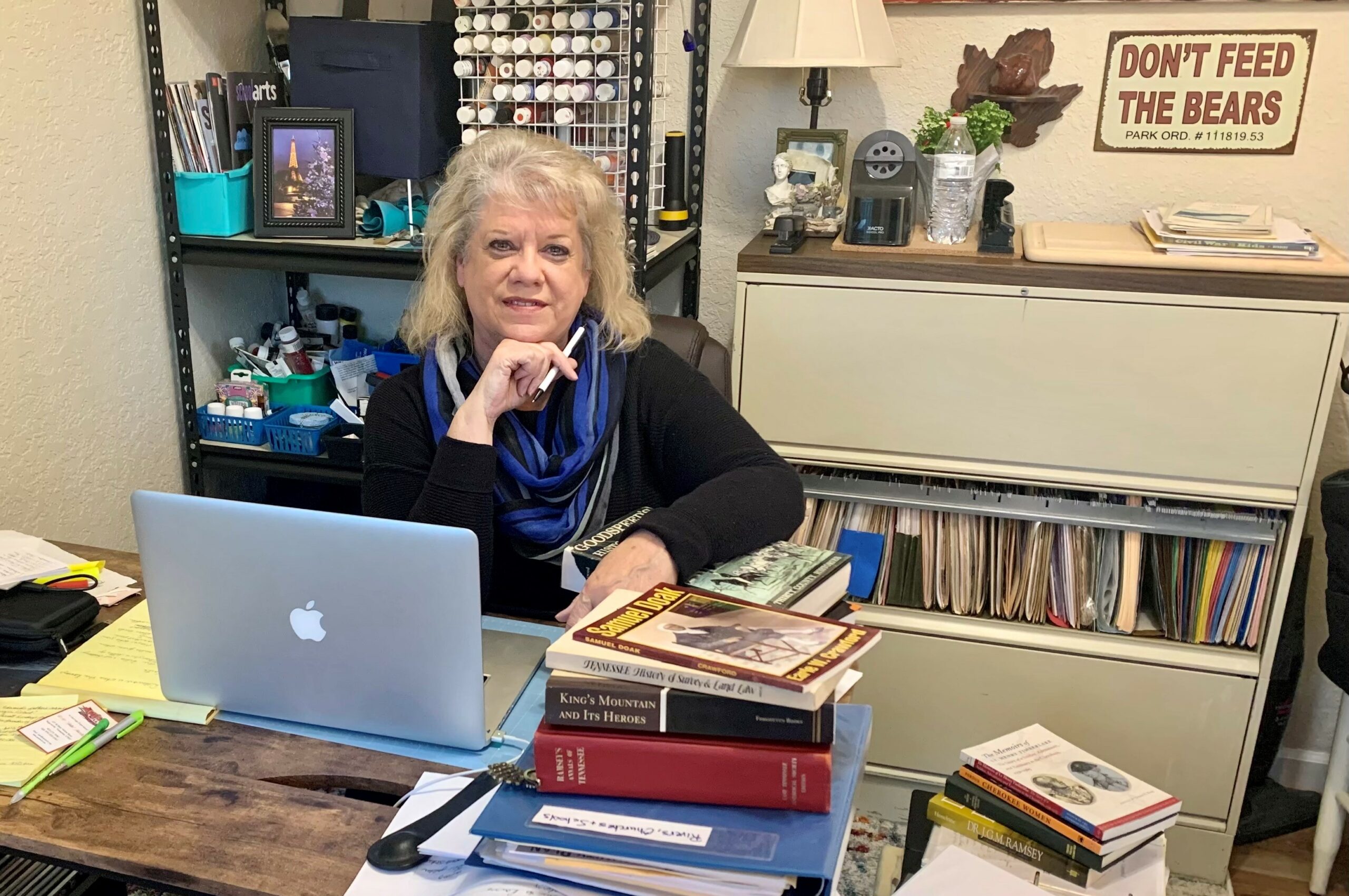
I’m obviously fascinated by the tidbits I find in the 40+ diaries of Dr. Swancey Kennedy (1844-1923), a physician who served folks between the French Broad and Holston rivers in Knox County. I’m now reading what he wrote in 1887. On the first day of January, he noted, “I wrote a letter to Washington for Andrew McMillan for forage the government took during the war.”
The War Between the States had ended 27 years before, but Dr. Kennedy was still helping his neighbors with its aftermath. As I mentioned in last week’s article, he helped disabled Union veterans complete the application process for a pension, and evidently, he’s helping other community members try to recoup some of their wartime losses. So, what was it like to live in the Fork during the Civil War?
Most people who are interested in the history of East Tennessee know that our eastern division of the state was primarily pro-Union, to the point that many of our local men followed guides into Kentucky and joined the federal army instead of just enlisting in downtown Knoxville. The pattern that I’ve seen in the Fork is that a lot of those who supported the Confederacy were already families of wealth or were on the rise in their economic status. They were businessmen or had the larger farms, usually along the French Broad or Holston rivers, while the smaller farm families in the interior of the Fork were more likely to support the Union.
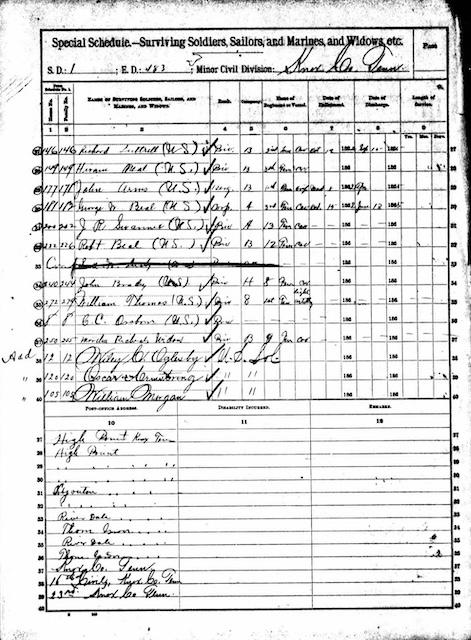
Record of a few Civil War Fork veterans and their Fork residences
When the vote was taken in June of 1861 about whether Tennessee should secede, at Ramsey’s stone house in District 17 of the Fork, 148 of the men voted against it and only 12 were for it. That must have been awkward, considering the majority were voting against secession in the very home of a Confederate sympathizer. At Lyon’s Store near where Carter High now sits, 143 voted against secession, while only 14 voted for it. Similarly in Tuckahoe, it was 246 against 18. The anti-secession total for all of Knox County was 3,196 to 752, yet pro-secession votes in the Middle and West Tennessee divisions outnumbered the anti-secession votes from the East. And in the same way that West Virginia broke away from Virginia to form its own state, East Tennessee attempted to break away from its other two divisions in 1861 but was outvoted by the rest of the state. Tennessee was the last state to secede from the Union.
In 1863, Confederate General Braxton Bragg wrote to General Samuel Cooper that they “held all roads leading into Knoxville except the one between the Holston and the French Broad, and General Jones cavalry might close that.” In other words, although the Confederates controlled all the other roads, the portion of the route that is now 11E, running through the Fork and leading toward Asheville, was controlled by the Union at that particular time. However, no matter who was in control of what and when, the citizens of the Fork were at the mercy of the troops, deserters, and renegades who came through and scavenged whatever food they could find to feed their bellies.
Because most of the men were away, farms were neglected, causing shortages. Residents protected what they could. Hams were wrapped and buried in the dirt in barns or hidden under floorboards in the houses. Sheep were herded into places such as the Sheep Cave in Marbledale. Still, crops were raided, poultry was taken, and livestock was killed by each side to feed their soldiers. In one particular instance, local Confederate leaders looking for food supplies from the top of a ridge in the Fork were seen by an alarmed Union sympathizer who took off running. They shot him in the leg, but he still died of his wounds. It was neighbor against neighbor. So, Andrew McMillan’s hay or grass “forage” taken by the Federals was only one example of what Fork residents sacrificed during the war.
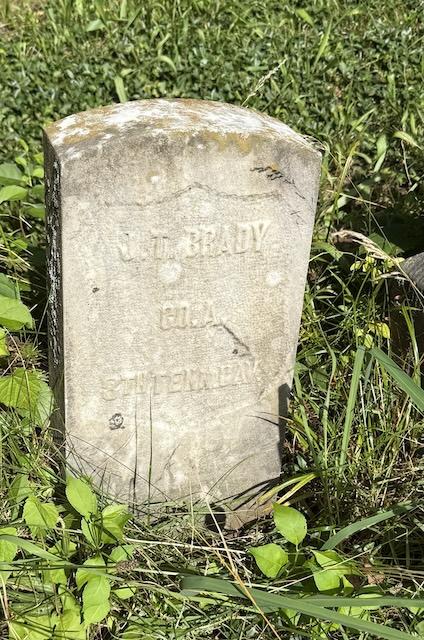
Walker Cemetery marker in the Fork for Union soldier John T. Brady (1836-1898), who served as a saddler for Company A, 8th TN Cavalry and was taken as a prisoner
Both sides lost Fork men who were buried near where they fell in battle elsewhere, though some were transported by train back to their families. Many of the Union men who lost their lives during the war, as well as those who survived, are remembered with government markers. Of the many little cemeteries in the Fork, I’ve found at least 70 Union gravestones, and I’m sure there are more that have been forgotten in the Fork.
Jan Loveday Dickens is an educator, historian, and author of Forgotten in the Fork, a book about the Knox County lands between the French Broad and Holston Rivers, obtainable by emailing ForgottenInTheFork@gmail.com.
Enjoyed this article? Read more of Jan Loveday Dickens’s stories about the people, places, and history that make the Fork community unique.
Follow KnoxTNToday on Facebook, Instagram, X, and LinkedIn. Get all KnoxTNToday articles in one place with our Free Newsletter. Comments may be sent to news@knoxtntoday.com.




Thanks for trying to send the information to my email. I have deleted a bunch of emails so it should have room now in my email. Thanks for letting me know about it being full. I am sorry about that. I would love to learn more about my family that lived in the Knoxville area. I have Walkers too that I would love to learn about. My 3rd great grandparents on the other side are Harvey and Lavina Orlena (Brooks Bunch) Walker who were buried at the Carter’s Mill Cemetery near. Knoxville (Strawberry Plains) . I am having difficulty learning who Lavina Orlena Brooks Bunch’s parents are. This family intrigues me. I won’t give up. A challenge keeps me trying harder. Thanks for your help and for teaching us about East TN’s history. I enjoy learning about it!
An excellent piece.
Thank you, kind sir!
Thank you! My 3rd Great Grandfather served during the Civil War. His name was Marcus Lafayette Smith. He was a waggoner. He was also an orphan who left his family in Burke, NC (mostly Confederates) to fight for the Union. I am still trying to find who his parents are. He was buried at Pleasant Hill Methodist Church near Knoxville and very close to the Carter’s Mill In Strawberry Plains. Oh, how I admire him. I will keep looking for his parents too. I love him so much!
Cindy, I’ve recently seen several Smiths mentioned in Dr. Kennedy’s diaries. I’ll reach out to you via email!
Cindy, the email I sent was returned because your box is full.