
Back in 1970, the National Park Service finally got around to banning the feeding of wildlife in the National Parks. What seems like a no-brainer now wasn’t exactly that in the early days of the parks, especially in the first, Yellowstone.
Bear feeding was intentionally done to keep bears in view of the tourists. Bad enough with black bears, but unfathomable with grizzlies. By the time the Great Smoky Mountains National Park came into being, the practice had ended and was actively discouraged before becoming law for most of my lifetime.
Despite this, and all the signs and the hefty fines, visitors to our park still do this. Just a month ago, the park sent out a reminder that feeding is forbidden and that rangers had responded to three incidents of bear feeding in one week. Geeze Louise. And to think the rangers can’t do a thing about the foolishness that happens outside but immediately adjacent to the park.
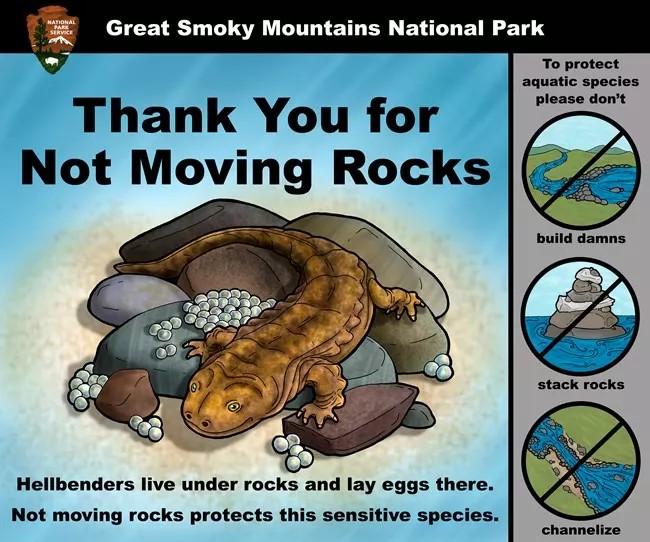
I’m beating the drum about bears because yet another issue has been raised (again) by the GSMNP in the past week – messing with rocks in the rivers and the streams, particularly rock stacking. While this activity messes with all manner of aquatic critters in the Smokies, it is ESPECIALLY detrimental to one of our prize amphibians, the eastern hellbender salamander.
The hellbender is the largest salamander in North America and can reach lengths nearly 30 inches. They are rarely seen because they are most active at night and spend their days lounging under rocks. Which is why people need to leave the rocks alone. The park posted last week that after taking down a rock cairn constructed by visitors, a crushed hellbender was found at the bottom of it.
The original range of the hellbender is in 15 states, primarily running along the Appalachian Mountains and areas immediately adjacent, plus a subspecies in Missouri and Arkansas. While there are populations still throughout that original range, the largest and healthiest population groups are in western North Carolina and East Tennessee, primarily in the park. They require clear, cool, well-oxygenated, fast running rivers and streams with plenty of rock cover.
Outside of protected areas, their existence is threatened by habit loss, pollution, and human stupidity. Inside protected habitats, its mostly just human stupidity. Well, also selfishness, because, just like “don’t feed the bears,” not disturbing habitat, at all, has been the rule for years now. But too many people just don’t care. They think the rules do not apply to them.
I often see comments to such posts by the park to the effect of “well, we did that when we were kids, it didn’t hurt anything.” No. It DID hurt things. You just didn’t know it. Cough syrup in 1900 contained heroin, cocaine, opium and/or alcohol. We don’t do that anymore, either. Point being, when you learn better, do better.
We are quickly coming upon the one-year anniversary of the devastation of Hurricane Helene. The human cost as well as recovery is the highest priority. But there was also massive damage done to fragile ecosystems, especially those that support the hellbender (learn more from Smokies Life here).
Take care of the earth, people, and all the critters in it.
Beth Kinnane writes a history feature for KnoxTNToday.com. It’s published each Tuesday and is one of our best-read features.
Sources: National Park Service, Great Smoky Mountains National Park, American Museum of Natural History, Smokies Life
Follow KnoxTNToday on Facebook and Instagram. Get all KnoxTNToday articles in one place with our Free Newsletter


I love your topics and your words, Beth. Keep on!