As we continue to move toward our nation’s semiquincentennial, I’m still focusing on elements of the Revolutionary War effort of attaining independence and the related contributions and connections of families of the Fork, the Knox County lands between the French Broad and Holston Rivers.
While I’m touting my own Fork family connections to Revolutionary War soldiers, let’s talk about the Webbs.
If you read last week’s article, you might remember how my Loveday line goes from Jesse James Loveday (who brought his family to the Fork, where he was a dynamite man in the quarry during the Great Depression) back to the Sevier County Loveday progenitor Edward. Looks like Edward Loveday married Barbara Parrott, daughter of Parrottsville founder John Parrott, another Revolutionary War veteran.
Revolutionary War veteran John Webb’s line goes down to Jesse James Loveday like this: John and Elizabeth (McMurtry) Webb’s son Joseph (Sr.) had another Joseph (Jr.), who had Perry (a Civil War veteran), whose daughter Sarah had Jocie (Oakley), who married my grandfather Jesse James Loveday.
John Webb and his brother Jesse had married sisters, Elizabeth and Anna, respectively, who were the daughters of Revolutionary War veteran Joseph McMurtry. Joseph McMurtry and his sons-in-law all lived in what was Greene County, North Carolina, before Jefferson County was divided from it in 1792 and Sevier County was divided from Jefferson in 1794 before Tennessee became a state in 1796. Specifically, Joseph McMurtry and Jesse Webb spent most of their lives in what is now Jefferson County, where Jesse was a circuit-riding Methodist preacher. He and Anna are buried at the cemetery behind Bush’s Family Café at Chestnut Hill. Jesse’s brother John received a warrant for 640 acres, and his family ended up about 12 miles away in what is now Sevier County, where their Webb descendants lived near the Lovedays. Generations of Webbs and Lovedays are buried in the Mize-Thomas Cemetery off Jones Cove Road. Webb Mountain and Webb’s Creek still bear the family name.
Like their father-in-law, brothers John and Jesse Webb had fought in the Revolutionary War. Jesse enlisted in 1781 in the South Carolina Line under Captain Robert Lusk and served under General Greene while fighting Tories loyal to the crown in the Carolinas. Meanwhile, his brother John, my ancestor, enlisted for 18 months under Captain John Steward in Georgia, where the brothers even served together at Fort Steward and at Nail’s Fort for a few months each. After returning home, John was called again and served as a spy under Captain Phillip Null.
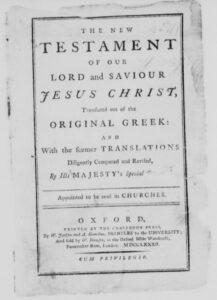
The title page from Revolutionary War veteran John Webb’s 1782 Bible
Immediately after the war ended in 1783, soldiers who had become disabled because of battle wounds could draw a pension. The first legislative act allowing Revolutionary War veterans to apply for a pension based on financial need didn’t pass until 1818, after John’s death in 1798. Another act was passed in 1832, allowing pensions to soldiers and militiamen who had served at least two years. Jesse applied in 1832, received a pension, and lived to be 81 in 1848. However, the act allowing widows to apply for a pension wasn’t passed until 1836, and each woman had to have been married to the soldier during the war but remain unmarried after his death in order to draw a pension. John’s widow, Elizabeth, didn’t remarry.
In 1844, brother Jesse, age 78, and his wife Anna, age 76, both provided testimony that Elizabeth and John had married in 1780 or 1781, while he was a soldier and that Elizabeth had remained unmarried. But they had a hard time proving her case. Even after Elizabeth’s death in February 1852, her only surviving child, Elizabeth (Webb) Baker, was still trying to get the pension approved. (John and Elizabeth’s son Joseph Webb Sr., my direct ancestor, had died sometime between 1840 and 1848, but Joseph Jr. lived until 1864.) Despite multiple testimonies, John’s pension never was awarded, probably because so many John Webbs had fought in the war, and it was difficult to tell whose record was whose.
One jewel in John’s 69-page file, though, was the record from his 1782 Bible, showing his children’s birthdates and that his oldest son was born before the war ended. While the written ink is almost illegible on the page listing his and Elizabeth’s children, the Bible’s title page is clear. Pretty cool, despite the fact that they had to tear the pages out and give them to the pension office. Little discoveries like that make my heart smile.
Although his service has been forgotten in the Fork by most of John Webb’s descendants, I hope this information makes my kin smile, too. We come from some pretty good stock with deep roots in this region.
Jan Loveday Dickens is an educator, historian, and author of Forgotten in the Fork, a book about the Knox County lands between the French Broad and Holston Rivers, obtainable by emailing ForgottenInTheFork@gmail.com.
Follow KnoxTNToday on Facebook and Instagram. Get all KnoxTNToday articles in one place with our Free Newsletter.


This was a very interesting read, thank you.
My husband is one of a small handful of John Webb’s descendants born & raised in England.
John & Elizabeth are his 7th great grandparents.
Hi. I’m a direct descendant of Jesse and Anna Webb. Both are buried just over a half mile from the church, Chestnut Hill Methodist, on the family property he owned. Buried with them are two very small children. My cousin owns the property now. The plantation burned down or fell down many years ago. Jesse’s family Bible was found behind stones in a hiding place in the stone fireplace.
Hi, Tammy! Thanks for reaching out!
I thought Jesse and Anna were buried at the church, where he donated the land. At least markers there indicate they are. Please tell me more!
With appreciation,
Jan
Dear Jan, thank you for your dedication to the area knows as the “Forks”. Growing up on Asbury Road until marriage in the early 70’s, I fondly recall the elders talking about the forks. In our world as isolated as it was in the 50’s the forks was from the boatdock and Lebanon-in-the-Fork Presbyterian church and a encompassed the local quarries where most men worked.
I learned from your talks, books, etc. the area is much larger than I ever dreamed. However, being less enlightened does give one pause. My Forks is not the same as the majority.
Respectfully submitted. Judy Vest
I get it, Judy! I thought the same thing until just a few years ago when I got serious about the research. I have been stunned by all the references I’ve found to the Fork including Huckleberry Springs, Thorn Grove, Carter communities, etc., everything in Knox County between the French Broad and Holston.
I guess I’ve reconciled it in my mind by considering the larger mass of the Fork to include the area a lot of people call the Forks!
Judy, I hope you don’t think I’m saying that John Webb lived in the Fork. I’m just writing about Revolutionary War soldiers whose descendants later moved here! I don’t know of any Revolutionary War soldiers who actually could have lived in the Fork while the war was going on! The area was opened up the year the war ended. However, the men who then moved here and rode with men like John Sevier after the war did receive Revolutionary War pensions.