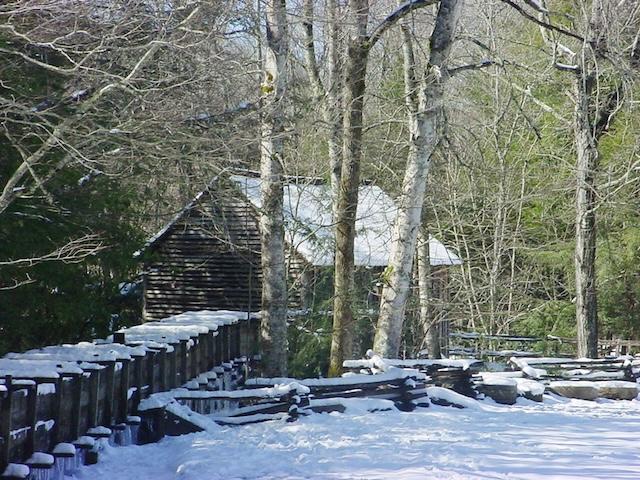
In 1868, John P. Cable built a grist mill on the same grounds on which the Cades Cove Visitor Center is presently located. The mill stands in the same location today.
In the early days, the residents did not have a grist mill to have their corn ground into meal or their wheat into flour.
Ladies would place their corn on a hard surface and then pound it with a rock. Can you imagine what your hands would look like after preparing enough cornmeal to feed a family of eight or more? Through the years that people were living in Cades Cove, families tended to have many children. A few families built tub mills; however, only small amounts of corn could be ground in those mills, it took a lot of time, and the corn meal was not of top quality.
The operations of John Cable’s mill were powered by a water wheel, which was described as an overshot water wheel. An overshot water wheel is fed water from above after coming through the sluice. The water wheel is covered with vanes, and the weight of the water causes it to rotate as the water falls into the vanes. What is called a race carries the water to the sluice from two streams (Mill Creek and Forge Creek).
-

- Runner Stone John Cable Grist Mill
-

- Shoe on John Cable Grist Mill
-

- Hopper on the John Cable Grist Mill
The water wheel is attached to an axle that, through a series of gears, turns the top millstone, called the runner stone. The runner’s stone turns 25 times every time the water wheel turns one time. Below the runner’s stone there is a stationary stone which is called the bed stone. If a person wanted their corn meal fine, the miller would move the runner stop (top stone) closer to the bed stone (bottom stone). If you wanted your cornmeal course, the miller would move the top stone further from the bottom stone. The movement of the runner’s stone was moved by what looks like the device that you would see on the top of a railway car that is used by train crewmen to stop a railroad car from being switched into a side track. To me, this device looks like a car’s black steering wheel.
While the miller was grinding your corn you would see him sniffing the corn meal every so often to be sure that he was not scorching it. If the corn meal is ground too fast it is likely to be scorched. This action by the miller was where the expression “keeping your nose to the grindstone” originated.
The residents of Cades Cove were considered to be very productive (cando people). Mr. Cable built the mill to do three things: ground corn, ground wheat and cut wood. Only one of these three functions could be done at a time (all powered by the water wheel).
When a resident went into the mill the miller would take his corn and pour it into a device which is open on the top and wider at the top. This device is called the “hopper”. The corn comes out the bottom into a device called the “shoe”. The shoe looks like your hands cupped together (bottom of your hands facing upward). The shoe is vibrated by a wooden stick that is called the dimsel rod. The corn falls into a hole on the top of the runners stone and is then ground between the two stones.
The saw used to cut lumber was called a sash saw. It went up and down, and the wood was cut as the blade went down. The wood used to build the Becky Cable house, currently located on the visitor center grounds, was cut in the mill.
Today we likely pay for our corn meal, flour, or wood by cash, a check, or a credit card. In Cades Cove, few people had money, checks were unheard of, and there was no plastic to be found. If you had your corn ground, the miller would be paid by either corn or corn meal. For example, the miller would give you seven scoops of cornmeal and keep one for his services. If you had wood cut, the miller would take one board out of twelve as compensation.
Most of us can go to the store for cornmeal or flour seven days a week, any time between 6 a.m. and midnight. If you were living in Cades Cove and needed to have corn ground you normally would go to the mill on Saturday morning.
While you were waiting for your turn, you would visit with other people waiting for their turn. This is where the expression “milling around” originated. If you needed corn at another time, there was a bell attached to the side of the mill that you would ring to alert the miller to come to the mill to grind your corn.
As we compare our lives with those of the residents of Cades Cove, we might agree that our lives have it much easier with more conveniences than the citizens of Cades Cove. May we count our blessings and be thankful
Tom Harrington is a regular hiker who reports on his hikes and mountain stories from the Smokies.
Follow KnoxTNToday on Facebook and Instagram. Get all KnoxTNToday articles in one place with our Free Newsletter.

