

In 1818, the United States government and the Cherokee Indians signed the Calhoun Treaty, which opened Cades Cove to Anglo-Saxon settlers.
At the time, John and Lucretia Oliver were living in a rented property in Carter County, Tennessee, about 100 miles east of Knoxville. John Oliver had fought in the War of 1812 with a fellow named Joshua Jobe. Joshua, who was now a land speculator, made an offer to John whereby if John and Lucretia moved to Cades Cove, they would be given supplies to farm and land to live on.
Their only obligation was to send back a report that would encourage others to buy land in Cades Cove and move there.
In November of 1818, John, Lucretia, and their baby daughter Polly arrived in Cades Cove. (The Calhoun treaty was not to be effective until 1819.) Ladies, what would you think if your husband moved you to a remote wilderness area where there was no store, doctor, school, church, postal service, friends or relatives, and no communications with the outside world, and where there were natives that might be a danger to you and your baby? It was said that John had lost his fear of Indians because of his observation of the bravery of Andrew Jackson in the battle of Horseshoe Bend.
The Olivers settled in an abandoned Cherokee hunting cabin. In 1826, John built a home that still stands in Cades Cove. The cabin was about 20 feet by 20 feet, and a loft covered the first floor. The Olivers reared seven children in this structure. John and the three sons slept in the loft, and Lucretia and the four daughters slept on the main floor.
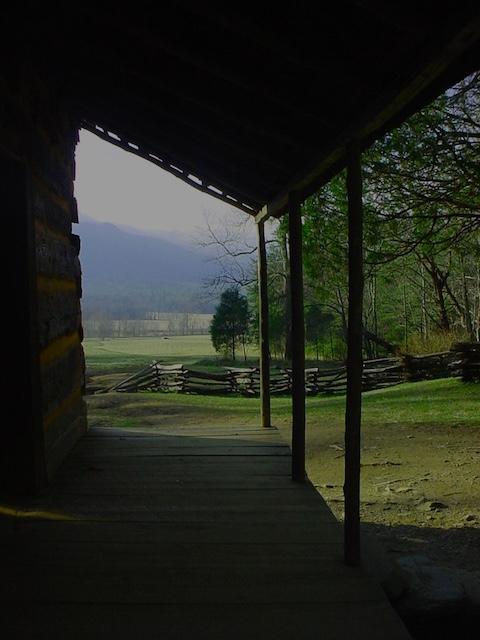
John Oliver Cabin porch
Meals were prepared on the fireplace. Can you imagine cooking in that fireplace in the summer months with no air conditioning while wearing a dress that went up to your neck, down to your ankles, and with sleeves that reached to your wrists?
Around 1912, a kitchen was added onto the house (no longer there), and there were two porches attached to the house, one window on the main floor, and three doors to the outside (for such a small structure, most likely for ventilation in warm weather and for light). In front of the fireplace, one can see what looks like a trap door. Today we call this the root cellar. In those days, it was called “The Tater Hole”. In one of the outside doors at the bottom, there is a four-inch-square opening called the “cat hole”. Cats were very important in order to deal with rodents.
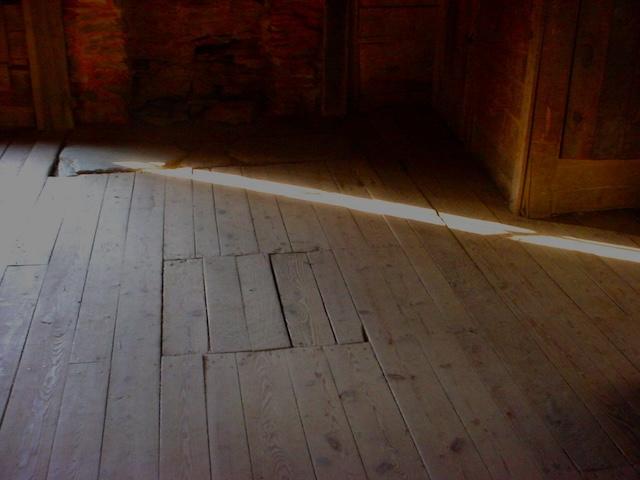
Root Cellar-Tater Hole
The first winter was cold and harsh, leaving the Olivers dangerously low on food. You will remember that they moved to Cades Cove in November, which meant that they did not have time to grow crops that season and would only have what they brought with them in their wagon. Happily for the Olivers, the Cherokee Indians were very civilized and provided them with dried pumpkin to eat and to survive the first winter. It was said that John was so touched by this act of kindness that from that point on, he grew pumpkins. The story goes that one year, he had such a large crop of pumpkins that one could walk from one side of the field on top of the pumpkins without touching the ground.
One can only imagine the hard work the Olivers put in to survive in this remote setting. The land in Cades Cove is fertile and porous, and the average rainfall in the cove is 50 to 60 inches a year, so residents of Cades Cove fared much better than their counterparts in other parts of Appalachia. By 1850, it was reported that 685 people (132 families) resided in Cades Cove.
When we experience challenges, it might be well for us to remember the Olivers and others who lived in that day and time.
Tom Harrington is a regular hiker who reports on wildflowers in the Smokies.
Follow KnoxTNToday on Facebook and Instagram. Get all KnoxTNToday articles in one place with our Free Newsletter.


It would be interesting to learn more about the families who lived in the house after the Olivers. Or did their children stay on?