
The term “blended” conjures up connotations: blended family, blended worship, blended learning. Similarly, the Concord/Farragut community is considered a “blended” community’ by some. To older residents, Concord was conceived as the community and Farragut as the school. However, since the incorporation of the town of Farragut in 1980, newer residents simply refer to the community as Farragut.
The early history of Concord, however, recounts various overlapping communities through time. The communities of Blue Grass and Ebenezer are often inclusive with the community of Concord. It is interesting to note, however, that Ebenezer was once recognized as having its own place on the map, complete with its own post office and known as Ebenezer Station.
Today, the Ebenezer area boasts the zip code of 37923 in Knoxville, but there are historical landmarks still standing from when the land was initially a part of the Campbell Station outpost and later, Concord, Tennessee.

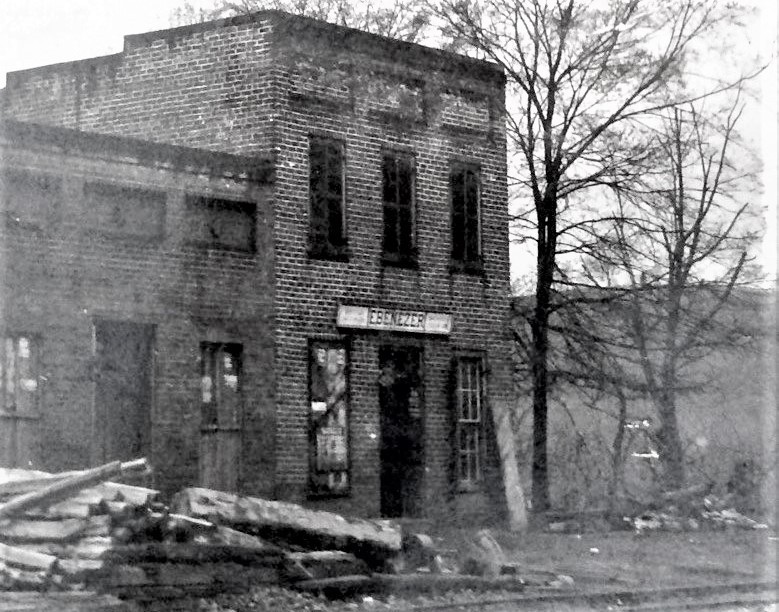
An unidentified man visits with T. L. Peters (right) at Ebenezer Station circa 1910 – Photo courtesy of Ellen Peters Morrison
In 1796, Ebenezer Presbyterian Church (and cemetery) was formed and was the forerunner of today’s Cedar Springs Presbyterian Church.
The Ebenezer Post Office, initiated in 1858, was added onto an existing store and railway depot. Earlier owners included Elijah S. Parsons and later, T.L. Peters (appointed postmaster in 1905). The Ebeneezer Post Office continued to be operated until it was transferred to the Concord Post Office in 1936.
The Ebenezer Mill, built circa 1870, sits on the banks of Sinking Creek at 411 Ebenezer Road. Once a turbine mill for grinding corn and wheat, it is now recognized on the National Register of Historic Places.
And not to be overlooked, one of the main roads heavily traveled through that area today is Ebenezer Road!

Ebenezer Mill
As often occurs in history, names of locations and landmarks have an origin. As in the case of Ebenezer, the above landmarks were named after Ebenezer Byram/Biram III. The story of his family migrating from England and how he happened to end up in Tennessee is intriguing. His second great grandfather, Nicholas Byrum II, was born in England but was removed to Ireland as an infant. When his son, Ebenezer Byrum Sr., was only 16, Nicholas entrusted a friend to take young Ebenezer to visit friends in England. The chaperone, however, was not to be trusted and instead robbed him and delivered him to the West Indies, selling him as an indentured servant. Young Ebenezer was generalized as a white working-class immigrant, and, after he had worked out his debt for passage, he traveled to Bridgewater, Massachusetts.
Ebenezer Sr. and his father were founding members of the Church of Christ in Bridgewater, and he owned two plantations of considerable value. The Byrams were considered by townspeople to be “new lights” (immigrants) and as such were denied use of the church when Ebenezer Jr. was to marry Abigail Alden of Mayflower lineage. This scorn influenced his move to New Jersey where he continued to be active in the Presbyterian Church and owned the “Black Horse Tavern.”
By 1771, Ebenezer III was enamored with the call of the beautiful North Carolina mountains and purchased a land grant, now a part of Tennessee, and was one of the first settlers in Greene County. Shortly after arriving in the North Carolina/Tennessee area, he bravely fought in the Revolutionary war and is recognized as a Patriot for his service. He eventually settled along the Sinking Creek area and built a cabin in 1792. History accounts his fight with the Creek Indians over his homestead, but he persevered. He entered the war of 1812 and survived but died in Knoxville in 1827. The remains of this gallant Patriot are at the Caledonia Cemetery in Knox County.
Mona Isbell Smith is a retired computer systems analyst who enjoys freelancing.






Thank you for any help you can offer
Hi there. Thank you so much for any help you can offer. I do appreciate it very much.
I have heard from Robert McGinnis who is an author of many books “Asleep in Jesus” and he asserts that there is no record of Ebenezer Byram III buried in the State of Tennessee. My source for his place of burial when writing my article was from Findagrave which, apparently, can have erroneous information. In addition, he states that Old Caledonia has never seen a reinterment of remains from another cemetery; last recorded burial there was in 1917. I would value Mr. McGinnis’ opinion over those who would post on Findagrave.
I would add that Ancestry and Newspaper.com have information of the Byrams relocating to Alabama and of interments in Jordan Cemetery, Jackson County, Alabama. As I am finding out, one must do their own due diligence in vetting information found on Findagrave; I would proceed with caution in any assumptions of accuracy. Probably the safest hypothesis would be that he was buried in an unmarked grave in a family cemetery, probably around Beaver Creek. If you have connections with the Daughters of the Revolution, that might be a good place for verification that includes well-established sources. I am not a member and do not have access to their database. I hope this will assist you with additional insight into your research. Wishing you all the best.
Thank you so much for your answers. My next thought was Robert McGinnis. Mr. Byram is not listed at McClung not in Robert’s books. It is a mystery indeed. You mention Beaver Creek and I am confused about that as well. I noticed that Beaver Creek was mentioned on several first family records at McClung,however other things I have read stated Beaver Creek does not connect to the ten mile or sinking creek near where Ebenezer the 3rd settled. Do you have any insight on that?
Hi Mona. Doing some research of Ebenezer Road and family. Do you know the reason why Ebenezer Byram was buried in East Knox County?
Hi Jamie ~ I cannot answer your question with certainty, but I do have a theory and it’s only that. Findagrave.com has an excerpt from Nephthali Bryam who was a brother to Ebenezer III. He said that the location of Ebenezer’s grave was uncertain but it was “close to Beaver Dam Creek in Knox County” And then he placed in parenthesis “their own land”. I only know of two Beaver Dam Creek’s in the State of Tennessee. One is in Robertson County and the other Hickman County. There is, however, a Beaver Creek in Knox County that is close to the Oak Ridge area. Parts of the Byram family lived previously in the upper northeast portion of East Tennessee/North Carolina. This is the area where the Overland Mountain men lived which was the beginning of the formation of the Watauga Settlement. But I digress. Old Caledonia Church, on Ruggles Ferry Pike, is quite a distance from Beaver Creek in Knox County where Ebenezer died. Since Ebenezer was also a Revolutionary War Patriot, my theory is that he was initially buried on his land, probably the family cemetery. I have read of other Revolutionary Patriots that were disinterred and moved to Old Caledonia Cemetery and it is possible that he was later placed with other Patriots there. I will reach out to Robert McGinnis who is an authority on cemeteries in Tennessee as well as Robbie Peters Hendon who grew up in the Ebenezer area and her roots are with the early Cedar Bluff church to see if they can provide any additional information. Thank you for your interesting question. Hopefully we can answer it more completely with their help.