
In late October 14 years ago, I decided to go on a day trip to the other side of the Great Smoky Mountains National Park. I hadn’t been back in Knoxville even a year yet, and my work schedule was about to get busier. I took off on a weekday hoping for slightly reduced crowds. Fall colors were still showing but past peak.
To borrow from Samwise Gamgee in The Lord of the Rings, instead of going to Rivendell to see the elves, I was going to Cataloochee to see the Elk (but the Smokies are our Rivendell, really). As it turns out, I could have spared myself a bit of trouble by just going over 441 to the Oconaluftee Visitors Center near Cherokee, North Carolina. I didn’t know parts of the herd had migrated over Balsam Mountain to an easier access point.
Not that I regret going to Cataloochee, exactly. Other than Big Creek, I hadn’t spent much time in that part of the park. A good stretch on the most treacherous part of the road into the Cataloochee Valley isn’t paved and really not wide enough for two-way traffic. The valley reminded me a lot of Cades Cove, minus a loop road. It was beautiful and enchanting, and there were elk everywhere. Bulls were bugling, tourists were touristing (mostly on their best behavior), but one touron nearly ruined my day.
It’s one way in and out of the valley, the speed limit is 15 miles an hour and there are elk, tourists and grandmas on bicycles to watch out for. I had one of the latter in front of me on my way back out, doing great but determined to remain dead center in the lane. Behind me there was an impatient numbskull in a large and jacked up pick-up truck following entirely too close. He could easily see the lady on the bike in front of me.
Up ahead I saw a graveled manway to my left, so I decided to pull in, let the traffic pass, then pull back out and be on my merry way. Everything was fine until I went to back out. There was a horrid crunch and my car ground to a stop. I thought I had hit a pole. Nope. I tried to pull forward. Also Nope. I got out and found that, somehow, I’d hit a boulder buried deep beneath the gravel in the perfect way to make it pop up and wedge between my tire and wheel well. Extreme consternation ensued.
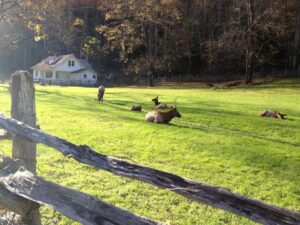
Elk in the Cataloochee Valley, October 2012 (Photo: Beth Kinnane)
Helpful passersby went to round up a couple of rangers for me. It would take hours for a tow truck to get there, so we had to figure something out. It was a group effort, but with the cunning use of jacks, crowbars and shovels, we eventually got my car freed from the rubble, and I was on my way back home.
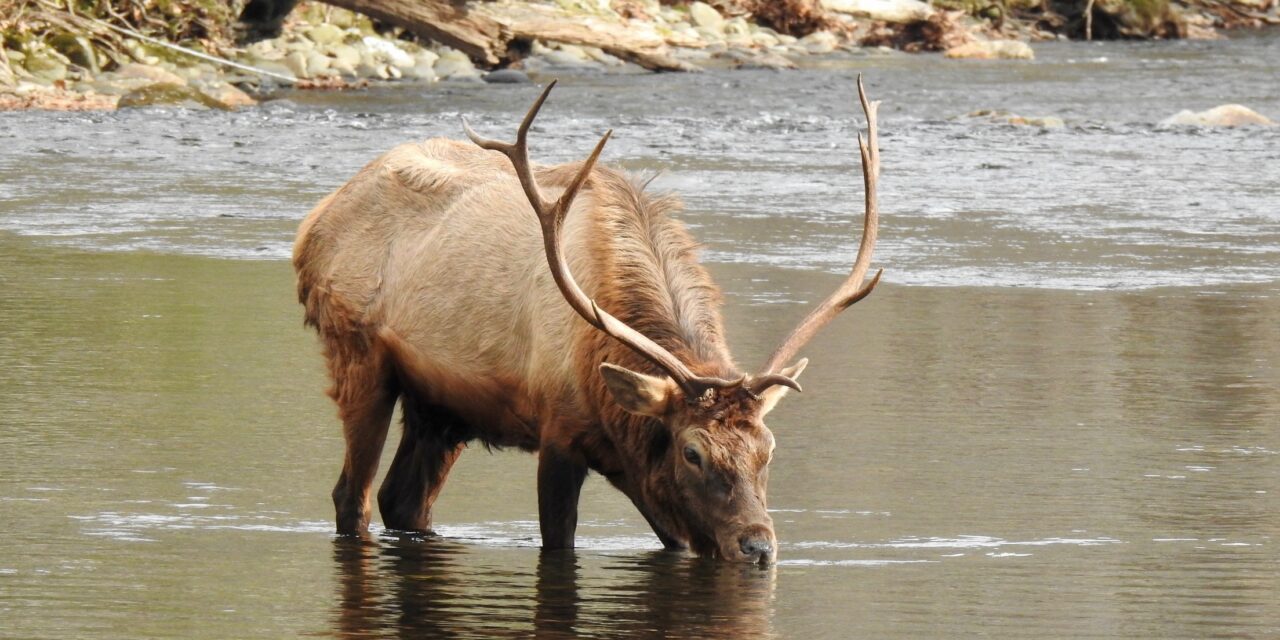
Nowadays when I want to see the elk, I do just pop over to Oconaluftee. There are elk jams there just as there are bear jams in Cades Cove. A few years ago, I took a friend over the mountains to see them. We stopped at the Visitors Center, and as we were heading down the river trail I was getting my camera ready. I told him the money shot was to catch the elk in the river, extra points if it’s a big bull. No sooner had the words left my mouth, there he was.
We probably watched that big bull for 15 minutes before he made his way across the water to the Cherokee side of the river. We walked the rest of the trail, and as we were heading back, the lion’s share of the herd came thundering across the field towards us. We picked up our pace and hugged close to the trees. Tourons we would not be.
The elk have been in the Smokies now for 25 years. I got to thinking about them as we approach the second anniversary of the damage wrought by Hurricane Helene. The Cataloochee elk weathered the storm far better than the valley they call home. While the area and its campground reopened after six months, there are still swaths of the Cataloochee and Balsam Mountain area that are closed or marked “proceed with caution” at best.
Sources: Knoxville Journal digital archives, Great Smoky Mountains National Park
Beth Kinnane writes a history feature for KnoxTNToday.com. It’s published each Tuesday and is one of our best-read features.
Enjoyed this article? Read more of Beth Kinnane’s stories about the people, places, and history that make our community unique.

