
Dr. Swancey Kennedy (1844-1923), and his 40+ diaries give us a peek into life in the late 1800s in the Fork, the lands between the French Broad and Holston rivers in Knox County.
I slowly walk through Huckleberry Springs Cemetery (originally Whortleberry) in the new day’s light, looking for a particular stone. Patches of moss are still spongy with the morning’s rain, and the wet grass and periwinkle (or “cemetery vine”) soak my tennis shoes. The child’s name was “Haly,” as written by Dr. Kennedy on September 24, 1887, and she was “John Stinnett’s girl.” She had just died of typhoid fever. The next day, the good doctor “went to Whortleberry to see to digging Haly Stinnett’s grave.”
As I read the old grave stones, I’m hit with the realization that I feel like I’ve known these people, the names I’ve come to recognize through Dr. Kennedy’s diaries. The babies Dr. Kennedy delivered, and the moms and dads who fretted over their infants’ health when they were teething or later took them to have an arm set when they broke one. And the old Civil War veterans Dr. Kennedy helped with their pension applications. The preachers he heard preach. The neighbors he “took dinner with.” And the ones he ministered to in their last days. I feel like I’ve been part of that late 1800s community, and I’ve become attached to these neighbors as I read about their lives. Seeing their names on headstones makes me wistful.
In the weeks before and after Haly’s death, Dr. Kennedy made several diary entries about additional Fork patients who had typhoid fever. Most lived, but the disease had become all too common. Articles by the Scientific American at the time addressed concerns of related contagions and how to disinfect “privy vaults,” and anything associated with “alvine discharges” with antiseptic germicides. A doctor with the French navy touted how coffee could be a cure.
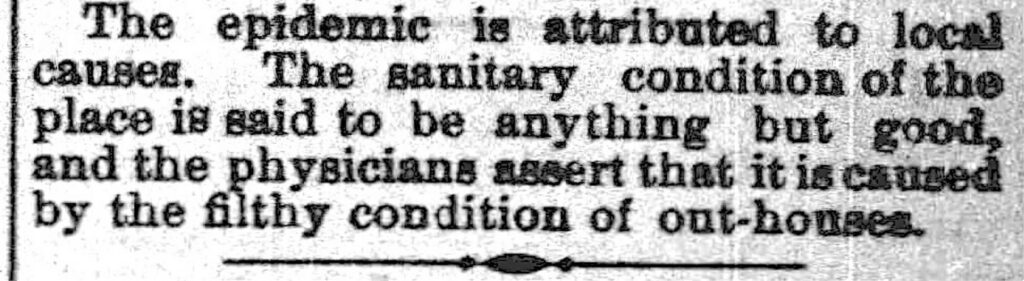
Typical news statement about typhoid
Another article cited how Major General Artemas Ward of the Revolutionary War once described “the laziest man he ever knew as one too lazy to go to the spring after water and would take the tea kettle off the fire and cool the water for drinking,” only to conclude that “the course of the lazy man may have been in accord with the highest wisdom.” By that time, the scientific and medical communities had realized a little bit about what contributed to such epidemics. The article goes on to say that droughts followed by heavy rains caused water supplies to become filled with organic material that caused typhoid fever and that boiling water was a preventative measure, making the claim about coffee a little more meaningful.
People who insisted on drinking ice water were admonished to get only ice made from distilled water, because ice that came from river water would still contain typhoid bacilli, which low, freezing temperatures wouldn’t kill. Typhoid fever was more common on rural farms, where wells became contaminated because of poor drainage, or none at all, in relation to privies and “slop holes.”
Tonics such as Duffy’s Pure Malt Whiskey and Darby’s Prophylactic Fluid were advertised as cures for typhoid fever, while using black pepper, mustard, and vinegar in the diet were believed by some to help with prevention. When a home was known to house a typhoid patient, sometimes the street was taped off to prevent anyone from passing by and breathing the air. Typhoid was a scary diagnosis for all.
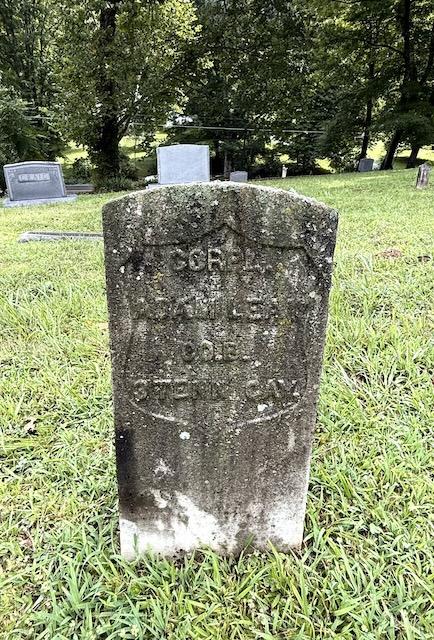
Civil War marker for Adam Leak, whom Dr. Kennedy helped secure a pension and who was close to the Stinnett family
We don’t know what caused “Haly” to contract typhoid. I never found her grave. In fact, I didn’t find any Stinnett stones at Huckleberry, although I know the family had close associations with others buried there. As I walked among the fallen hickory nuts and walnuts scattered under the trees, I wondered whether her name was actually Mahala, for which “Haley” is often a nickname. I don’t even know how old she was.
They say we all die twice, the second being the last time our name is spoken. Even though I couldn’t find her, I spoke her name so that she is not yet forgotten in the Fork.
Jan Loveday Dickens is an educator, historian, and author of Forgotten in the Fork, a book about the Knox County lands between the French Broad and Holston Rivers, obtainable by emailing ForgottenInTheFork@gmail.com.
Enjoyed this article? Read more of Jan Loveday Dickens’s stories about the people, places, and history that make the Fork community unique.
Follow KnoxTNToday on Facebook, Instagram, X, and LinkedIn. Get all KnoxTNToday articles in one place with our Free Newsletter. Comments may be sent to news@knoxtntoday.com.