Halls has changed considerably since Thomas Hall arrived in the valley more than two centuries ago, but tucked inside the Halls Crossroads Historical Museum are reminders of the people, places and everyday life that made the community what it is today.
The museum at 7119 Afton Drive is not about history from somewhere else. It is unmistakably Halls history — the schools, businesses, churches, families, photographs, newspapers and familiar names that generations of residents remember.
And much of what is being preserved might have disappeared if people in the community had not decided it was worth saving.
The museum traces its roots to longtime Halls historian Hubert LaRue, who spent years collecting photographs, artifacts and family histories. LaRue grew up hearing stories of Halls from his father, Bennett LaRue, and eventually began collecting stories and photographs himself. His collection grew into thousands of images and other pieces of local history.
The Halls Crossroads Women’s League established a preservation committee to help protect that collection. Working with the Halls High Alumni Board of Directors, volunteers spent six months in 2018 digitizing LaRue’s photographs and creating an index. About 3,200 photographs were ultimately digitized. LaRue died in 2021, but the collection he built became the foundation for the museum that followed.
An opening walk through the museum to give readers a sense of the collection and space.
Before there was Halls
One of the museum displays takes visitors all the way back to the beginning.
In 1785, the North Carolina General Assembly directed militia members to clear a road toward Nashville wide enough for wagons and carts. Part of that early route became what we know today as Emory Road.
Thomas Hall arrived from Orange County, North Carolina, around 1796. A Revolutionary War veteran, Hall had been captured by the British during the Siege of Charleston and held as a prisoner of war. He eventually settled on land north of Black Oak Ridge.
Two generations later, his grandson Pulaski Hall returned to the area after heading west during the California Gold Rush. Pulaski and his family operated a general store, inn and blacksmith shop near the intersection of Emory Road and what was then Jacksboro — later Andersonville — Pike.
The store became known as Halls Crossroads, giving the growing community its name.
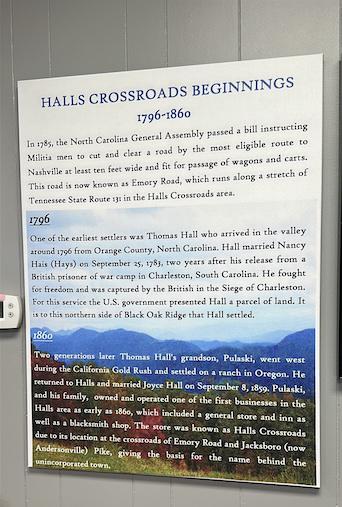
Halls Crossroads Beginnings, 1796-1860
That history is displayed prominently inside the museum, but the collection does not stop with the community’s founding.
The Halls people remember
Part of the appeal of the museum is that its history becomes increasingly familiar as visitors move through the years.
There is the story of Halls schools. The original Halls Consolidated School opened in 1917 with 331 students and eight teachers. Children from several smaller community schools were brought together under one roof, with some arriving aboard horse-drawn “buses.”
Growth eventually overtook the old school. A new Halls Elementary School opened on Andersonville Pike in 1984, and the former school complex was destroyed by fire in 1990.
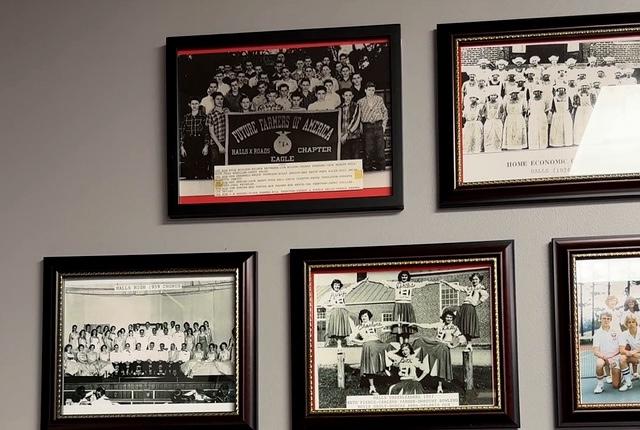
There are also photographs and records of Halls businesses, farms, homes, community organizations and people — some prominent and some remembered primarily by their neighbors and families.
That is what makes a community museum different.
The history isn’t limited to famous people or major events. A newspaper, school photograph, apron, business sign or family picture can tell just as much about a place.
The museum’s collection includes decades of the Halls Shopper, photographs of Halls military veterans, local books and personal artifacts. Among the items displayed when the museum opened was a midwife’s apron belonging to Ella Vineyard.
Preserving more than objects
The museum itself is relatively small, but its purpose is much larger.
The Halls Crossroads Historical Museum was chartered as a nonprofit organization in 2022 with a mission to preserve both important and everyday objects and photographs that document the Halls community and make them available for education, research and public use.
That mission can be seen even in the practical side of museum work.
Not every piece of history can be displayed at once. Photographs, documents and artifacts must be sorted, identified, protected and stored. The containers and work areas behind the exhibits are reminders that preserving history requires more than hanging old photographs on a wall.
It requires people willing to do the work.
For longtime Halls residents, a visit may produce plenty of “I remember that” moments.
For newcomers, it explains why roads, schools and places carry familiar names and how an unincorporated community developed an identity strong enough to endure for generations.
And for the next generation, the museum provides something perhaps even more important: a record.
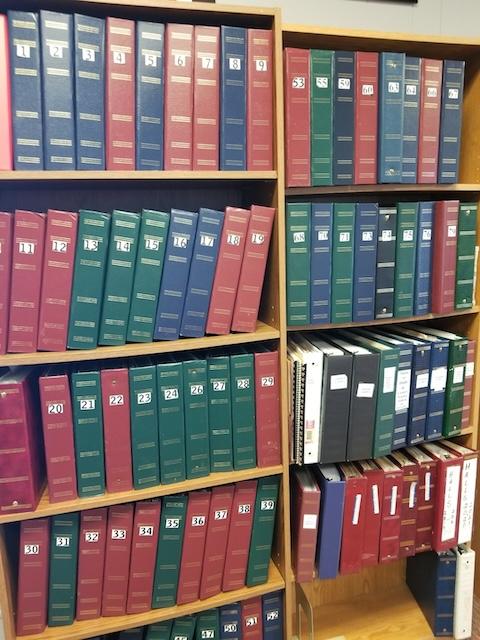
Rows of carefully organized albums preserve photographs, documents and other records of Halls Crossroads history at the Halls Crossroads Historical Museum.
Halls Crossroads has grown far beyond the rural community of farms, country stores and dirt roads captured in many of the old photographs. Buildings disappear. Businesses close. Schools are replaced. People who remember how things used to be are eventually gone.
But their stories don’t have to disappear with them.
That may be the most important thing inside the Halls Crossroads Historical Museum — not any single photograph or artifact, but the determination of one community to remember where it came from.
The Halls Crossroads Historical Museum, 7119 Afton Drive, is open Wednesdays from 10 a.m.-4 p.m. and Sundays from 2-5 p.m., according to the museum’s current website.
Information: Halls Crossroads Historical Museum website.
Follow KnoxTNToday on Facebook, Instagram, X, and LinkedIn. Get all KnoxTNToday articles in one place with our free newsletter. Comments may be sent to news@knoxtntoday.com.