

Tying college football to the big USA birthday may take more than my Boy Scout knots – but I’ll try.
College football isn’t quite as old as our country but it is keeping in step. It is artistic. It is evolving. It has not visited outer space but early games this season are scheduled for Dublin, Rio de Janeiro and London. Money is the magic word.
I’ve been told the first college football game was in 1869 between Rutgers and the College of New Jersey, now known as Princeton.
Seven years later, godfathers of Harvard, Yale, Princeton and Columbia gathered in a smoke-filled room, said it was lemonade they were sipping, and wrote some rules. That helped. It did not solve the fundamental problem. The game was rough and tumble – and dangerous.
A Georgia player died in a game against Virginia in 1877. The New York World newspaper got excited, somehow conducted research and found that at least eight were killed in football that season. It listed more than 200 other serious injuries.
Exaggeration? The World said the list was “a gory calendar of human anguish, an encyclopedia of broken bones, torn ligaments, fractured skulls, twisted necks, shredded muscles, broken ribs, gashed bodies, dislocated joints, backs and chests crushed in, scalps ripped off and jaws mashed.”
Indeed, football was gruesome. There were no helmets, mouthpieces or protective padding; brawls frequently broke out; players hit each other where it hurts, bit each other and gouged eyes; and it was hard to find anyone willing to referee the games – even for $8.
But it was called football.
In 1905 President Theodore Roosevelt invited several college coaches to the White House and told them that if they didn’t clean up the sport, he would ban it.
This meeting led to the end of the notorious flying wedge. Some say another spinoff was the introduction of the forward pass.
Player deaths did not end. In 1915, University of Tennessee halfback W. Bennett Jared suffered spinal damage in the Vanderbilt game and died a few months later.
More than enough of the violent stuff: I am certain Texas at Tennessee on September 26 won’t look much like what happened most every Saturday back then.
***
Historians much smarter than me have decided college football peaked in the 1990s. It was a great era loaded with outstanding teams. The focus was on coaches, players and television, long before NIL, transfer portals and everyday lawsuits.
For the Volunteers, it was a splendid decade, maybe the best in Tennessee history. They were near enough to perfect in 1998, 13-0 and national champions.
Thank you, Arkansas, for the stumble and fumble. Thanks, Billy Ratliff, for causing it and recovering.
The 10-year record was 99-22-2. John Majors and mostly Phillip Fulmer shared ownership. So did Peyton Manning, Al Wilson and John Henderson, on their way to the Hall of Fame.
Alas, a scar remains from the coaching change. Majors triggered it. Majors never healed.
***
The 1930s were good. Robert R. Neyland delivered the 1938 national championship according to six math-based selection systems. Texas Christian won the Associated Press poll.
Robert Neyland (Tennessee Athletics)
This was the time of Tennessee’s best-ever defense – 15 consecutive shutouts. Think about that – the Vols held 15 foes, including big names like LSU, Ole Miss, Alabama, Auburn and Oklahoma, week after week, to zeros. Commit the guards’ names to memory – Bob Suffridge and Ed Molinski.
The decade and the scoreless streak didn’t end right. The SEC champs, No. 2 in the country, took the train cross-country to the Rose Bowl to play Southern Cal. George Cafego was on the injured list. The Vols had other problems. The Trojans scored two touchdowns.
Neyland’s record in the decade was 75-12 plus five ties. There was one bad season, 1935. The young Army officer was recalled for military duty. Several Vols were engaged. Bill Britton was the substitute coach. Tennessee struggled to 4-5.
***
My Tennessee football interest picked up in 1950. Cousin Ray Byrd was a reserve fullback. He treated me to complimentary tickets. As a high school senior, I rode the Clinton Highway bus from the Beaver Creek community to Knoxville, walked to the stadium and concluded that Tennessee almost never lost a game.
Neyland’s 1950 was 11-1 with a Cotton Bowl win over Texas. Big-name Vols were tailback Hank Lauricella, tackle Jack Stroud, guard John Michels, blocking back Jimmy Hahn, wingback Bert Rechichar and fullback Andy Kozar.
Defense had end Doug Atkins, guard Ted Daffer and a host of hitters.
My grandmother told me I was somehow going to UT in the fall of ‘51. Cousin Ray briefed me on who was who, just in case I met somebody. Edna Callaway was the athletic business department. Gus Manning was publicity director. Nathan W. Dougherty was chairman of the athletics board.
Harvey Robinson was in charge of offense. Basketball coach Emmett Lowery did most of the scouting. The trainer was Mickey O’Brien.
I eventually knew them all. (Side note: Josh Heupel’s staff is larger).
Neyland’s 1951 team ranked No. 1 going into the season and never looked back. It rolled behind Lauricella to 10-0 and the consensus national championship. Maryland spoiled the season in the Sugar Bowl.
Neyland was not in good health in 1952. Team went 8-2-1. That made his final three-year record 29-4-1. Robinson inherited the job but had to keep assistant coaches. Harvey lasted two seasons.

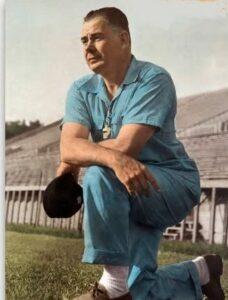
Bowden Wyatt
A folk hero, 1938 Vol captain and All-American Bowden Wyatt, arrived as the new head coach – driving a gift Cadillac presented by Arkansas fans for winning the Southwest Conference championship.
Wyatt’s peak was 1956, his second season, SEC champs, 10-1, Majors’ senior campaign. Tennessee lost to Baylor in the Sugar Bowl. Majors fumbled a punt. His mother responded with one of the great quotes in football history.
“Everybody burns the biscuits now and then.”
Big play of the decade was Nov. 7, 1959, underdog Vols doing homecoming against defending national champion LSU, star player Billy Cannon.
The Stop: Coach Paul Dietzel decided to go for two and the lead instead of kicking a tying extra point at 14-13 with 13:30 left in the fourth quarter. Cannon got the ball. Wayne Grubb, Charlie Severance and Bill Majors got Cannon, inches short of the goal (I think).
Wyatt’s career declined rapidly. Alcohol was the official villain. Shortage of single-wing tailbacks was a factor. The winds of change were swirling.
Marvin West welcomes comments and questions from readers at marvinwest75@gmail.com. Read more westwords by Marvin West.
Follow KnoxTNToday on Facebook and Instagram and subscribe to our Free Newsletter to receive every new article in one convenient email.

