
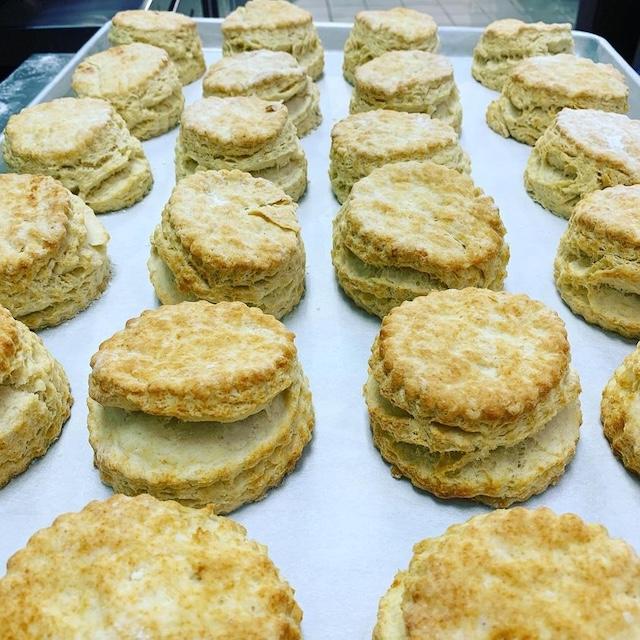
This coming Friday is National Biscuit Day. In the Southern United States, the term biscuit typically brings to mind soft, fluffy buttermilk biscuits covered in gravy or slathered with butter. But in other parts of the English-speaking world, the term biscuit refers to what we might call a cookie or a cracker. So why the difference, and what is a biscuit?
Biscuits can be traced back at least to ancient Rome. The word biscuit derives from the Latin word “biscotus” meaning twice-baked. Breads would be baked twice to remove moisture, creating a hard, dry food that was easily transportable and would last for a long time without spoiling. Soldiers were given these bland biscuits as part of their rations.
By Medieval times, the category of biscuits had expanded to include more flavorings, both savory and sweet, but the original biscuit remained popular, especially as rations aboard ships. Throughout the colonization of the Americas, these notoriously unpalatable biscuits, known as hardtack, remained a staple for Europeans coming to the New World.
The establishment of the slave trade and plantations led to the evolution of the biscuit in both the United States and Great Britain. The availability of cheap sugar led to the sweetening of biscuits in Great Britain to make them more palatable. In the American South, the availability of slave labor led to biscuit recipes that had to be beaten for over an hour to introduce air and create a small rise, creating a more cracker-like biscuit.
With the abolition of slavery, the labor-intensive biscuits fell out of popularity. But a new type of biscuit soon took its place, thanks to the invention of commercial leaveners like baking soda. The most iconic of these new biscuits was the buttermilk biscuit. The company now called Arm & Hammer advised housewives to make their biscuits with buttermilk as the acidic ingredient that reacts with their baking soda. Buttermilk would have been in ready supply for farmers’ wives as the leftover liquid from making butter.
The sweet, cookie-like biscuits of Great Britain and the soft, fluffy biscuits of the United States have come a long way from the hard, flavorless soldiers’ rations of ancient Rome. Although the Italian biscotti does still keep the twice-baked nature of the original biscuits. For those wishing to celebrate National Biscuit Day, you have a wide variety of biscuits to choose from spanning several millennia and cultures.
Crystal Kelly is a feature writer for Bizarre Bytes with those unusual facts that you only need to know for Trivial Pursuit, Jeopardy, or to stump your in-laws.
Follow KnoxTNToday on Facebook and Instagram. Get all KnoxTNToday articles in one place with our Free Newsletter.