
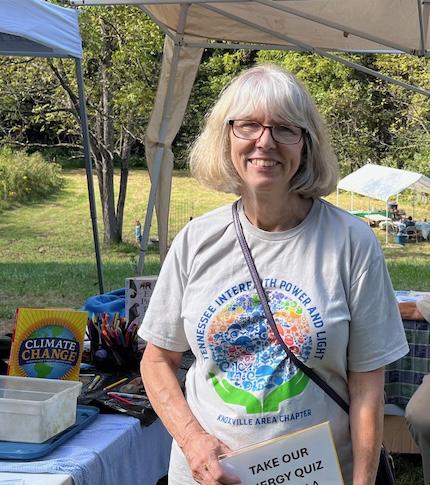
I’m chatting today with Courtney Shea, a retired staff attorney to the US Department of the Interior who volunteers with Tennessee Interfaith Power & Light.
Question: Why were you drawn to this particular volunteerism in your retirement years?
Answer: “My work with the Department of the Interior included coal mine regulation, national parks, and endangered species. Working with the coal industry included understanding energy usage projections, pollution from coal power plants, and alternative fuels. Habitat conservation was a central part of working with parks and with endangered species. In each of these areas, we grappled with climate change, driven by the increasing amount of CO2 in our atmosphere.”
Question: What is the purpose of Tennessee IPL? What do you try to do for communities?
Answer: “Tennessee Interfaith Power and Light seeks to support and uplift the education and actions of the faith community and to highlight the impacts of climate change on those with the fewest resources to adapt. Because we are an all-volunteer organization, the interests and talents of committed volunteers steer the emphasis of our programs. For instance, our newly forming Memphis group has a strong interest in Environmental Justice and has found that a film series is a great way to connect with one another. Our Knoxville Chapter has worked on energy audits and workshops for houses of worship.”
Question: It has not been an easy year in 2025, with the National IPL office shutting down, leaving state and local groups to organize for themselves. How has that gone?
Answer: “The two main impacts on Tennessee Interfaith Power and Light have been the loss of connection with a marvelous nationwide network of committed individuals and the loss of the Cool Congregations resources. The quarterly encounters provided ideas, policy insights and the opportunity to meet talented, committed individuals from across the nation. Two TIPL volunteers attended a retreat in November with many of the other state chapters, looking to structure in a new format to allow these networks to be re-established. I lament the loss of the Cool Congregations clearinghouse of information, and am concerned that it may be gone for good.”
Question: There may be churches, synagogues, or other nonprofits out there that have never heard of IPL and never thought about starting a climate committee or something like that. What is the most practical way they might get started to at least lower the nonprofit’s energy bill?
Answer: “Energy savings work is so beneficial for the finances of an organization, for the comfort of a facility, and for the long-term resiliency of an organization. It does not take a green team nor a particular belief in climate change, although those are also good places to start. Houses of Worship are so variable in size, age, condition, and configuration that we try to help determine the best next steps for their facilities, rather than prescribing any particular path. I am happy to talk with the green team, the building committee, or most anyone about what other facilities have found workable on this energy savings journey.”
Question: What are you most hopeful about?
Answer: “I like to focus on things close to home. New solar installations at Church of the Savior and the Diocese of East Tennessee, electric bikes, the 9 County Breathe report, and dedicated individuals all give me hope.”
Question: How can folks get in touch to learn more about Tennessee Interfaith Power & Light?
Answer: “We have a website at http://www.tennipl.org that can help. I can refer folks to specific individuals in other parts of the state or to local experts. Email me courtshea@aol.com.”
Thank you.
Anne Brock-Rankin is Marketing Coordinator for Solar Alliance, a renewable energy company based in Knoxville. She can be reached at abrock@solaralliance.com.
Follow KnoxTNToday on Facebook and Instagram. Get all KnoxTNToday articles in one place with our Free Newsletter.

