
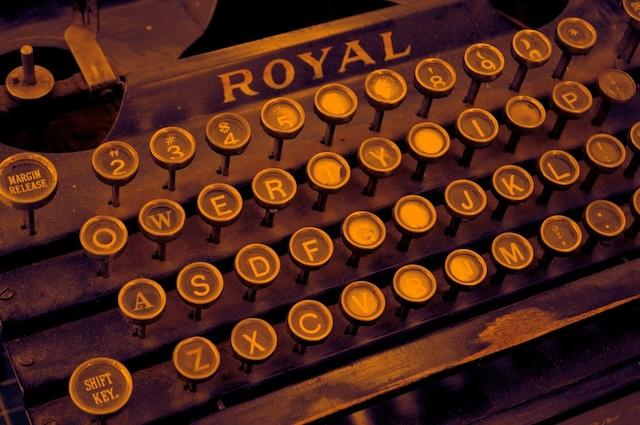
Which came first, the typist or the keyboard? Why are the letters not arranged alphabetically? The numbers are in ascending order, so why? When learning to type, slowly hunting for each letter, I am sure many of us looked at the keyboard in frustration and wondered why the letters had to be all jumbled up.
The QWERTY keyboard, named for the first six letters in the top row, was invented by Christopher Latham Sholes and his colleagues. The first typewriter that he patented in 1868 had two rows of keys similar to a piano with alphabetized letters. The QWERTY keyboard was patented by Sholes in 1878 as an improvement over previous designs; however, the reason for the particular arrangement of letters is unclear.
One oft-repeated story is that the letters were arranged to prevent the typewriter levers from jamming. Another theory, put forward in a 2011 research paper from Kyoto University, suggested that telegraph operators, who were early adopters of typewriters, found the alphabetical layout confusing and inefficient for transcribing from Morse code. Their input influenced the QWERTY layout.
Although the reasoning behind the QWERTY layout is uncertain, it is clear that the Remington Company popularized it and gave it its staying power. Remington, looking to expand beyond gun manufacturing after the Civil War, made the first commercially viable typewriter. That typewriter had a QWERTY layout. Remington also offered training courses for aspiring typists. If businesses wanted the efficiency of a trained typist, they had to buy the Remington typewriter that the typist had been trained on. When Remington merged with several other typewriter manufacturers in 1893, it was the QWERTY keyboard that became the standard and has remained so ever since.
Sholes continued to make improvements to the keyboard layout, but they were not widely adopted. The more people who were trained to use a QWERTY-style typewriter, the harder it became to change the design. We are no longer tied to jamming keys or Morse code, and we can theoretically create any keyboard layout we like on our phones and tablets. Other layouts that claim improved efficiency have been promoted, such as the Dvorak or, more recently, the KALQ, yet QWERTY still reigns supreme. It seems the answer to “Why are the letters arranged like that?” may be simply because that is how we have always done it, and we do not want to change.
Crystal Kelly is a feature writer for Bizarre Bytes with those unusual facts that you only need to know for Trivial Pursuit, Jeopardy, or to stump your in-laws.
Follow KnoxTNToday on Facebook and Instagram. Get all KnoxTNToday articles in one place with our Free Newsletter.

