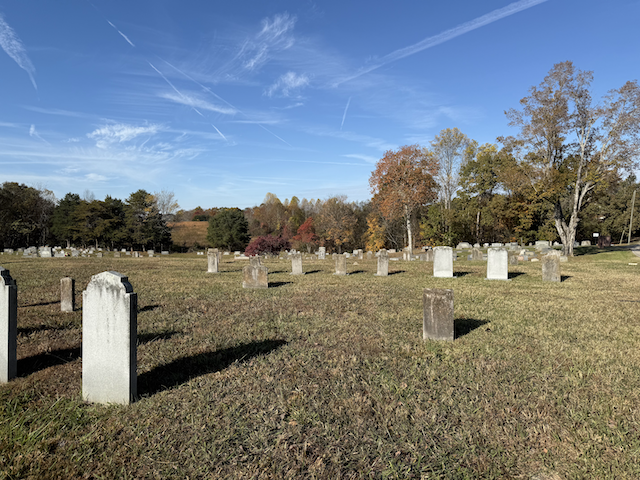
As we continue to move toward our nation’s semiquincentennial, my research continues to focus on the Revolutionary War effort of attaining independence and the related contributions and connections of families of the Fork, the Knox County lands between the French Broad and Holston rivers.
Zachariah Davis’s story is interesting because it reveals more very real aspects of a Revolutionary War soldier’s life. His pension file shows that he was born on February 6, 1760, and that he enlisted as a private in the Pennsylvania line in 1780 for a nine-month term. He was part of the 9th Regiment led by Lieutenant Colonel Butler under Captain Davis in the 2nd Brigade. They marched to Little York, where they stayed about 40 days, then to Lancaster and on to Philadelphia. They were later at Trenton and Princeton, New Jersey, and after 11 days at West Point, they eventually ended up at nearby Morristown, “where there was a rebellion.” Weary soldiers, who had already served for three years, began to make demands.
The threatened mutiny of many men within the Pennsylvania Line of the Continental Army resulted from the little pay received by those who had been retained beyond their enlistment periods or who felt they had been misled and coerced into reenlisting. Some had enlisted for a $20 bounty, while new enlistments in other states were being given hundreds in order to build the army. The lack of proper clothing during the cold winter and the scarcity of food made their service miserable, at the very least, and deadly for many. They only wanted to be treated fairly and be given what the government owed them. Other segments of the Continental Army had taken the same actions to secure better treatment.
Official war records show that when Zachariah’s regiment refused to join comrades who were dragging away artillery, the artillery was shot over their heads to force them to comply. One commander was shot and killed. When the Pennsylvania Line marched toward Princeton to state their grievances, their commander, General Anthony Wayne, pursued them and then presented their demands to his superiors.
Because Washington pleaded with Congress for better support, the men returned to duty after negotiations promised the requested provisions. The disgruntled soldiers’ threats were not a result of a lack of patriotism, but rather a demand for better treatment while fighting for independence.
Zachariah was discharged from Valley Forge just a few days before his nine-month term was to end. When he applied for his pension at the age of 73, his loss of memory prevented him from recalling more detailed aspects of his service. Still, though mutinous fellow soldiers had shot at him and his steadfast regiment, he knew he had never been involved in a battle.
In 1838, Zachariah appeared in Cincinnati, Ohio, requesting that his annual pension of $28.33 be sent to “the neighborhood of Knoxville, Tennessee.” Here’s where his story tugs at my heartstrings. Because of the loss of his wife and “a wish natural to most men to spend their old age with their children,” he was relocating. Sadly, the move and twisted red tape caused him not to receive his pension payment for more than two years. However, Zachariah did spend his remaining days with his family. His marker at Thorn Grove Cemetery shows that he died in 1842, after at least four of his grandchildren were born. He was 82. His son Jesse’s marker is beside it, and later generations are also buried there.
Though Zachariah’s marker records his service, much of his story has been forgotten in the Fork.
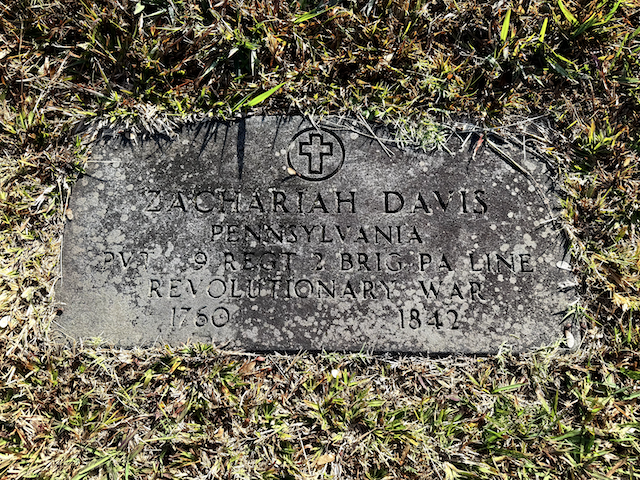
Zachariah Davis’s marker in Thorn Grove Cemetery in the Fork
Jan Loveday Dickens is an educator, historian, and author of Forgotten in the Fork, a book about the Knox County lands between the French Broad and Holston Rivers, obtainable by emailing ForgottenInTheFork@gmail.com.
Follow KnoxTNToday on Facebook and Instagram. Get all KnoxTNToday articles in one place with our Free Newsletter.


Fascinating history and life story. Thank you.