One of the things I miss from my youth is being able to walk into whatever store, wherever blue jeans were sold, and just going to my size in Levi’s, picking the style and color I wanted, paying and walking out the door. I didn’t need to try them on. I could take them home and know that that were going to fit.
Levi’s were made right here in Knoxville for nearly 50 years. I don’t know that every pair I bought for two decades came from here, but I suspect that most of them did. At one time, the plant on Cherry Street was Levi’s larger producer. But not anymore. And while they’re still good jeans, coming from so many disparate places, the sizing is no longer trustworthy.
Knoxville was once known as the underwear capital of, if not the world, the good ole U.S.A. The city was awash in large textile mills producing like madness and providing solid jobs: Brookside, Cherokee, Holston, and Jefferson are but a few of them.
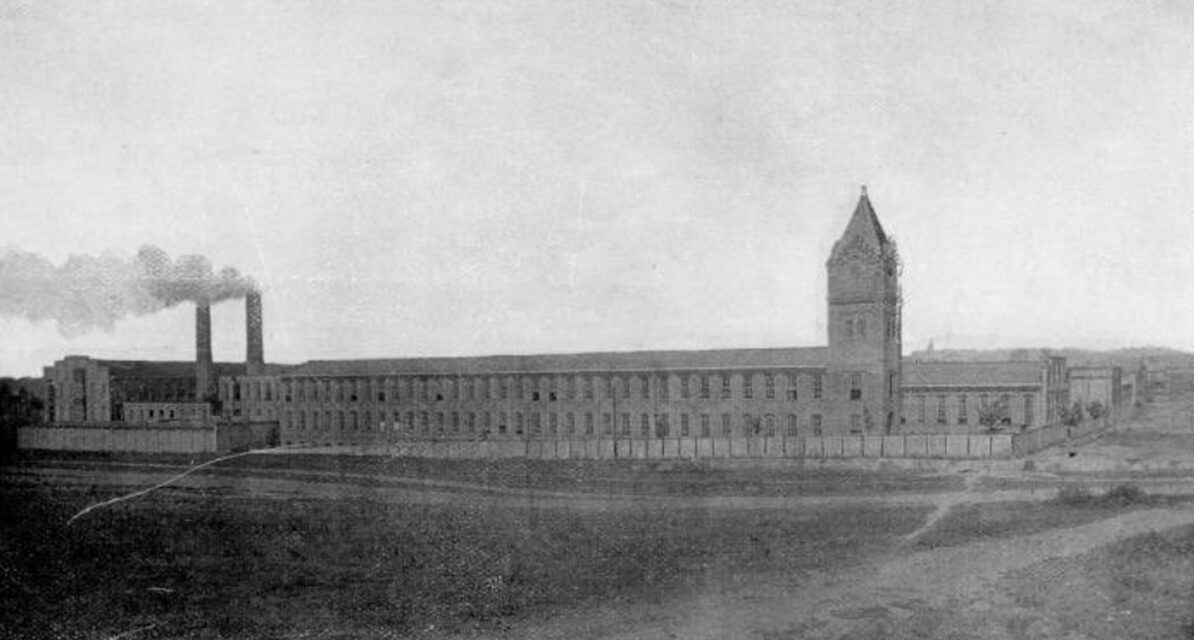
One that disappeared during my lifetimes was a harbinger of things to come for the success of Levi’s here for so many years. It was originally called the Knoxville Woolen Mills. The massive building sat on 17th Street just north of Fort Sanders, bounded on one side by Dale Avenue and the other by railroad. At the time of its founding, it was the East Tennessee, Virginia & Georgia, the precursor to Southern Railroad. The building, that went up in the mid-1880s, covered eight acres and featured a stately clock tower. The Handbook of Knoxville – 1892 claimed the plant as the largest jeans mill in the country. So, we weren’t just the kings of underdrawers.

Aerial view of Appalachian Mills in 1947 (Photo by Paul Moore: Tennessee State Library & Archives)
By 1922, the company had changed hands and was renamed Appalachian Mills. The site was eventually purchased by UT football player and area entrepreneur Herman D. “Breezy” Wynn, founder of Southern Athletic Company, which he sold in 1964. He and his family owned over 20 clothing factories in the areas. After stepping away from Southern Athletic, Wynn purchased the mothballed Apparel Corporation of America and started back up again in the old mill.
By the 1970s, the mill complex was known as the Wynn Building. Breezy owned the property, but four entities were operating there when disaster struck in February 1977. What started as a grass fire near the railroad tracks turned into an inferno that destroyed large portions of the nearly century old building. The estimated damages at first blush were approximately $2 million, affecting Wynn Retail Center, Greenbrier Industries, Normak International and Jandi Classics. Wynn stood and watched the four-alarm blaze tear through the space that held a large chunk of his memorabilia, football trophies, personal files, letters, some from U.S. presidents (during WWII he expanded into military apparel and equipment).
Despite his own loss, Wynn was primarily concerned with the 1500 workers temporarily (eventually permanently) displaced from their employment and finding new positions for them. Greenbrier and Normak did return to operations about a week later. It was believed the most damaged portion had still housed the old Appalachian Mills spinning wheel, and that years of cotton lint accumulated under the building helped fuel the fire.
Beth Kinnane writes a history feature for KnoxTNToday.com. It’s published each Tuesday and is one of our best-read features.
Sources: The Knoxville Journal digital archives, McClung digital collection
Follow KnoxTNToday on Facebook and Instagram. Get all KnoxTNToday articles in one place with our Free Newsletter




My grandmother, mother, and many of the women in Concord, Tennessee worked at Appalachian Mills during the war. They rode the Fox Motor Lines to Knoxville out to the mill site. She would tell a story about how each seamstress had to make a certain quota of underwear per day. One person may sew a size 32 waist, another 36, etc. She said when it came to the end of the shift, if someone was short a pair or two, another would toss them some from her stack, regardless of whether or not that was the same size that she needed to finish her quota. So, if one thought they were purchasing a particular size, you couldn’t count on the fact that the size of the garment was in actuality the correct size. I sometimes wonder if that still isn’t going on today. You can’t go by the size on the label but must try it on. I hadn’t thought about that story in years until I read your article. Good job Beth!
Wow. Amazing stuff. Back in a better place in time. Good hard working Citizens who made their own way, and produced quality goods. “At night we’d sleep cause we were tired.” And stayed out of trouble. I’d go back to that in a NY second.
Growing up in the 60s and 70s we also enjoyed the cheaper Levi jeans we could get at the factory second stores, OOPS and GOOFS around town.
Fascinating history. Wonder how much longer Wynn would have lasted without the fire. So many textile companies were moving overseas about that time.