
There were some pretty interesting headlines 105 years ago this week, from a Mexican bandit named Pedro Zamora holding American and British tourists for ransom in the Jalisco Mountains to the troubles in pre-republic Ireland. Belfast was on fire, and the Lord Mayor of County Cork was on a hunger strike in prison. Poland was fighting off an invasion from the U.S.S.R. Charles Ponzi was in the hotseat in Boston, testifying about his get rich quick schemes.
But the local news on page one was centered on the state legislature in Nashville. On August 18, 1920, Tennessee ratified the 19th Amendment to the Bil of Rights giving women the right to vote. The finality of it still took a few days to settle in, because, of course, there was an uproar and attempt to usurp the result.
One interesting aspect of this is that Tennessee was ahead of the 19th Amendment in some regards. The year prior, Democratic Governor Albert H. Roberts had signed into law Public Chapter 139 of 1919:
Be it enacted by the General Assembly of the State of Tennessee, that all women, citizens of the United States of and above the age of 21 years, having resided in the state for one year and in the county for six months preceding any election therein, and who shall be an inhabitant of the election district or precinct in which they offer to vote, shall be entitled and allowed to vote at such elections for electors of President and Vice-President of the United States, and for all officers of cities, towns and taxing districts, and upon all questions or propositions submitted exclusively to a vote of the electors of such municipalities.
So, Tennessee women had already gained the right to vote in most elections. Why there was pushback against guaranteeing that right for all women nationwide seems a bit ridiculous, as the rights of women should be same across state lines. Gov. Roberts called for a special session in August to settle the issue. Ratification had passed in 35 states. Only one more was needed for the Amendment to become law.
The motion cleared the state senate with great ease, by a 25-4 vote. The house was more evenly divided and became a bit of sticky wicket. After much debate and two rounds of voting, the house kept coming up with the same answer: a 48-48 tie. The youngest house member, Harry T. Burn of McMinn County, had originally been a yes to ratification. Pressure from the anti-contingent got the better of him, and he voted no. Until he read a letter from his mother, Febb Burn, encouraging him to vote to ratify. He carried that letter in his jacket pocket that day to vote, and ratification passed the house by a vote of 49-47.

Harry T. Burn Memorial behind East Tennessee History Center (Photo: Visit Knoxville)
Burn was accused of bribery and all kinds of other foul play for changing his vote, but, no, he just did what his mama asked him to do. The antis tried to file an injunction to prevent the governor’s certification of the vote. Self-assured they would prevail, about 24 members of the house skipped town to Decatur, Alabama, to ride out the clock on the special session, convinced there would be no further action on the amendment until January 1921. Their plans were foiled when the courts said “nah” and Roberts signed the ratification at 10:20 a.m. on August 24.
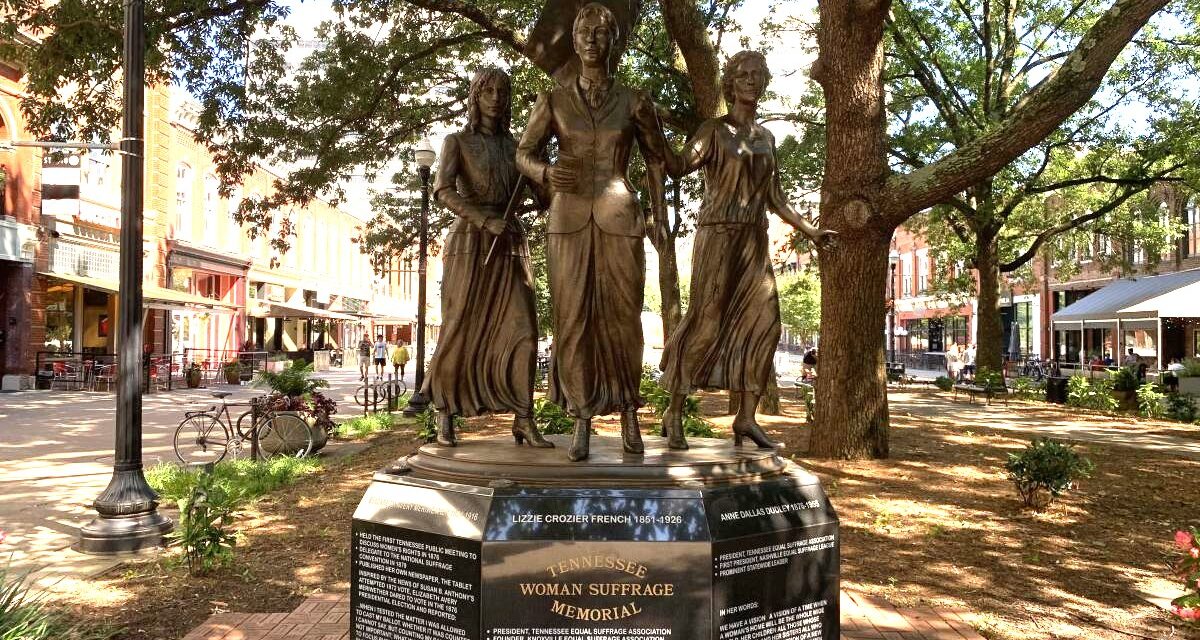
And with that Tennessee became the last state needed for the 19th Amendment to the U.S. Constitution. And we’re not giving it back. You can see the local Harry Burn Memorial at the corner of Clinch Avenue and Market Street behind the East Tennessee History Center. You can find the Tennessee Woman Suffrage Memorial on the south end of Market Square
Beth Kinnane writes a history feature for KnoxTNToday.com. It’s published each Tuesday and is one of our best-read features.
Sources: The Knoxville Journal digital archives, McClung Historical Collection-Knox County Library, Tennessee Encyclopedia
Follow KnoxTNToday on Facebook and Instagram. Get all KnoxTNToday articles in one place with our Free Newsletter
Story updated to reflect the 19th amendment was to the U.S. Constitution rather than the Bill of Rights.


The amendment was not an amendment of or to the Bill of Rights. The first 10 amendments to our Constitution make up the Bill of Rights; this was the 19th amendment to the Constitution.
You are correct. We will make this edit.