
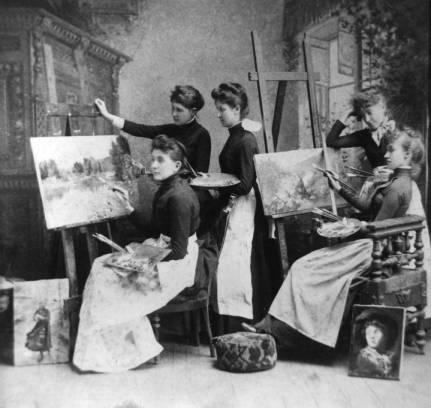
As you drive down Kingston Pike between Neyland Drive and Cherokee Boulevard, you travel through the life of Knoxville artist Adelia Ann Armstrong Lutz. First you will pass by Crescent Bend, also known as the Armstrong-Lockett House, which belonged to her paternal grandfather, Drury Armstrong (whom she never knew). Just a little further west stands Bleak House, the house where she grew up (well, except for when it was occupied by confederate general James Longstreet and company during the Civil War).
Born to privilege, Lutz arrived in 1859 in Jefferson County, at the home of her maternal grandparents. Her parents were Robert Houston Armstrong and Louise Franklin. Bleak House was built in 1858 as a wedding present from Louise’s father, Major Lawson D. Franklin. The land was given by Robert’s father, Drury. And, yes, it was named after Charles Dickens’ novel, which seems an odd choice for the beginning of married life.
A bit further down, historic Westwood sits on the north side of Kingston Pike just before you get to the boulevard. Built by the Baumann Brothers in 1890, it is a Queen Anne masterpiece constructed on land given to Adelia and her husband John by her father. Passing parcels on the pike was a family tradition.
Adelia was born with a natural gift as an artist. Her education included the East Tennessee Female Institute, which offered high school and college level courses to area young women who could not attend the University of Tennessee. She also attended the Augusta Seminary (Mary Baldwin College) in Virginia as well as the Southern Home School in Baltimore. Her artistic training was honed at the Pennsylvania Academy of Fine Arts and the Corcoran School in Washington, D.C., during a period when she was also touring Europe.
Once she returned to Knoxville, she opened a studio in the Kern Building on Market Square (current home of The Oliver hotel, Peter Kern Library speakeasy and Tupelo Honey). She didn’t just occupy her time with her own work; she also taught art classes. In 1886, she and John were married in a lavish ceremony at Second Presbyterian Church. They had two children, Edwin Rowland Lutz and Louise Lutz Holloway.
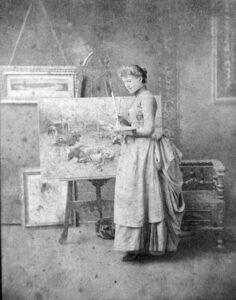
Adelia Armstrong Lutz photographed in her Market Square studio, 1880s (Knox County Two Centuries Project-McClung Digital Archives)
But married life and children did not bring her artistic endeavors to a halt. Once Westwood was completed, it included a cathedral-esque studio which is today much as it was well over 100 years ago. She continued to paint and to teach and was an active member in the local art community. She served as a director of the Knoxville Art Club and was a founding member of the Nicholson Art League, which included photographer Joseph Knaffl, fellow painters Catherine Wiley, Charles Krutch and Lloyd Branson as well as architect George Barber. She exhibited at the Columbia Exhibition in Chicago in 1893 and the Tennessee Centennial Exhibition in Nashville in 1897. She was integral to organizing the art displays for the Appalachian Expositions at Chilhowee Park in 1910-11 as well as serving on the art department’s executive board for the National Conservation Exposition in 1913.
Adelia kept working up until she died in 1931. She is buried in Highland Memorial Cemetery.
Sources: Knoxville Journal digital archives, Heart of the Valley: A History of Knoxville, Tennessee, Alice Howell, Lucile Deaderick (ed). Tennessee State Museum
Beth Kinnane writes a history feature for KnoxTNToday.com. It’s published each Tuesday and is one of our best-read features.
Enjoyed this article? Read more of Beth Kinnane’s stories about the people, places, and history that make our community unique.