The more than forty diaries of Dr. Swancey Kennedy (1844-1923) show us how active he was in social reform in the late 1800s in the Fork, the lands between the French Broad and Holston rivers in Knox County.
The Temperance Movement, which encouraged people to drink less alcohol or stop altogether, began in the early 1800s and was led in part by the Woman’s Christian Temperance Union (WCTU). By Dr. Kennedy’s time, the push was on for “prohibition,” to legally ban the making, transporting, and selling of alcoholic drinks. In June of 1887, a resolution was made by the local Prohibition Executive Committee to call “all ministers, teachers, politicians, and editors to lend their influence to the cause of the amendment, by speaking, teaching, and writing for it,” in order to make Knox the banner county of the state for its support.
The only possible reference to alcohol I’ve seen thus far in Dr. Kennedy’s diaries is a note on January 27, 1887, where he and his brother Bill “went to see John Stinnett about a little toddy he had in the cedars.” I’m not sure what that meant, but I do know that Dr. Kennedy arrested a couple of men for not showing up in court, so I guess he had some legal authority in the community. And I don’t know exactly which John Stinnett he’s referring to, for there were multiple men by that name in the area. The wife of one of them was once charged, along with a few men, with stealing a sack of sugar from a Knoxville railway depot. Was it for making moonshine? Are the two events related?
In August of 1887, the Daily Sentinel reported that “one of the most enthusiastic prohibition meetings ever held in this part of the country” was held at Pleasant Hill in the
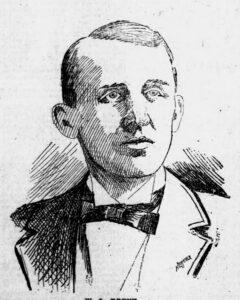
Journal and Tribune sketch of W.L. Trent
heart of the Fork. County Superintendent Professor J.W. Saylor was joined by Rev. R.O. Ayers, the Honorable Alex Reeder, and W.L. Trent, Esquire, in delivering speeches to the Amendment Club at High Point in what was then the 16th District. A “grand prohibition picnic” was planned for September, and everyone was invited to attend and “bring well filled baskets.”
Dr. Kennedy wrote in his diary that he made a couple of trips in August, one “to a speaking at Asbury on the prohibition question,” and another, “to hear W. Trent make a speech on the proposed amendment to the constitution.” W.L. Trent, who owned a tobacco factory at what is now known as Trentville, became a delegate from the Fork to the State Temperance Alliance in Nashville. (In later years, Trent also served as Knoxville’s postmaster.) In September of 1887, Dr. Kennedy “went to Moshina to hear Rev. Hamstead and Ledgerwood speak on the amendment to the constitution on prohibition.” Two weeks after that, he went to the prohibition picnic at Lyons Creek, where Mr. Trent and John M. Meek spoke about the evils of alcohol. On multiple occasions, Dr. Kennedy, too, spoke in favor of prohibition at various places.
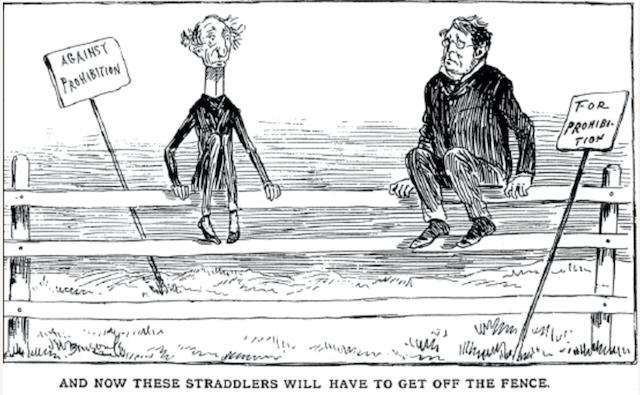
Prohibition was a hot topic all across the nation and was a major dividing point for political candidates running for office. While anti-prohibition establishments handed out whiskey on election days, the Women’s Christian Temperance Union handed out coffee and sandwiches. Initially, legislation in Tennessee was passed that liquor couldn’t be sold within four miles of a school, which almost essentially achieved prohibition long before alcohol was banned entirely, simply because every small community had a school.
By 1907, the WCTU and the local Sunday Schools had installed a public drinking fountain next to the downtown Knoxville post office to give pedestrians a place to quench their thirst besides the usual saloons. Of course, the 18th Amendment prohibiting the sale of alcohol was passed in 1920 and was repealed by the 21st Amendment in 1933.
I remember when my dad wouldn’t buy gas at any station that sold beer, but even those days have long been forgotten in the Fork.
Jan Loveday Dickens is an educator, historian, and author of Forgotten in the Fork, a book about the Knox County lands between the French Broad and Holston Rivers, obtainable by emailing ForgottenInTheFork@gmail.com.
Enjoyed this article? Read more of Jan Loveday Dickens’s stories about the people, places, and history that make the Fork community unique.
Follow KnoxTNToday on Facebook, Instagram, X, and LinkedIn. Get all KnoxTNToday articles in one place with our Free Newsletter. Comments may be sent to news@knoxtntoday.com.