
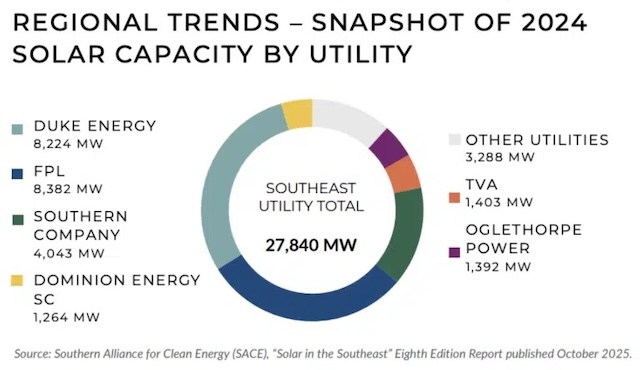
How effectively is the US Southeast taking advantage of free solar rays to produce clean energy? The latest edition of Solar in the Southeast shows the slow pace of progress, as summarized from the nonprofit Southern Alliance for Clean Energy. SACE estimates that this region will have nearly twice the current solar capacity by 2030: nearly 54 gigawatts (GW).
The report notes that most new solar additions are large, utility-scale photovoltaics (PV), with distributed solar, such as a warehouse or other business, might add themselves, making up a smaller portion.
“We know that solar and storage are the least costly to build, and they are quick to build. So we are encouraging that,” said Stacey Washington, the SACE Clean Energy & Equity Director.
SACE Executive Director Stephen Smith stressed that, since utilities are so influential in driving communities to switch to clean energy, they have a responsibility to make even greater progress in renewables. The report showed that of southern utilities, Florida Power & Light, with what Smith called “the most ambitious” solar program, is leading the way. The organization found data to show that FPL has about five times the solar capacity of the Tennessee Valley Authority region and is outpacing several other utilities.
Related to the need for more clean renewable energy is the increasing demand for energy overall, and the need to curb rising energy costs, with solar providing the most economical solution.
You can read more about the Solar in the Southeast report here.
Anne Brock is Marketing Coordinator for Solar Alliance, which provides Commercial Solar services. She can be reached at abrock@solaralliance.com or 865-221-8349.
Follow KnoxTNToday on Facebook and Instagram. Get all KnoxTNToday articles in one place with our Free Newsletter.

