
As the weeks progress, we will continue moving toward our nation’s semiquincentennial by focusing on the related contributions and connections of folks of the Fork, the Knox County lands between the French Broad and Holston rivers.
The year was 1781, just after the Battle of Kings Mountain during the American Revolution, and her name was Jane Spurgeon. Her husband, William, was a Tory who remained loyal to the king. Because of his service as a justice of the peace there where they lived at Abbott’s Creek in Rowan County, North Carolina, he had been asked by Gov. Josiah Martin to raise troops to help suppress the insurrection. He was commissioned as a colonel under British General Cornwallis in 1776. She, on the other hand, was a devoted Patriot in spite of her husband’s position.
When Gen. Nathaniel Greene brought his Continental troops to Abbott’s Creek, he made his headquarters at the comfortable Spurgeon home. William was absent, but Jane made sure the colonel had what he needed. In turn, Greene warned her that in the event of a battle, she should take all the children to the cellar for safety. His plans for engaging the enemy required knowing Cornwallis’s position, so he asked Jane whether she knew of anyone she could trust to go to the river where his men had forded to learn whether Cornwallis was going to cross there as well. She volunteered her sons William, John and Joseph who were proud to accommodate the general.
They made more than one trip for Gen. Greene, but son William finally found Cornwallis’s men under Lt. Colonel Banastre Tarleton crossing at Shallow Ford, about 30 miles from the Spurgeon home near Trading Ford. He rode as fast as he could to report back to Greene, who immediately took his 2,000 men, a quarter of whom were militiamen, to Martinville to engage Cornwallis. However, because they were vastly outnumbered, Greene decided to wait on the other side of the Dan River, where they would be joined by re-enforcements. They soon inflicted massive casualties on the British at the Battle of Guilford Court House near Greensboro on March 15, 1781, which opened the campaign that led to ultimate American victory in the fight for independence. The British surrendered at Yorktown just seven months later.
Jane chose independence in more ways than one. Her husband, William Sr., ended up leaving the area, taking a second wife, and moving to Canada, where he started another family. The family Bible and William’s will, which lists his two families, verify the story. It is also supported by military records of the Revolution and is noted in John Buchanan’s book, The Road to Guilford Courthouse.
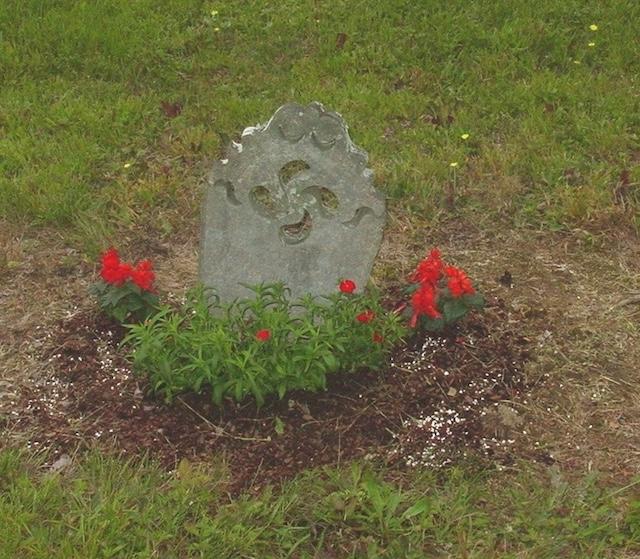
Jane Spurgeon’s grave marker at Abbott’s Creek.
What’s the Spurgeon family’s connection to the Fork? Their descendant, another William Spurgeon, bought the Ramsey family’s stone house in the Fork after the Civil War. And I am a gr-gr-gr-gr-granddaughter of Jane and William Spurgeon of Abbott’s Creek. I wrote this article, that their legacy might not be forgotten in the Fork.
Jan Loveday Dickens is an educator, historian, and author of Forgotten in the Fork, a book about the Knox County lands between the French Broad and Holston Rivers, obtainable by emailing ForgottenInTheFork@gmail.com.
Follow KnoxTNToday on Facebook and Instagram. Get all KnoxTNToday articles in one place with our Free Newsletter.

