
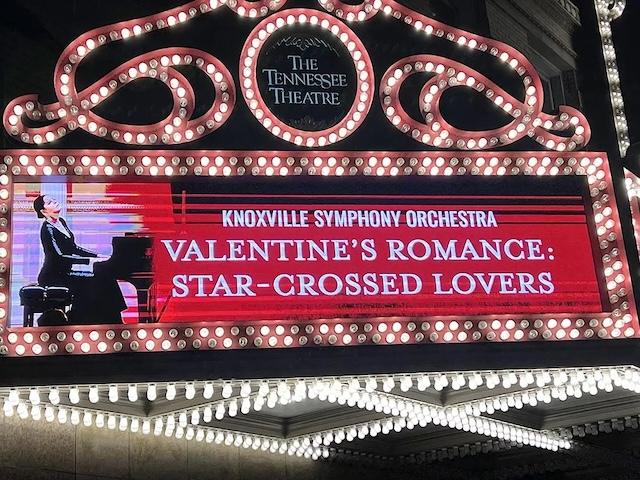
Admittedly, Valentine’s Day is one of our stranger holidays. Having been commercialized into a merchandising platform for chocolate, roses, jewelry, and anything pink, the day also impacts the programming of events in February. Classical music falls into this category: organizations must either embrace the romantic gravity of Valentine’s Day or explore other marketing opportunities. While either course is valid, the Knoxville Symphony Orchestra chose the former path this year, offering “Valentine’s Romance: Star-cross’d Lovers” as their mid-February Masterworks concert. Now, which star-crossed lovers might that be?
Maestro Aram Demirjian chose three works for the occasion, two of which involve Shakespeare’s classic tale of tragic romance, Romeo and Juliet. Practically mandatory, of course, was Peter Ilyich Tchaikovsky’s Romeo and Juliet Overture-Fantasy. The orchestra also explored another angle of the well-known story with a suite constructed from Sergei Prokofiev’s ballet Romeo and Juliet and the composer’s own suites. Before the Prokofiev, however, Demirjian and the orchestra took an alternate journey of musically infused romance, Rachmaninoff’s Rhapsody on a Theme of Paganini. Given a very memorable take by guest pianist Zlata Chochieva, it had no problem exhibiting the expected lushness, color, and drama that practically defines Romanticism.
The internationally well-traveled Chochieva, now in the midst of establishing a solid reputation in the U.S., was something of a revelation in the Rachmaninoff Rhapsody on a Theme of Paganini. She seemed innately attuned to Demirjian and the orchestra, even in moments of softness, conveying a sense of ensemble that was intensely satisfying. Importantly for the Valentine occasion, the romantic lushness was full-bodied, musical ice and heat existing simultaneously.
After intermission, Demirjian returned to the star-cross’d lovers of the Bard via selections from Prokofiev’s Romeo and Juliet. Interestingly, after the tumult of “The Death of Tybalt”, the energy and bite of the storytelling seemed to fall off, perhaps an indication that the compilation needed some additional editing.
By the final bars of “The Death of Juliet,” though, the audience had come to terms with the tragic story and was ready to show their appreciation in no uncertain terms. And, that they did with an extended ovation.
Follow KnoxTNToday on Facebook and Instagram. Get all KnoxTNToday articles in one place with our Free Newsletter.

