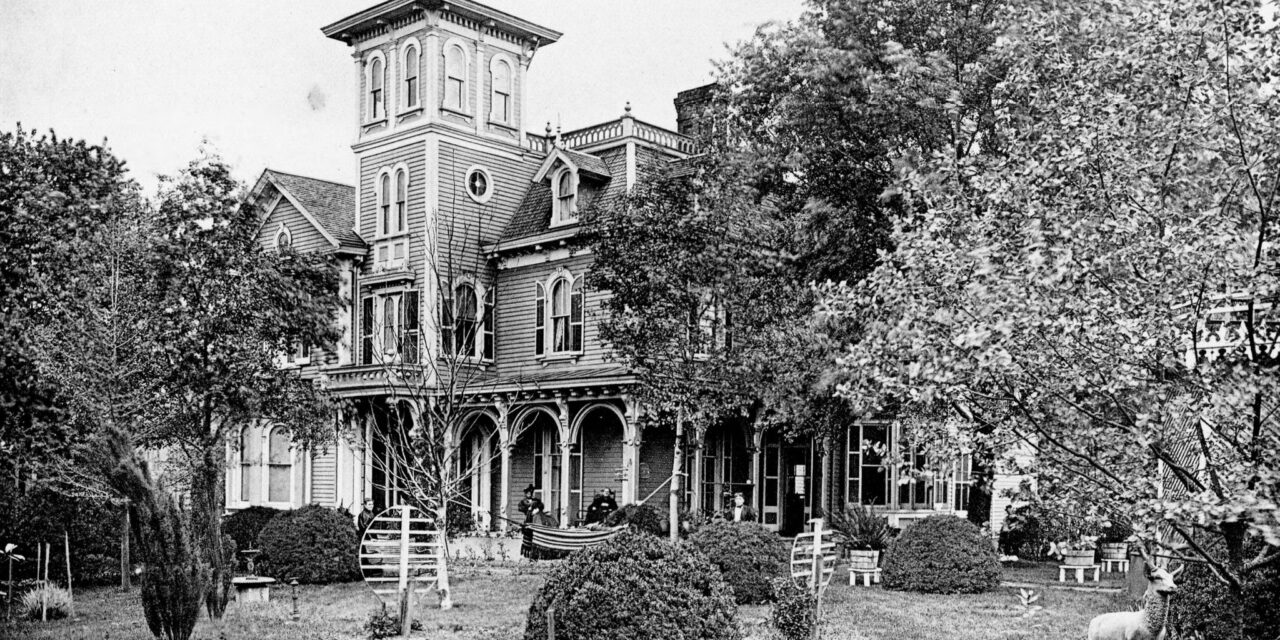
On Wednesday, November 10, 1909, a cornerstone was laid on the property at the Northeast corner of Central and Fifth Avenues. A choir of 100 would be singing. A parade led by local Masons would precede the speeches of various officials and dignitaries as well as benedictions by a handful of ministers. It was dedication day for the construction of the new Knoxville High School, eventual alma mater of John Collum, Patricia Neal, Clarence Brown, James Agee and John Ward, to name a few.
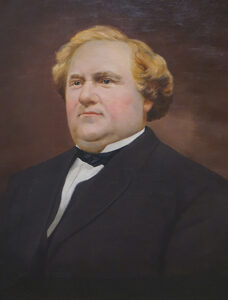
Portrait of Joseph H. Jaques – City of Knoxville
The school lasted 41 years, later becoming the home of the Knoxville City Schools administration as well as hosting night school and adult education. Now it’s high-end apartments and part of the Emory Place Historic District, with its World War I doughboy statue still standing sentinel out front.
But before the property became a high school, it held the well-appointed home of one of Knoxville’s mayors, Joseph H. Jaques. The impressive obelisk in Old Gray Cemetery indicates Jaques was born in northern England, near Appleby-in-Westmoreland on March 31, 1825. Exactly when he made his way to the states is unclear, but he first landed in Virginia, where he met and married his wife, Jane Whitaker/Whiteaker.
The newlyweds moved to Loudon County, where Jaques set up shop as a riverboat captain, operating three paddlewheel steamboats, the Loudon, the Tennessee and the City of Knoxville. By the late 1850s, they were living in Knoxville, where Jaques was a depot agent for the East Tennessee, Virgina & Georgia Railroad, and he was elected to the Board of Aldermen, the predecessor of City Council. For whatever reason, the city had five mayors in 1858, and he was briefly one of them. He resigned from the position after just a few days.
He spent most of the Civil Wars years as the superintendent of the Holston Salt and Plaster Company in Saltville, Virginia, but returned to Knoxville in 1869 after the cessation of hostilities. He became the vice president and general superintendent of the ETV&G Railroad, and by 1872 founded and was president of the East Tennessee National Bank. This naturally led to him becoming mayor of Knoxville again in 1878. He did not quit after just a few days on that round.
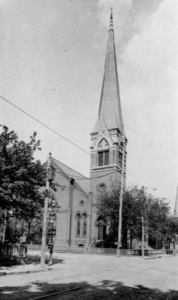
Broad Street Methodist Episcopal Church at Broadway and 5th Avenue (Photo: Art Work of Knoxville – 1895, McClung digital collection)
Jaques was renowned for his generosity, reportedly had a soft spot for anyone in need and took that “for the least of these” part of the Bible to heart. He provided some of the funding for the new Broad Street Methodist Episcopal Church, completed after his death in 1885, on the Southeast corner of Broadway (then Broad Street) and 5th Avenue, just a few blocks from the Jaques stately home. The space is now a parking lot and several businesses.
Jaques died June 19, 1885, at the age of 60. The Knoxville Tribune (which became The Knoxville Journal) remarked upon his passing:
Captain Jaques led a blameless life abounding in good works … His charity was unselfish and without ostentation … It lifts our faith in mankind to behold a man … who has acquired great wealth, and in all his life never turned a dishonest penny. He was an upright and honorable man, and his like is rarely seen.
The captain and his bride never had any children. She followed him to Old Gray in 1897, and was celebrated and mourned by the city as much as her late husband.
Beth Kinnane writes a history feature for KnoxTNToday.com. It’s published each Tuesday and is one of our best-read features.
Sources: The Knoxville Journal digital archives, McClung Historical Collection-Knox County Library, The Mayors of Knoxville by Jack Neely and Paul James. –
Follow KnoxTNToday on Facebook and Instagram. Get all KnoxTNToday articles in one place with our Free Newsletter